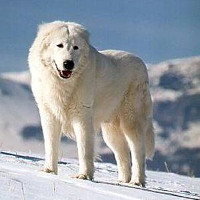
The Abruzzese Mastiff (Italian : Mastino Abruzzese, sometimes also called Pastore abruzzese, and known as "cane da Pecora" in the Abruzzo region) is a breed related to, but distinct from, the Maremmano-Abruzzese (commonly known as Maremma Sheepdogs in America) of the Italian Abruzzo region. The Mastino Abruzzese represents the original Abruzzese strain and is characterized by its larger size, with some male dogs exceeding 100 kg. Some of these dogs have been used successfully as livestock guard dogs in the USA and Norway, where they are said to have been effective in deterring bear predation. Mastini are used in packs of 4 to 10 (depending on the size of the herd). The pack leader is the one who will most often engage predators in combat, and will generally wear a spiked iron collar to defend his throat.
The Abruzzese Mastiff is a breed composed of specimens that often differ from one another, due to the fact that it is a Landrace breed and not of human origin. In recent years, attempts have been made to unify this breed by applying a single standard as for other dog breeds. This has led to the disappearance of several breed types of the Abruzzese Mastiff, which had been selected for the specific needs of shepherds in each region of Abruzzo. There are significant morphological differences between specimens from different regions of Abruzzo. There are seven main subtypes of the Abruzzese Mastiff.
The Marsicano type
This type has a large, lion-like head. Its structure is robust, the chest deep but they are not too big with its height of 70-75 cm and weight between 40 and 60 kg. They normally have a scissor bite. These dogs are bred mainly in the Marsica region, one of the few places in Italy where the brown bear (Ursus arctos) can still be found.
The Aquilano type
Specimens of this breed have an impressive structure, with a large head that is longer than the Marsicano type. Its height is between 75 and 83 cm, but some specimens can grow even taller, and its weight is between 60 and 80 kg. These dogs are mainly bred in the villages around Gran Sasso and in the Peligna Valley. Specimens of this type appear long and lean when young, but this aspect disappears when they are around three years old and stop growing to take on an imposing appearance. These dogs often have pincer teeth.
The Pescocostanzo type
This dog looks more like the modern dogs shown at dog shows (the Maremma Shepherd) than a real working dog. This type is much smaller than the others. Its head is wolf-like and its temperament is truly territorial. Specimens of this type are 68-72 cm tall and not particularly robust in structure.
The Maiella type
This type lies between the Aquilano and the Pescoconstanzo, with a structure similar to the Aquilano and a head resembling that of the Pescoconstanzo. In some specimens, the head resembles that of a bear. One of this type's most prized features is its thick collar of fur around the neck and chest, almost like a lion's mane.
The Peligno type
Physically, this dog is very similar to the Aquilano, from which it differs in temperament. This type was widespread in the '50s. The disappearance of the wolf led to a gradual decline in the population of this type. Specimens of this type are very impressive dogs, reaching up to 100 kg with a bear-like head and long, thick fur. These dogs were truly dedicated to their work, protecting the sheep, even guarding them from other flocks.
The short-haired type
Virtually extinct, these dogs were found in the Maiella and Morrone mountains and had shaved coats. With its imposing structure, its head was reminiscent of the Marsicano (molossoide) type and its structure similar to the Aquilano type. A few specimens can still be seen at the foot of the Maiella in the herds of shepherds present at the San Leonardo pass and near the S. Antonio wood.
The Maremmani type
Despite its name, this dog is also native to Abruzzo, where it probably originated. Despite not being overly large, it is much more aggressive than others, especially with people. This dog, very similar to the Pescocostanzo type, originated from a few specimens brought back from Abruzzo by wealthy Tuscan owners.
Originally, this breed was mainly made up of specimens "discarded" in Abruzzo, with small stature and visible orange patches on the hair. Maremmani enthusiasts were able to make a difference for Abruzzo shepherds, promoting this type of dog to become a new breed. But such was the charm for the Abruzzesi that they couldn't give up crossing with Abruzzo specimens, blurring the lines and creating a dog very similar to the original. So, in the early '50s, the standard was standardized and the dogs were called Maremmani-Abruzzesi. Unfortunately, most of the fans who promoted the drafting of the standard were non-Abruzzese who, in order not to penalize their dogs, defined a standard that had little to do with certain lines of dogs found in Abruzzo. |




 English (United Kingdom)

Comments