 |
American Alsatian |
|
He is not recognized by the F.C.I. |
Origin |
U.S.A. | |
Translation |
Francis Vandersteen | |
This breed is also known as |
Alsatian Shepalute |
A brief presentation of the American Alsatian |
| The American Alsatian is a recently developed large to giant-sized dog. It is an attempt to create a larger dog specifically designed to be a pet that also approximates the appearance and size of the extinct Dire Wolf. The breed is not currently recognized by any multi-breed kennel club and is not seeking recognition, as breeders focus on temperament and longevity before appearance. At present, the main aim is to extend the lifespan of these dogs to more closely match that of wolves living in captivity, around fifteen to twenty years. Currently, the American Alsatian has a lifespan of twelve to fourteen years. |
History of the American Alsatian |
| Lois Denny, later Lois Schwarz, began developing a dog breeding program in 1987, known as the Dire Wolf program, with the aim of developing a new breed of domestic dog resembling the wild-looking Dire Wolf that had the right temperament to make an ideal pet. Although the Dire Wolf look was the ultimate goal of this breed, no wolves or wolf crosses were used in its development due to its less stable temperament, instead starting to cross German Shepherds and Malamutes chosen specifically for their intelligence, stability and tendency not to bark, later crossing the best of these dogs with a fawn-colored English Mastiff to increase the overall size of the dog, resulting in a dog that was originally called a Shepalute or Alsatian Shepalute. By 2002, dogs with the right temperament were breeding in earnest and, in 2006, a Great Pyrenean Shepherd / Anatolian selected for its size and temperament was also added to the mix. In 2010, the Alsatian name Shepalute was changed to American Alsatian, partly to avoid any suggestion that it was a specific crossbreed. The American Alsatian is gaining in popularity and new breeders continue to work towards the goals originally set by Lois and have helped to improve the breed. Although no effort has been made to add the breed to multiple breed registries, slow and consistent progress has been made in efforts to perfect this new breed of dog. |
Appearance of the American Alsatian |
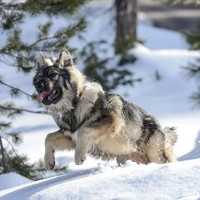
| The American Alsatian, though smaller than the extinct Dire Wolf it is supposed to resemble, is still a very large dog, most of these dogs standing over a meter tall at the withers and weighing around a hundred kilos as adults. They are powerfully built with a broad chest, thick neck, sturdy legs and exceptionally large feet that give them extra stability, making them very safe. Their backs are generally a little longer than larger dogs, giving them a rectangular profile and a large, slightly rounded skull that flattens slightly as they approach the eyes. The substantial muzzle is slightly tapered and their almond-shaped eyes can range from brown to yellow, although those closer to yellow are preferred. Their erect triangular ears are slightly rounded at the tips and generally wider and shorter. Straight tails are preferred to longer or curled ones. |
Temperament of the American Alsatian |
| Unlike most large dogs, the American Alsatian was developed purely as a companion animal. They prefer to be as close as possible to their owner or family at all times and are generally quite tolerant of strangers and other animals, although some are more aloof and a few tend towards shyness, although this tendency is resolved by conscientious breeding. Despite being large dogs, they are very calm indoors and out, and although dogs and small children should always be closely supervised when interacting, these dogs are generally quite trustworthy and not overly boisterous. Despite their size and the German Shepherd in their environment, these dogs don't make good protection, guard or watchdogs except because of their wolf-like physical appearance. They've been bred specifically to be on the calm side and are more likely to cordially show a criminal around the property than try to protect their territory. However, they make excellent therapy dogs because of their naturally tolerant and gentle nature, and a few have been trained for search and rescue work. |
Needs and activities of the American Alsatian |
| Although these dogs are not particularly energetic or active on their own, they nevertheless need exercise to stay in top shape, and should get at least an hour of moderate activity every day. Although not a particularly playful or energetic breed, they are generally well built and are capable of much longer walks if you prefer. They tend to thrive in many situations and can live comfortably in a large house with a yard or a smaller apartment. Although they are well suited to cold climates due to their thick winter coat, they can be more sensitive to heat and need to be watched closely in warmer climates. |
Maintenance of the American Alsatian |
| The American Alsatian has been bred to have a low odor and its thick coat is quite effective at repelling dirt and debris, so it only needs to be bathed occasionally. The outer coat is somewhat coarse and of medium length. It has an extremely thick undercoat for the winter months, but is almost completely removed in spring, reducing the undercoat to almost nothing. Although this breed requires brushing every few days throughout the year to manage their moderate shedding, they will probably require daily brushing, if not more often, when they shed their undercoat, and will usually leave a trail of hair. Teeth and nail care should be carried out regularly, with teeth needing brushing a few times a week and nails requiring monthly trimming. |



 English (United Kingdom)

Comments