
 |
American Staghound |
|
He is not recognized by the F.C.I. |
Origin |
U.S.A. | |
Translation |
Francis Vandersteen | |
This breed is also known as |
Staghound
|
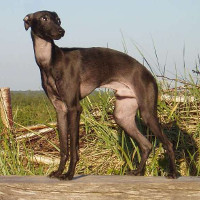
| The American Staghound is mainly the result of Scottish Deerhound and Greyhound genetics of unknown genetic percentages. For the most part, the Staghound has been bred from Staghound to Staghound since the 1800s, but excellent Greyhound / Deerhound hunting dogs are still added to the breed. It is not the direct offspring of a pure Scottish Deerhound crossed with a pure Greyhound. When America was settled, the Greyhound, Scottish Deerhound and perhaps their crosses found their way to the New World. The curling quarry was used for sport, food and fur. For the first time, the coyote was raced with racing dogs. Racing dogs were used for wolves in other countries as well as in America, but the coyote posed a new challenge. The coyote is faster than the wolf, and fights as hard as a wolf. During colonization and westward expansion, it was found that crossing the fast, well-boned Greyhound with the more robust Scottish Deerhound produced a powerful racing animal used for coyotes in difficult terrain. The Scottish Deerhound also contributed its rough coat and better scenting abilities. Staghound was bred to Staghound and was most often reformed specifically for the characteristics that favored coyote pursuit. A few hundred generations of this kind of breeding led to what many call the coyote sighthound epitome. In essence, the American Staghound was born. General George A. Custer used the Staghound as part of his pack of dogs he used to lecture on a variety of North American animals. The Staghound has always been in the hands of hunters, and without the right to pursue a career with racing dogs, the Staghound will disappear. The American Staghound is not recognized as a breed, but is a type of greyhound that is used to pursue (course) a variety of quarry (game). Although not recognized as a breed, some "lines" have been bred longer than some recognized modern breeds. The best way to visualize the American Staghound is to mix the characteristics of the Scottish Deerhound with the Greyhound. This is a racing dog with the physical characteristics we call the Greyhound prototype. It has long legs, a deep chest and strong muscles. The Staghound has great visual acuity, and some have been bred for their ability to scent while running. It can be found in any of the assortment of color or colored patterns that can be found on Greyhound and Scottish Deerhound. There are three types of hair: the "shag", which is more like the Scottish Deerhound; the "slick", which is more like the Deerhound; and the "broken", which is somewhere in between. The American Staghound has all the physical and mental characteristics needed to make the most of his career. It's known to have speeds approaching those of a Greyhound, but unlike a Greyhound, some specimens have incredible stamina. Staghounds are very quiet around the house. It solicits human attention and is very affectionate with its owner. Although this dog is mainly used for the racing career, the American Staghound makes a wonderful companion. In recent years, there seems to be more interest in the Staghound as a pet. He's good with children, but his size can be a problem with youngsters. Most Staghounds are wonderful watchdogs because of their excellent vision, but they are not guardians or protectors. Staghounds are very fast, but not hyperactive. For some people, the Staghound even seems to be a bit lazy around the house once mature. The running instinct in the American Staghound is unsurpassed, so anything that runs can be considered a quarry. In the field, this dog is courageous, tenacious and very determined about everything, whether it's a rabbit or a deer. The Staghound is pack-oriented, so it can accept other dogs it knows, but pets such as cats are a challenge that can never be overcome, but other Staghounds live happily with cats. Staghounds throughout history have been bred for one purpose - to hunt! Only the best hunters are bred, so even puppies raised in a house develop strong hunting instincts. Most Staghounds are used to hunt predators, not prey. Rather than hunting something like a rabbit that won't put up a fight when caught, they instinctively hunt something like a coyote that acts like a wild jigsaw when captured. They need to be muzzled when unsupervised or on a leash. They need a special pen to keep them separated from other animals when the owner is unable to supervise. The aim of training this dog is to achieve pack leader status. It's a natural instinct for a dog to have a command in his pack. When we humans live with dogs, we become their pack. The whole pack cooperates under one leader. The lines are clearly defined. You and all other humans MUST be higher in the pecking order than the dog. That's the only way your relationship can be a success. There are no known genetic health problems. Being bred for countless generations for function, the American Staghound is very healthy. Because of its low percentage of body fat to muscle, the Staghound is sensitive to anesthesia. It should not be run after eating a large portion of food due to problems of torsional bloat. Not an apartment dog, but can do well in an urban environment if given time to exercise in a fenced yard or on walks. Best suited to rural areas. The Crested variety can acclimatize to harsh winter conditions, while the Slicker requires special attention during cold winters. Most are kept outdoors, but all prefer the comforts of home. Staghounds require daily exercise to mature physically and mentally. It lives to run and should have a place to run freely. The Staghound would be an ideal companion for someone who jogs or bikes often, assuming the dog is over 12 months old. Don't overwork dogs aged 12 months and under, as their bones are still developing. Daily walks are essential to satisfy every dog's instincts. Height at withers for males 66 to 81 cm and for females 61 to 74 cm. Weight : 25 to 41 kilos for males and 20 to 39 kilos for females. |



 English (United Kingdom)

Comments