 |
Mucuchies |
|
He is not recognized by the F.C.I. |
Origin |
Venezuela | |
Translation |
Francis Vandersteen | |
This breed is also known as |
Venezuelan Mucuchies
|
A brief presentation of the Mucuchies |
| The Mucuchies dog breed is an extremely rare breed of dog that originated in the Venezuelan mountains before the 1800s, after dogs that traveled with Spanish conquistadors in the 1500s and 1600s began breeding with each other and with other dogs found locally. Although popular locally until the early 20th century, by the 1960s they were almost extinct. Concentrated breeding programs are underway in the mountains of Venezuela, designed to re-establish the breed, although the success or failure of these programs remains to be determined. |
History of the Mucuchies |
| When the Spanish conquistadors reached Venezuela in 1498, they were accompanied by their dogs, a motley mix of Spanish, Algerian and Pyrenean Mastiffs, as well as Pyrenees, Atlas Ovejero and possibly others. Once the conquistadors conquered the native peoples and settled with their dogs, they began to interbreed, and some speculate on an unknown breed of dog originating from this region of South America. This mix of breeds is thought to have been the beginning of the Mucuchies dog, possibly with further infusions of Dogue over the following centuries. In the 1800s, during their campaign for liberation, Simon Bolivar and his men stopped at a hacienda in Mucuchies, but were blocked at the door by a ferociously barking puppy, bravely protecting its master's property. The puppy's owner called the young dog and when Bolivar expressed how impressed he was, the owner offered him the dog. Bolivar named the puppy Nevado, a name that means snowy, and they became loyal companions with a man named Tinjaca who was chosen to care for the dog on their travels. Navado was credited with saving Bolivar's life on several occasions during his campaign for independence, but was pierced with a spear at the battle of Carabobo in 1821, losing his own life but helping to secure the independence of the Venezuelan people. The Mucuchies breed remained popular in the region for some time, but by the mid-1900s, poor breeding practices had brought the Mucuchies breed to the brink of extinction. In the 1960s, Santiago and Carlos Cruz attempted to reinvigorate the breed by importing dogs from the Great Pyrenees, but the attempt failed to restore the Mucuchies and was subsequently disbanded. The Navado Foundation, a group linked to Venezuela's 63rd president Hugo Chavez, has since been set up to try and save the breed. |
Appearance of the Mucuchies |
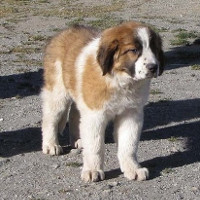
| Mucuchies are a fairly large breed, measuring around 61 centimeters high at the shoulder and sometimes reaching around 100 kilos, with a straight back and deep chest, although they are still much smaller and slimmer than their Mastiff ancestors. Their wedge-shaped heads have slightly domed skulls and broad, straight muzzles that end in a large black nose. They have large, expressive brown eyes with dark lids and medium-sized triangular ears that are set just above the eye line and hang over the sides of the head. These dogs are white or white with patches of color such as apricot, brindle and black. Their coat is medium-short and thick, and their hair is thicker, with a more pronounced wave in the chest area, and while the feathers on their legs are fairly light, the feathers and fur on their long tails are abundant. |
Temperament of the Mucuchies |
| Mucuchies are courageous, confident guardians of sheep flocks and people. They are sensitive, intelligent animals that quickly form a strong bond with their families, and are known to be both loyal and trustworthy. It's important to note, however, that if these social dogs are isolated too often or for too long, they tend to develop separation anxiety and even become aggressive. If they're good with children, they can become overprotective, especially if socialization training isn't given enough attention as the dog grows older, and young dogs can knock out younger children. Although Mucuchies are naturally highly intelligent, they have a remarkable tendency towards stubbornness, as well as a tendency to become bored and impatient with repetitive or excessively long training sessions; they are more sensitive to short, upbeat training sessions that include varied activities. |
Needs and activities of the Mucuchies |
| Mucuchies are rather active dogs for their size, requiring forty-five minutes to an hour of vigorous activity a day. As these are fairly large dogs, care must be taken and it's essential that their bone and joint health is perfect and doesn't cause excessive fatigue of the legs and hips while the bones are growing. In adolescence, activities such as vigorous running, jumping on elevated surfaces or standing on their hind legs for long periods can contribute to the inappropriate formation of the skeletal system. These dogs need more space than you'd typically find in an apartment-type environment, and are best suited to a home with a yard. |
Maintenance of the Mucuchies |
| This breed of dog only needs to be bathed a few times a year, and bathing too often can strip away its natural oil layer and reduce its resistance to extreme weather conditions. It's particularly important to rinse this dog's coat thoroughly after shampooing, as its thick coat can trap soap residues, causing dirt and dust to adhere to its coat. Although the coat is thick, it's also quite short and only needs brushing once or twice a week to protect it from dirt, debris and tangles. Their dangling ears should also be checked regularly to make sure they're not wet or dirty, to avoid infection. |



 English (United Kingdom)

Comments