
 |
Russian Harlequin Hound |
|
He is not recognized by the F.C.I. |
Origin |
Russia | |
Translation |
Francis Vandersteen |
A brief presentation of the Russian Harlequin Hound |
| The Russian Harlequin Hound is a rare breed of dog found almost exclusively in Russia. A mix of Russian Hound and English Foxhound, this Scenthound is known for its ability to track prey traditionally known as red game, such as foxes and wolves. They tend to be friendly and sociable with most people they meet, whether human or canine, but have a strong prey drive and may not be safe around cats and other small animals. This breed is not suitable for apartment living due to its high activity level and vocal nature. |
History of the Russian Harlequin Hound |
| In the 18th century, a hunting dog native to Russia began to develop naturally, but it wasn't until 1900 that selective breeding began in earnest and the first breed standard for the Russian Harlequin Hound was developed in 1925. Breeders then crossed the Russian Hound with English Foxhounds, sprinkling in some French loam as well. The result was the Russian Harlequin Hound, a slightly squarer-looking dog with tricolor markings on a white body. The Russian Harlequin Hound's voice is much deeper and more melodic than that of a Russian Hound, and often bears black markings on the saddle. Until 1951, this new breed of dog was known as the Anglo-Russian Hound, but when it was accepted as a breed in its own right, it became the Russian Harlequin Hound instead. This breed was well known, not only for their melodic voices, but also for their speed and endurance when tracking their prey. They were frequently used as red hounds, meaning they hunted foxes and wolves, traditionally known as red game, and are rarely found outside the Soviet Union. Russian Harlequin Hound breeders are still improving both type and uniformity, and the breed is now sometimes seen at Soviet dog shows, and is considered equal in quality to the best Russian Hounds. William Dunker also used the Russian Harlequin Hound to develop his eponymous dog, the Dunker, sometimes also called the Norwegian Hound. |
Appearance of the Russian Harlequin Hound |
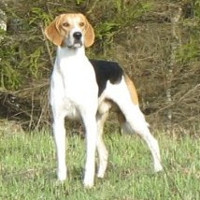
| The Russian Harlequin Hound is a muscular, medium-sized dog, measuring around 20.5 centimeters and weighing between 18 and 32 kilos. They have a square shape, long straight legs and a curved or saber-shaped tail. They also tend to have a slightly broad, square head with a straight, square muzzle, which always ends in a black nose. They have slightly pendulous lips, oval-shaped eyes, usually dark brown in color, and medium-sized, pendulous ears that are set high on the head and hang to the sides to frame the face. The Russian Harlequin Hound's distinctive short coat is predominantly white with tricolored markings on the head, face, back and tail. This coloring is particularly useful when hunting with the Russian Harlequin Hound, as it makes it much easier to differentiate the hound from its prey. |
Temperament of the Russian Harlequin Hound |
| This dog is generally friendly and playful with almost everyone it meets, but is always gentle enough to be trusted by most children, although interactions between children and dogs are always well supervised. They are very loyal, people-oriented animals with lively minds, who are very easy to train and respond particularly well to positive training techniques. These dogs are agile and active, and can enjoy and even excel in many canine sports. The Russian Harlequin Hound is generally friendly to other dogs, but they are also hunting dogs, and have a strong prey drive, which can make them dangerous to have around smaller animals like cats, unless they have grown up with them or been well socialized. They have a particularly melodic voice, which they love to use. This, combined with their high activity level, makes them unsuitable for apartment living. |
Needs and activities of the Russian Harlequin Hound |
| The Russian Harlequin Hound is a very active dog, with a rather strong prey drive. They generally require at least an hour or two of vigorous physical activity every day, and can often manage much more. Because of their strong prey drive, they can find it hard to resist chasing smaller animals, so a leash should be used unless they are actively working. They are also generally very intelligent, so they need to exercise their minds every day. Puzzles and alternative mind exercises, such as rally sport, advanced obedience and agility training, can be useful in meeting these requirements. |
Maintenance of the Russian Harlequin Hound |
| This breed has fairly simple grooming requirements. Bathing should be practiced only occasionally to avoid stripping the natural protective films from their oils. In addition, Russian Harlequin Hounds are more prone to skin allergies than other breeds. Their coats shed moderately and require brushing once or twice a week. Although this breed's coat is short, it's also quite dense, which can make a smoother brush or grooming glove somewhat ineffective at removing loose hairs. They also have long, hanging ears, which need to be checked regularly to ensure they are clean, dry and free from infection. |



 English (United Kingdom)

Comments