 |
New Zealand Huntaway |
|
He is not recognized by the F.C.I. |
Origin |
New Zealand | |
Translation |
Francis Vandersteen | |
This breed is also known as |
New Zealand Sheepdog
|
A brief presentation of the New Zealand Huntaway |
| The Huntaway was developed in New Zealand by mixing the Border Collie with a variety of other breeds, such as the Doberman, to create a herding dog that uses its voice in the field. Their appearance varies and, although most are medium to large-sized black and tan dogs, their other physical characteristics differ considerably within the population. Their lively spirit and athletic ability make them well suited to their work. Thanks to their good nature, they tend to integrate well into the farming family. They can be independent and need solid training to make the most of it. Hyper and destructive when underused, this dog absolutely needs an active lifestyle. |
History of the New Zealand Huntaway |
| In a country with the densest sheep population in the world, the demand for New Zealand Sheepdogs has always been high. A determined dog with stamina to spare was needed to patrol the vast terrain of the country's large sheep farms. What sets the Huntaway apart from other breeds, such as the Border Collie, is the powerful bark it uses to graze. The use of their voice is a useful feature on very hilly land, when both farmer and dog sometimes disappear from view. Their short coat is also an advantage in summer, when long-haired breeds like the Border Collie can struggle to keep cool. Developed by mixing a variety of sheepdogs, including the Border Collie, as well as other breeds, such as the Rottweiler and Labrador, the Huntaway occupies a place in the sheepdog market, with its ability to guard flocks by bark rather than sight. Although its exact origin is unknown, the first known written record of the Huntaway appeared in 1870 in the Upper Waitaki region, where it was known that a sheepdog trial had a Huntaway class. Also, in 1884, in the Otago Daily Times newspaper, there were advertisements featuring the breed. It wasn't until 2013 that the Huntaway dog was recognized by the New Zealand Kennel Club. However, as these are working dogs whose appearance has never been specifically selected, it's simply not possible to create a breed standard and show your dog at this stage. There is great variety in the appearance of this breed. The organization also made it clear that the Huntaway should never be kept solely as a pet, but must continue to exist as a working dog. When breeding a Huntaway, the breeder must focus exclusively on its abilities and health, and never on its appearance, which is insignificant to the breed. Although best known in New Zealand, Huntaways are also used in Australia and Great Britain, and a Huntaway club has recently been formed in Japan. |
Appearance of the New Zealand Huntaway |
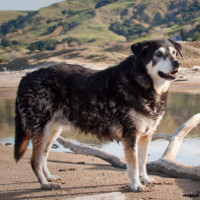
| Unlike most modern dog breeds, the Huntaway is not a dog with a uniform appearance and breed standard. They come in a wide variety of colors, sizes, conformations and coat types. Their appearance is far less important than their working ability, for which they are bred. Any description can only be a generalized account, as there is enormous variability within the breed. Saying that, Huntaways tend to be a medium to large breed, and typically a Huntaway will measure between 50 and 66 cm and weigh between 18 and 45 kg. They are known for their black and beige coats, which can be of any texture. Although black and tan are by far the most common color combination, it's quite common to see a Huntaway in a different color, such as brindle, black or white. For working purposes, most dogs will have a well-muscled, athletic body. The majority of the breed will have soft ears and a deep chest with long legs. |
Temperament of the New Zealand Huntaway |
| Diligent workers, Huntaways are motivated, obedient and extremely intelligent. They are renowned for their problem-solving skills and will excel at sheepdog trials. Thanks to their intelligence, they can quickly become bored and dislike repetitive tasks. Built for endurance and the ability to be active for long periods, they will quickly become destructive and hypertrophic if they don't have an adequate outlet for their high energy levels. They are generally not suited to an indoor lifestyle. They therefore prefer to move around outdoors, and like to work in groups rather than alone. Despite their dedication to their work, they enjoy the company of humans, and respect their managers in particular, often forming a close bond with them. They do well with children and other animals, but may attempt to herd smaller creatures if given the chance. As they are shepherds by nature and not guard or defense dogs, they are very tolerant of strangers and often welcome them with bonhomie. Although you might assume that Huntaways will bark incessantly, and that this would be problematic, anecdotally, they will rarely bark if they're not working. |
Needs and activities of the New Zealand Huntaway |
| In the right hands, this breed is a dream to train. Sensitive to absorption and eager to learn, they will pick up new commands and tricks with remarkable speed. It's true, however, that they can often be quite independent and thus benefit from a consistent and dedicated business owner. Keeping their training interesting and varied is the key to their interest and participation. Given the purpose of this breed, it's not surprising that they need a great deal of exercise to stay sane. In addition to physical activity, they also need appropriate mental stimulation. Participation in a variety of activities, such as breeding, agility and obedience, will lead to a satisfied dog. Inevitably, an under-used Huntaway will become a nuisance in the home and can be destructive, hyper and misbehave. |
Maintenance of the New Zealand Huntaway |
| Because of the variety of coat types in this breed, each individual will have particular needs. In general, however, this is a low-maintenance breed, rarely requiring brushing and bathing. As with all dogs, daily brushing and nail trimming are recommended every few months. These are tasks that should be introduced at an early age. Because of their soft ears, Huntaway hunters need to be regularly checked and cleaned. The ear canals must be thoroughly dried after bathing to prevent infection. Huntaways are known to be incredibly hardy dogs with relatively few health problems. They tend to live into their early teens. Due to the rarity of the breed, very few relevant health tests have been carried out. |



 English (United Kingdom)

Comments