 |
Can de Palleiro |
|
He is not recognized by the F.C.I. |
Origin |
Spain | |
Translation |
Francis Vandersteen | |
This breed is also known as |
Galician Palleiro Dog
|
Usage |
| Can de Palleiro owes its name to the fact that it used to sleep in a haystack (palleiro means haystack in Galician). He is distinguished above all by his mental stability and balance. What's more, today it fulfils a wide range of functions, from pasture dog to military dog. |
General appearance |
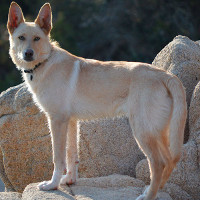
| Indo-European trunk, hardy and stocky, lupoid type, straight profile, emetrical, medium-sized, around 60-62 cm at the withers, mesomorphic and dolicomorphic, of harmonic proportions and strong constitution, with fairly broad bones, characteristic of its hardiness. Females are slightly lower, lighter in appearance and of longer proportions. Although strong-boned, they do not feel heavy or lymphatic, as their movements are rapid and well muscled. |
Behaviour / temperament |
| Shepherd and guard dog, versatile, because both go with the cows, guarding them and bringing them back, as well as taking care of the house. A guard dog with proverbial intelligence, it has a strong, reserved character with strangers, as well as being courageous and biting, characteristics that make it an excellent collaborator in driving and guarding livestock. He shows great loyalty to his master. With people in the home, he becomes gentle and calm. It's important to emphasize the psychological stability and balance of this typical sheepdog. This characteristic must therefore be exploited to the full, by encouraging the selection of well-balanced and sufficiently socialized specimens. |
Head |
||
Cranial region |
||
Head |
The head is strong, with a length of approximately 4/10 of the height at the withers, in the form of a horizontal pyramid, with dense bone, provided with the animal's conformation. | |
Skull |
The skull is flat and broad, with slightly marked superciliary arches and inconspicuous orbital basins. | |
Stop |
Slightly marked. | |
Facial region |
||
Nose |
The nose and muzzle are medium-sized and narrow, in proportion to the size of the head. | |
Lips |
Normal and taut (without the upper part extending beyond the base of the lower gums), with no tendency to droop. | |
Jaws and teeth |
Strong, with full dental arch and orthognathic, scissor bite. | |
Eyes |
Medium-sized, vividly expressed, varying in color from dark brown to black, honey or yellow. In some specimens, the pigmentation of the eyelids is black. | |
Ears |
Strongly inserted, large, raised ears with slightly open implants. | |
Neck |
| Muscular and proportionate with the head and trunk. It must form a 45º angle with the horizontal, the elevation being more evident when the dog is in action. The skin does not form a double chin. |
Body |
||
Body |
The overall body is medium but slightly elongated. | |
Topline |
Slightly descending, without tack, with short, broad, strong loins. | |
Withers |
Strong for neck insertion. | |
Croup |
Rounded. | |
Chest |
Long and deep, with a perimeter a quarter higher than the withers, with strong ribs that are neither flattened nor pronounced. The abdomen is short and slightly rising to the folds of the belly. | |
Tail |
| Thick, high-set, with abundant, dense hair. On the move, it lifts but does not curl toward the croup. |
Limbs |
| The extremities are straight and very vertical, with a strong bone structure. | ||
Forequarters |
||
Generality |
The forelegs are strong, lean, parallel and very vertical. | |
Shoulders |
The shoulder blade forms a 45º angle with the horizontal, joining the upper arm at right angles (scapulohumeral joint). | |
Upper arm |
Strong, muscular arms. | |
Elbows |
Elbows should not be too far apart or tight against the chest, with freedom of movement. | |
Forearm |
Straight forearms, gradually tapering down to the feet. | |
Carpal |
Carp are well developed and strong. | |
Pastern |
The metacarpals are well proportioned, with good bone development. | |
Forefeet |
The feet are oval, although with a certain tendency to be rounded, with thick, short, well closed toes, very hard plantar pads and short, strong nails, dark in color or also white in the lighter layers. | |
Hindquarters |
||
Generality |
The hind limbs are strong, parallel, perfectly tapered later and with obvious angulations. | |
Upper thigh |
The thigh is broad, muscular and flexible. | |
Lower thigh |
Strong legs. | |
Stifle |
The knee is strong. | |
Metatarsus |
Solid, strong, parallel metatarsals. | |
Hock |
Hocks are strong and parallel. | |
Hind feet |
Oval feet, with a tendency to round off, with thick, short, well closed toes, very hard plantar pads and short, strong, dark or white nails in light-coated animals. Dewclaws and sixth toes are relatively common, although not desirable. | |
Gait and movement |
| Movements are agile and strong. The usual movement is the walk, moving to trot and/or canter effortlessly if the work requires it. |
Skin |
| Tends to be thick, without sagging, attached to body and head. |
Coat |
||
Hair |
Hair is dense and thick, more so in winter, as this is an animal that generally lives at the foot of the house, but always outside, with livestock or in the haystack. | |
Colour |
Normally uniform, with a wide variety of sand, cinnamon, chestnut, wolf and even black. It is sometimes possible to encounter specimens with the binary coat (yellow hairs and, at the tips, black), with the intimate mixture of yellow and black hairs, yellowing in the neck, throat, chest and tips, as in the case of wolfhounds. Albinos or those with large white markings are not acceptable. | |
Size and weight |
||
Height at withers |
Males 59 to 65 centimeters, females 57 to 63 centimeters. | |
Weight |
Males from 30 to 38 kilos, females from 25 to 33 kilos. | |
Faults |
| • Any departure from the foregoing points should be considered a fault and the seriousness with which the fault should be regarded should be in exact proportion to its degree and its effect upon the health and welfare of the dog and its ability to perform its traditional work. • Faults listed should be in degree of seriousness. |
NB : |
| • Any dog clearly showing physical or behavioural abnormalities shall be disqualified. • The above mentioned faults when occurring to a highly marked degree or frequently are disqualifying. • Male animals should have two apparently normal testicles fully descended into the scrotum. • Only functionally and clinically healthy dogs, with breed typical conformation should be used for breeding. |



 English (United Kingdom)

Comments