Redbone Coonhound

He is not recognized by the F.C.I.

Origin
U.S.A.
Translation
Francis Vandersteen
This breed is also known as
Redbone
American Redbone Hound

A brief presentation of the Redbone Coonhound

The Redbone Coonhound was created in 18th-century America by Foxhounds and Bloodhounds from Ireland and Scotland. Intended to be fast hunters capable of fending off raccoons, these dogs were agile and energetic, able to traverse many types of terrain quickly. These versatile hunting dogs were selected for the characteristic red coat of the breed we know today. This dog is known for its loyal, affectionate nature, which makes it a good family dog, and for its adaptability, which lends itself well to the field. Redbone Coonhound lovers appreciate the deep, melodious voice that can carry for miles, especially when it has discovered a good scent, much to the annoyance of their neighbor.

History of the Redbone Coonhound

The Redbone Coonhound is an American-made breed descended from Foxhounds and Bloodhounds. In the late 1700s, Red Foxhounds were imported to the USA with Scottish immigrants. Before the American Civil War, Irish Red Irish were also brought with Irish settlers. In the late 18th century, raccoon hunters needed a faster, warmer-nosed dog capable of locating and retrieving raccoons faster than the region's current breeds. By crossing these immigrant breeds, this faster dog was born. For many years, breeding focused on creating an almost solid-colored red dog, bred for speed and agility on a variety of terrains. Many early versions of the breed had a black color on the back resembling a saddle and were called "Saddlebacks". As the color red was favored, the black saddle was eventually bred out of the breed. George Birdsong, famous hunter and breeder of Georgian foxes, obtained a pack from this breed in 1840 and successfully perfected it. Many believe that the Redbone Coonhound owes its name to its brilliant red color, but it is more likely that it takes its name from Peter Redbone, a promoter of the breed in Tennessee. In 1902, the United Kennel Club recognized the Redbone Coonhound. Familiarity with the breed grew after the book and subsequent film, "Where the Red Fern", featured two Redbone Coonhounds. Today, this dog is still a versatile hunter that can not only handle raccoons, but also bears, cougars and bobcats. The American Kennel Club finally recognized the breed in 2009.

Appearance of the Redbone Coonhound

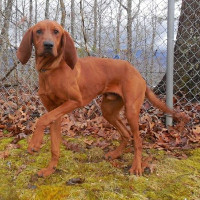
The Redbone Coonhound is a strong, streamlined, medium-sized dog designed to move swiftly across swamps, rocky hills and wooded areas. Its gait is well balanced, with head and tail raised. This dog is squarely proportioned and is slightly longer than it is tall. A long, slightly arched neck leads to a broad, slightly domed skull, with a well-balanced muzzle and large, open nostrils in a black nose. The face carries a pleading expression with round, dark brown or hazel eyes, and large, drooping ears moderately low on the head. A strong, straight back and broad chest are supported by well-muscled legs. This breed has cat-like paws that are compact and well-padded with arched toes. The tail is of medium length. The coat is composed of short, glossy hair. In general, the color is a rich, solid mahogany, although there may be a small amount of white on the chest and feet.

Temperament of the Redbone Coonhound

The Redbone Coonhound is a devoted and loyal family dog, intelligent and eager to please. They are affectionate, easy-going dogs that are playful and love their family's attention, without being overly demanding. Although they love children, Redbones can be too restless for toddlers when they're young. This breed can coexist peacefully with other animals, but can also regard small animals such as cats as prey and chase them away. They do best with cats if bred with them. The Redbone can also behave well with strangers, but can take on the role of guard dog. Good socialization while young can acclimatize this dog to different animals and people. The Redbone's most distinctive feature is its musical, clear barking voice, which can carry over long distances. These dogs are independent and stubborn, and can prove difficult to train. Start training early with short sessions, using positive reinforcement and treat rewards. Although they are more responsive to training than other breeds, obedience is not their forte. Energy abounds in this breed, which needs regular, daily exercise. Redbones are versatile and can hunt and swim in a variety of terrains. If hunting isn't on the agenda, these adaptable dogs can also benefit from agility and obedience trials, tracking, herding, dog shows and even employment in the search and rescue division.

Needs and activities of the Redbone Coonhound

The Redbone Coonhound is happy, well-balanced and very good with children. He can be surprisingly affectionate and has a pleasant voice. He loves being with his people. If raised indoors as a puppy, he will adapt well to family life. Coonhounds are all instinctive hunters, and it's not difficult to train the breed to follow scent and display a quarry. Redbones have a strong desire to please their master. Redbones are hot noses, able to locate raccoons in trees, faster than many other coonhounds. Like other coonhounds, Redbones are alert, fast and able to work in all weathers on difficult terrain. Their agility benefits them when hunting fenced terrain or steep, rocky terrain. With the iron grain of a Terrier and the pumping stamina of a Husky, the Redbone is every hunter's warm dream come true. A natural tree instinct has been bred into the Redbone, making it a raccoon hunting specialist. But it's also proficient in trolling and treeing bear, cougar and bobcat. When used as a game animal, Redbones often hunt in packs. Redbones are known to make excellent water dogs. In the home, they are affectionate and gentle. The Redbone should be well socialized at an early age and taught simple obedience like walking on a leash. Be careful with cats and other non-canine pets. If raised with a kitten, they can be fine, but some Redbone Coonhounds try to chase cats like raccoons. Some Redbone Coonhounds drool a lot, while others don't at all. It all depends on the shape of the lips. The coonhound mouth will drool a lot. The Redbone Coonhound needs a firm, but calm, confident and consistent pack leader to be mentally stable.

Maintenance of the Redbone Coonhound

This breed is generally easy to care for, requiring weekly brushing, as the Redbone Coonhound does not shed and is not hypoallergenic. Redbone Coonhounds are known to have a musty scent that can be controlled with normal baths. Long, floppy ears need to be cleaned regularly and kept dry to avoid the ear infections this breed is prone to. Nails grow quickly and need to be trimmed regularly to avoid breakage and cracking. This dog loves and demands frequent daily exercise and will get bored with nothing to do. The Coonhound can benefit from long walks and jogging, space to run, swim and hunt. Keep this dog on a leash or fenced in, otherwise he may run after a scent. Redbone can live indoors or outdoors, and does best in a rural home that allows him to hunt and yelp. Make sure you spend quality time with this dog, as if left to his own devices, he'll be looking for companionship. The Redbone tends to be obese, so avoid overfeeding him.

Comments

Latest page updates

  • Telomian

    Telomian He is not recognized by the F.C.I. Origin Malaysia Translation Francis Vandersteen A brief presentation of the Telomian The Telomian is a very rare breed of dog, and the only one native to Malaysia to have been bred outside the country. They were originally bred by the indigenous people of Malaysia to combat parasites such as snakes, rats,...
  • King Wheaten -- Cavalier King Charles Spaniel X Irish Soft Coated Wheaten Terrier

    King Wheaten He is not recognized by the F.C.I. Origin Great Britain <> Ireland -> U.S.A. Translation Francis Vandersteen A brief presentation of the King Wheaten The King Wheaten is a small dog with a heart this big and a playful disposition. Borrowing the energy and soft-coated waves of the Irish Soft Coated Wheaten Terrier and the size and...
  • Spanierd -- English Springer Spaniel X German Shepherd

    Spanierd He is not recognized by the F.C.I. Origin Great Britain <> Germany -> U.S.A. Translation Francis Vandersteen A brief presentation of the Spanierd The Spanierd is a hybrid dog. Its parent breeds are the English Springer Spaniel and the German Shepherd. They have an affable personality. He's known for entertaining family and friends with his...
  • Alaskan Goldenmute -- Alaskan Malamute X Golden Retriever

    Alaskan Goldenmute He is not recognized by the F.C.I. Origin U.S.A. <> Great Britain -> U.S.A. Translation Francis Vandersteen This breed is also known as Alaskan GoldenGoldenmuteAlaskan Gold Retriever     A brief presentation of the Alaskan Goldenmute The Alaskan Goldenmute is a descendant of two great dog breeds: the Alaskan Malamute and the Golden...
  • French pointing dog Pyrenean type

    French pointing dog Pyrenean type FCI standard Nº 134 Origin France Translation Mrs. Peggy Davis Group Group 7 Pointing Dogs Section Section 1.1 Continental Pointing Dogs « Braque » Type Working With working trial Acceptance on a definitive basis by the FCI Tuesday 18 January 1955 Publication of the official valid standard Tuesday 01 August 2023 Last...
  • French pointing dog Gascogne type

    French pointing dog Gascogne type FCI standard Nº 133 Origin France Translation Mrs. Peggy Davis Group Group 7 Pointing Dogs Section Section 1.1 Continental Pointing Dogs « Braque » Type Working With working trial Acceptance on a definitive basis by the FCI Monday 17 January 1955 Publication of the official valid standard Tuesday 01 August 2023 Last...
  • Vucciriscu

    Vucciriscu He is not recognized by the F.C.I. Origin Sicily Translation Francis Vandersteen En français, cette race se dit Vucciriscu Diese Norm ist in deutscher Sprache sichtbar Vucciriscu En español, esta raza se dice Vucciriscu In het Nederlands, wordt dit ras gezegd Vucciriscu This breed is also known as Sicilian Vucciriscu Sicilian Butcher...

© 2026 Groupe Milouchouchou ASBL. Tous droits réservés. En savoir plus

Protected by Copyright01
We use cookies

We use cookies on our website. Some of them are essential for the operation of the site, while others help us to improve this site and the user experience (tracking cookies). You can decide for yourself whether you want to allow cookies or not. Please note that if you reject them, you may not be able to use all the functionalities of the site.

Ok