
 |
Carolina Dog |
|
He is not recognized by the F.C.I. |
Origin |
South Carolina, U.S.A. | |
Translation |
Francis Vandersteen | |
This breed is also known as |
American Dingo
|
A brief presentation of the Carolina Dog |
| The Carolina Dog is a medium-sized dog considered a primitive breed due to its rarity, with most of the primitive natures of its ancestors still intact. Because it is not over-bred, the Carolina Dog does not seem to have the health problems to which many domestic breeds are exposed. They are not commonly found outside the United States, and are virtually unknown outside the south. He is good with children, b |
History of the Carolina Dog |
| Historians believe that the Carolina Dog descended from Pariah dogs imported from Asia to North America around 9,000 years ago. Historians have determined that dogs with the same bone structure as the Carolina Dog were found in ancient Native American burial sites. Written records of the breed were not preserved until about forty years ago, when Dr. I. Lehr Brisbin, Jr. a professor of biology at the University of Georgia, began his research into the race. Dr. Brisbin discovered the Carolina Dog at the U.S. Department of Energy's ecological site on the banks of the Savannah River. He noticed dogs that closely resembled the Dingoes living in the remote swamps of South Carolina. Some of these dogs were not domesticated, however, and he found breeders who specialized in the breed. It is thought that these dogs became trusted companions of Native Americans and migrated with the tribes. These dogs retained much of their wild nature, but also became hunting companions and village dogs as they traveled with the various tribes. They are still considered a primitive breed, which means they still retain many of the primitive instincts of their ancestors. Today, there are more domesticated Carolina Dogs than wild dogs in the deep south of the USA. Conservationists, including Dr. Brisbin, lead expeditions into the marshes of the Savannah Basin in search of purebred Carolina Dogs. As these dogs are found, they are placed in pre-approved foster homes and trained as hunters and family companions. The United Kennel Club has recognized the Carolina Dog and it is allowed to compete in all UKC-sanctioned competitions. The American Kennel Club has accepted him as a member of the Stock Service Foundation since July 2017. |
Appearance of the Carolina Dog |
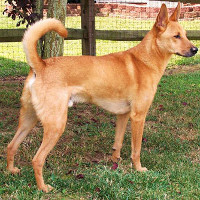
| The Carolina Dog is a medium-sized dog that closely resembles the Pariah or wild dogs that still inhabit the swamps of the Deep South. He has large, erect ears and a long, curved tail, but it doesn't carry high like a Spitz breed. His eyes are almond-shaped and dark brown. His eyes must be black. It has a large nose with open nostrils and should be black, although a brown or single-colored nose is acceptable in lighter-colored dogs. The Carolina Dog has a short, dense coat. Its summer coat is much sparser than its thicker winter coat. Its undercoat is short, thick and soft. The topcoat is longer than the undercoat, but still considered short. It is straight and coarse to the touch, with coarser guard hairs on the back to protect it in brush. The Carolina Dog can be found in black and tan, solid cream, red ginger, yellow, sable and orange. |
Temperament of the Carolina Dog |
| The Carolina Dog isn't an overly affectionate dog until it's closely bonded to you. He's calm and somewhat aloof. He's naturally wary of strangers and watches them closely, although he should never act aggressively towards others. He needs early socialization to make sure he doesn't become too shy and reluctant to accept any human interaction. He needs a strong leader to work with him and train him properly so that he can become a well-adjusted member of the family. He is a natural hunter and will often bring gifts of dead animals home for his family. He is a pack animal and will form a very close bond with the other dogs in his home. As a social dog, he thrives in a home that has at least one other dog for company. The Carolina Dog has a strong prey drive and should be watched closely when small pets are let out of their cages. It can do well with a cat it has been raised with since it was a puppy, but should always be supervised. |
Needs and activities of the Carolina Dog |
| The Carolina Dog is a pariah dog ("Pariah dog" is a general name in India for the half-recovered dogs that swarm every village, owned by no one in particular, but ready to accompany anyone on a hunting expedition). The Carolina Dog is one of the few breeds in existence today that is truly a primitive dog, the result of natural selection for survival in the wild, not selective breeding. Wild specimens are still known, so this is not a fully domesticated dog. This dog, which has survived as an animal living in the swamps, savannahs and forests of South Carolina and Georgia for thousands of years, has also proved highly adaptable and amenable to domestication, and an excellent pet. Many dogs are known to be extremely shy with people and don't like much handling unless socialized at a very young age. With proper socialization, they have proven to be loyal companion dogs. Many of the natural dog characteristics that predominate in Carolina Dogs contribute to their ability to adapt well to pets. Carolina Dogs are not recommended for apartment living. They do best with plenty of space around them. They are still not fully domesticated. They can live outside, provided it's not too cold. They adapt well to warm, sunny climates. The Carolina Dog should be taken for a long daily walk. When walking, it's very important that the dog is heeled beside or behind the human, on a leash, as in the dog's mind, the leader shows the way. |
Maintenance of the Carolina Dog |
| The Carolina Dog is relatively easy to care for. Its coat is easy to style and only requires a quick brushing once a week, except in the case of heavy shedding. It sheds seasonally, and usually twice a year, it will experience heavy shedding requiring daily brushing to ensure that all loose and dead hairs are removed. Use a smooth or natural bristle brush for grooming. A detangler can also be used. Because of its high shedding rate, the Carolina Dog is not a hypoallergenic breed. It generally doesn't have a strong odor and won't require many baths. He will need a bath when he sheds heavily to help loosen the undercoat and speed up the shedding process. Between baths, he can be given a dry bath using dry shampoo or baking soda, and cornstarch can be mixed and sprinkled on his coat to freshen it up. His ears should be examined at least once a week and cleaned if necessary. Clip his nails every two to three weeks. |



 English (United Kingdom)

Comments