
 |
Treeing Tennessee Brindle |
|
He is not recognized by the F.C.I. |
Origin |
U.S.A. | |
Translation |
Francis Vandersteen |
A brief presentation of the Treeing Tennessee Brindle |
| The Treeing Tennessee Brindle is a breed of Cur dog, descended from the Mountain Cur. Cur dogs are thought to be closely related hounds of North American origin, bred for treeing. Treeing is a type of hunting that uses dogs to force prey to climb a tree. It's from this type of hunting that the expression "going up the wrong tree" originates. Treeing can also be useful when naturalists need to radio-tag an animal. The Treeing Tennessee Brindle is a fairly recent breed of dog, originating in the USA in the 1960s. It is a strong dog with a dense, smooth brindle coat. The Treeing Tennessee Brindle doesn't require much grooming. Brushing once a week is recommended to remove dead hairs. A bath is only necessary if the dog gets dirty or muddy. The Treeing Tennessee Brindle is an exceptionally robust and healthy breed of dog. In addition, this breed is intelligent, courageous and a loyal companion. |
History of the Treeing Tennessee Brindle |
| The Treeing Tennessee Brindle is descended from a Brindle Cur dog, whose brown coat is adorned with black tiger-like stripes. The exact lineage of the Brindle Cur is unknown. Reverend Earl Phillips was a writer for a hunting magazine and, in the course of his research, came across a Brindle Cur with a brown coat and tiger stripes, which was highly prized for its incredible hunting skills. In the early 1960s, he contacted the dog's owners and learned more about the breed's keen sense of smell, tracking ability and arboricultural skills. In 1967, the Reverend spearheaded the creation of the Treeing Tennessee Brindle Breeders' Association. This association was created to preserve and protect this breed of dog. Treeing Tennessee Brindle breeding records have been maintained through the American Kennel Club's Foundation Stock Service Program since 1995. The dog breed has been recognized as the ninth Coonhound breed by the ACHA. Most of the breeding stock comes from Appalachia, the Ozark Mountains and other regions in between. In 2009, the Treeing Tennessee Brindle was licensed to compete in AKC companion events. Since 2013, the breed has had foundation stock status with the American Kennel Club. The breed still cannot be registered with the American Kennel Club, but its breeding records are kept. |
Appearance of the Treeing Tennessee Brindle |
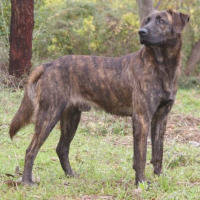
| The Treeing Tennessee Brindle is a medium-sized Cur. The coat of the Treeing Tennessee Brindle is short, dense and soft. The breed can be brindle or black with brindle edging. It can sometimes have small white markings on the chest and feet. The feet are round and well arched. The dewclaws of its long, muscular legs are usually removed. This breed of dog has a deep chest, muscular neck and well-proportioned body. The tail is thick at the base, tapering to the tip. The muzzle is slightly broad and long, with a strong jaw. The breed has a broad, flat skull that tapers toward the muzzle. The cheeks of the Treeing Tennessee Brindle are muscular and the lips are tight with a scissor bite. Ears are pendulous and V-shaped. Eyes may or may not be dark brown or amber, and the nose is black. This agile dog has a supple, effortless gait. |
Temperament of the Treeing Tennessee Brindle |
| The Treeing Tennessee Brindle has a strong hunting instinct and is very courageous. During a hunt, the dog bleats, which means it calls out loudly to the hunter. They are highly intelligent, agile and have an extraordinary sense of smell. The Treeing Tennessee Brindle is an active, outgoing breed that needs daily exercise. He's friendly with other dogs and strangers, but he's a good watchdog and will bark to warn you of visitors. He is not generally an aggressive dog and does not make a good watchdog. Puppies need to be trained and socialized from an early age. As a companion, the Treeing Tennessee Brindle is an affectionate and loving pet. He loves children, but because of his high energy level, it's best if he's accompanied by older children. The Treeing Tennessee Brindle is not meant to be an apartment dog. He's best suited to a home with a large yard or farm where he can run, play and explore. |
Needs and activities of the Treeing Tennessee Brindle |
| Due to their hunting nature, Treeing Tennessee Brindle have high energy levels that need to be expended every day. Walks of several miles, hikes in the woods and dog sports are all ways to keep your Treeing Tennessee Brindle dog satisfied. Treeing Tennessee Brindle can thrive on competitive sports like freestyle frisbee and agility, which are also great ways to bond with them. Many places host dog competitions, which may be something to consider as your puppy starts to grow up. Before starting a high-impact sport like agility, consult your vet to make sure your dog is healthy enough to participate. Treeing Tennessee Brindle are designed to learn quickly, so training shouldn't be too difficult with this breed. Consistent, confident training is essential for your Treeing Tennessee Brindle, avoiding overly harsh methods that will develop resentful behavior. As they can be a little difficult for new dog owners, a professional trainer with experience in Treeing and hounds can guide you in training your new Treeing Tennessee Brindle puppy. |
Maintenance of the Treeing Tennessee Brindle |
| The short coat of the Treeing Tennessee Brindle is easy to care for. A weekly brushing is recommended to remove dead hairs, and a bath is only necessary if it's very dirty. They are vocal and have a unique, loud bark, which is not acceptable for apartment living. The Treeing Tennessee Brindle is a very energetic dog that requires more than daily walks. This breed of dog needs an active owner who will take him hunting, into the trees and on hikes. They love space to roam, explore and use their tracking instincts. Because the Treeing Tennessee Brindle is an active dog, it needs a high-protein diet. This breed thrives best in cooler environments. Treeing Tennessee Brindle dogs kept outdoors need adequate shelter during the winter months. |



 English (United Kingdom)

Comments