 |
Sabueso Fino Colombiano |
|
He is not recognized by the F.C.I. |
Origin |
Colombia | |
Translation |
Francis Vandersteen | |
This breed is also known as |
Perro fino Colombiano |
Brief historical summary |
| The Sabueso Fino Colombiano is a hunting dog evolved in Colombia from hunting dogs and dog specimens imported from continental Europe, Great Britain and North America since colonial times. Because of its great hunting abilities, it became popular with all social strata, from the presidents of the Republic and the upper classes, for its interest in hunting as a sport; even farmers who often depended on the use of the dog to obtain the technical committee of the Colombian Fine Hound Club Association. For over 200 years, these hunting dogs have been used in Colombia to reshape different hair varieties, and are perfectly adapted to the country's diverse geography and climate. |
General appearance |
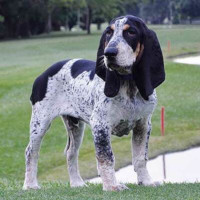
| Typical howling dog with long ears and tail, passionate hunter of great hardiness, medium size, rectangular shape, short hair of varied colors. |
Important proportions |
| Proportions 10: 11.5 for height at withers/length, depth of chest slightly less than distance from chest to ground, muzzle may be slightly shorter than skull on head. |
Behaviour / temperament |
| Stubborn and obstinate on the hunt, at home they are affectionate with children and do well as companion dogs. Thanks to its hunting nature, it is able to live in a group with other dogs, and is friendly with strangers. |
Head |
||
Cranial region |
||
Head |
Harmonious, proportionate to the body. | |
Skull |
Slightly divergent skull axes; proportionally, the skull may be slightly longer than the muzzle, slightly domed when viewed from the front, pronounced occipital crest. | |
Stop |
Clear, but not too pronounced. | |
Facial region |
||
Nose |
Large, well-developed nostrils, black or brown. | |
Muzzle |
Medium length, perhaps slightly shorter than the skull, straight profile. Viewed from above, rectangular. | |
Lips |
Neither very thick nor developed, with the upper lip overlapping the lower. | |
Jaws and teeth |
A scissor bite is acceptable, with complete dentition. | |
Cheeks |
Flat. | |
Eyes |
Soft, almond-shaped expression, any color is acceptable, matching the coat color. Blue eyes or eyes of a different color (heterochromia) are not permitted. | |
Ears |
Long, broad, hanging, medium-sized (at the corner of the eye), reaching at least to the tip of the muzzle, with rounded edges. | |
Neck |
| Strong, medium length, may have loose skin at the throat. |
Body |
||
Body |
Rectangular, of medium strength. | |
Topline |
With gentle movement, the topline rises slightly from the withers to the croup. | |
Withers |
Remarkably pronounced. | |
Loin |
Short and strong. | |
Croup |
Of medium length, slightly larger than the withers. | |
Chest |
Medium amplitude, remarkable sternum, depth reaches elbow level. | |
Ribs |
Slightly arched and set well back. | |
Underline and belly |
Retracted belly. | |
Tail |
| Long, passing to the hock, medium insertion, becoming finer towards the tip, must not be bristly. |
Limbs |
Forequarters |
||
Generality |
Very muscular, strong bones, vertical. | |
Shoulders |
The shoulder blade is slightly longer than the humerus, with a good inclination. | |
Upper arm |
Medium-length, strong bones. | |
Elbows |
Free, neither in nor out. | |
Pastern |
Slightly sloping. | |
Forefeet |
Medium-sized, hardy nails and pads. | |
Hindquarters |
||
Generality |
Powerful, angulated, well muscled. | |
Upper thigh |
Long, strong but fine muscles. | |
Metatarsus |
The metatarsals, seen from behind, are parallel. | |
Hock |
Strong hocks. | |
Hind feet |
Medium-sized, hardy nails and pads. | |
Gait and movement |
| Agile and effortless, balanced with good reach and drive, flowing trot. |
Skin |
| Fine and elastic. |
Coat |
||
Hair |
In the Fino, there are two varieties of coat: short-haired and rough-haired. a) Shorthair: Stiff, glossy. (should not have a brush in the tail). b) Rough-haired: At first glance, rough-haired specimens have the same appearance as short-haired ones, but they have greater roughness and a hair length that can be variable. On the muzzle, it forms a small beard and whiskers (specimens of the chin variety generally have heavier bones and a slightly thicker tail). |
|
Colour |
The Sabueso Fino Colombiano comes in a variety of colors. Red, black, white, brown, tabby (can come in different shades, patterns and combinations of these colors). | |
Size and weight |
||
Height at withers |
Desirable height: 45 to 55 cm (with a tolerance of 2 cm to 3 cm in height). | |
Weight |
Between 15 and 30 kg. | |
Faults |
| • Any departure from the foregoing points should be considered a fault and the seriousness with which the fault should be regarded should be in exact proportion to its degree and its effect upon the health and welfare of the dog and its ability to perform its traditional work. • Faults listed should be in degree of seriousness. |
General faults |
 Short ears (appearing long but not reaching the tip of the nose). Short tail (not reaching the hock). Too high or too low tail insertion. Elbows in or out. Straight topline. Excessively high croup. Short ears (appearing long but not reaching the tip of the nose). Short tail (not reaching the hock). Too high or too low tail insertion. Elbows in or out. Straight topline. Excessively high croup. |
Serious faults |
| Size not exceeding prescribed height (tolerance included). Excessive skin. Cheeks (very drooping lips). Very developed double chin. Drooping eyelids. |
Disqualifying faults |
| Extreme aggressiveness or shyness. Exemplary from short to long and abundant hair. Brush-like tail. Problems with long hair forming bangs on ears and/or tail. Lack of type (atypical dogs). Albinism. Blue or different-colored eyes. Dwarfed specimen (achondroplasia). Overshot or undershot mouth. Naturally knotted tail (deformed vertebrae). |
NB : |
| • Any dog clearly showing physical or behavioural abnormalities shall be disqualified. • The above mentioned faults when occurring to a highly marked degree or frequently are disqualifying. • Male animals should have two apparently normal testicles fully descended into the scrotum. • Only functionally and clinically healthy dogs, with breed typical conformation should be used for breeding. |



 English (United Kingdom)

Comments