Seppala Siberian Sleddog

He is not recognized by the F.C.I.

Origin
Canada
Translation
Francis Vandersteen

A brief presentation of the Seppala Siberian Sleddog

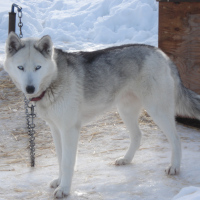
In the right context, in the right climate, like the frozen Arctic, you could be forgiven for thinking that the Seppala Siberian Sleddog was a wolf. They have the same lean, muscular body, the same ears, a similar coat and similar eyes, until you notice the friendly, surprisingly gentle expression. The Seppala Siberian Sleddog was developed from sleds imported from Siberia, and Leonhard Seppala, a legendary dog handler, is credited with its outstanding development. The Seppala Siberian Sleddog flew race after race, their fame earning the dog and Leonhard worldwide acclaim. Although primarily a working dog, they love being part of a family, forging close bonds with their owner and being known to be kind and gentle with children. They're no pushovers though, and need a strong, consistent owner who earns their respect, otherwise they'll become willful and disobedient. As part of a pack, this dog enjoys the company of its peers and gets on well with most dogs. They have a strong prey drive, so smaller furred animals may not fare as well. Eager, obedient, for a respected and strong owner, and devoted, this breed shows strength, speed and endurance, which makes it so exceptional as a sled dog.

History of the Seppala Siberian Sleddog

Northeastern Siberian sled dogs that have adapted to cope with high winds, blizzards and frozen wasteland are the ancestors of the Seppala Siberian Sleddog. Leonhard Seppala, a famous dog handler, is credited with creating this breed. He was a Norwegian immigrant who had gone to Alaska to seek his fortune, but went on to become one of the most successful sled dog racers of his time. Dog sled racing to the Nome goldfields was a popular pastime. So when a Russian fur trader named William Goosak brought a team of ten northeastern Siberian dogs to Nome, Alaska, he caught the attention of the locals. They immediately looked at the smaller dogs with disdain and called them Siberian rats. Their jeers and taunts came to an abrupt halt when the "rats" won the 1909 Nome Sweepstakes. At the time, Seppala owned a two-dog sled team, and in 1913 was entrusted with a team of Siberian Huskies, then known as Chukchi Huskies. Seppala worked from 1914 to 1917, becoming a legend by dominating the Alaskan draw. In 1925, the city of Nome suffered a diphtheria epidemic and Seppala became famous for leading his dog team, among others, in a series of relays covering more than 340 km in whiteout conditions and furious high winds to deliver the antidote. to the stricken city. He became an immensely popular figure and set up a kennel in Poland Spring to further develop the breed. But by 1969, Seppala Siberian Sleddogs were on the brink of extinction. Fortunately, these loyal dogs were given a reprieve when Markova Kennels in Canada and Seppineau Kennels in the USA joined forces. Today, the Seppala Siberian Sleddog is still alive and well.

Appearance of the Seppala Siberian Sleddog

The Seppala Siberian Sleddog is an Arctic breed of dog with an irritating wolf-like appearance. Beautiful in appearance, it's their ability and work ethic that matter more to owners than their looks. The Seppala Siberian Sleddog has evolved into a pack dog, content to work in collaboration with a team of dogs to get what their owner wants them to do. They are medium to large in size, with well-developed shoulders, neck and chest that have developed through centuries of work pulling sledges. Long, sturdy legs and a long tail that can be curled over the back when excited differentiate this dog from the Siberian Husky, of which they were once considered the same breed. But while Husky breeds were being developed for the showroom, where appearance was important, Seppala Siberian Sleddogs were separated to preserve their strength, skills and abilities in the icy Arctic regions. Now, they are considered two different breeds of dog. The Seppala Siberian Sleddog has an elongated head, pretty almond-shaped eyes that can be brown or blue, and a clean black muzzle. Their thick, dense double coats protect the dog from the cold, and their alert, pointed ears miss no turn. They are alert, handsome and elegant dogs, devoted to their owners and families.

Temperament of the Seppala Siberian Sleddog

The Seppala Siberian Sleddog is a working dog by nature. They need this training and purpose every day to be at their best. Intelligent and alert, they can get bored easily. This energy and motivation is why they make ideal working dogs, and work prevents bad habits from taking hold. The Seppala Siberian Sleddog is a rare primitive type of working dog. It was specially created to carry a sled in a cold, treacherous country. This breed is never aggressive, not even towards strangers, although they do bark to inform their owner of people in their territory. The beauty of this wolf-like dog lies in its affectionate nature; they are quite docile and gentle. Seppala Siberian Sleddogs form close bonds with their owners, always ready to cooperate with them and their families. They are also strongly bonded to the other dogs in their group, enjoying their company and coexisting peacefully. Seppala Siberian Sleddogs have the determination and high work ethic that keeps them going even in bad weather. Friendly, alert and sensitive to nature, these dogs have been saved from extinction by careful management so that we can all enjoy their beauty and exceptional skills.

Needs and activities of the Seppala Siberian Sleddog

Seppala Siberian Sleddogs are excellent working dogs with strong pack instincts and need a strong, consistent pack leader, the owner, to follow. They love to run and have a strong prey drive, often after small game. The Seppala Siberian Sleddog is an ideal running companion. They have the energy to burn and need to exercise to avoid developing destructive behavior. Born and bred in cold climates, they can quickly overheat at high temperatures. Consequently, they are at their best in cold climates and countries where they can roam and indulge their active nature. If you have a Seppala Siberian Sleddog in a city, be prepared to walk your dog twice a day, keeping a tight rein on the leash so they don't take off after small animals they see as prey. They love to play and get on well with children. So you can use them to keep them physically and mentally active. This is a dog that loves company. A Seppala Siberian Sleddog left to its own devices for too long will get bored and howl around the neighborhood.

Maintenance of the Seppala Siberian Sleddog

Seppala Siberian Sleddogs have beautiful coats that protect them from the elements. They are truly magnificent, majestic dogs. However, they shed this beautiful coat twice a year, and when they do, you can stuff a bed with the hair they've lost. So be prepared to brush your dog every day and leave your vacuum cleaner on standby. Apart from that, the Seppala Siberian Sleddog is easy to care for. They rarely need a bath, which can be a mission to accomplish. If a bath is necessary, use a mild dog shampoo to protect the oily coating of their skin and fur, which will help them withstand the most extreme weather conditions. To dry them in cool weather, you may need your hair dryer. Other than that, just brush their teeth, check their feet for injuries or long nails, and a wipe with a damp cloth in each ear and they're ready. They'll love the attention and go for it to show their buddies how cool they look afterwards.

Comments

Latest page updates

  • Telomian

    Telomian He is not recognized by the F.C.I. Origin Malaysia Translation Francis Vandersteen A brief presentation of the Telomian The Telomian is a very rare breed of dog, and the only one native to Malaysia to have been bred outside the country. They were originally bred by the indigenous people of Malaysia to combat parasites such as snakes, rats,...
  • King Wheaten -- Cavalier King Charles Spaniel X Irish Soft Coated Wheaten Terrier

    King Wheaten He is not recognized by the F.C.I. Origin Great Britain <> Ireland -> U.S.A. Translation Francis Vandersteen A brief presentation of the King Wheaten The King Wheaten is a small dog with a heart this big and a playful disposition. Borrowing the energy and soft-coated waves of the Irish Soft Coated Wheaten Terrier and the size and...
  • Spanierd -- English Springer Spaniel X German Shepherd

    Spanierd He is not recognized by the F.C.I. Origin Great Britain <> Germany -> U.S.A. Translation Francis Vandersteen A brief presentation of the Spanierd The Spanierd is a hybrid dog. Its parent breeds are the English Springer Spaniel and the German Shepherd. They have an affable personality. He's known for entertaining family and friends with his...
  • Alaskan Goldenmute -- Alaskan Malamute X Golden Retriever

    Alaskan Goldenmute He is not recognized by the F.C.I. Origin U.S.A. <> Great Britain -> U.S.A. Translation Francis Vandersteen This breed is also known as Alaskan GoldenGoldenmuteAlaskan Gold Retriever     A brief presentation of the Alaskan Goldenmute The Alaskan Goldenmute is a descendant of two great dog breeds: the Alaskan Malamute and the Golden...
  • French pointing dog Pyrenean type

    French pointing dog Pyrenean type FCI standard Nº 134 Origin France Translation Mrs. Peggy Davis Group Group 7 Pointing Dogs Section Section 1.1 Continental Pointing Dogs « Braque » Type Working With working trial Acceptance on a definitive basis by the FCI Tuesday 18 January 1955 Publication of the official valid standard Tuesday 01 August 2023 Last...
  • French pointing dog Gascogne type

    French pointing dog Gascogne type FCI standard Nº 133 Origin France Translation Mrs. Peggy Davis Group Group 7 Pointing Dogs Section Section 1.1 Continental Pointing Dogs « Braque » Type Working With working trial Acceptance on a definitive basis by the FCI Monday 17 January 1955 Publication of the official valid standard Tuesday 01 August 2023 Last...
  • Vucciriscu

    Vucciriscu He is not recognized by the F.C.I. Origin Sicily Translation Francis Vandersteen En français, cette race se dit Vucciriscu Diese Norm ist in deutscher Sprache sichtbar Vucciriscu En español, esta raza se dice Vucciriscu In het Nederlands, wordt dit ras gezegd Vucciriscu This breed is also known as Sicilian Vucciriscu Sicilian Butcher...

© 2026 Groupe Milouchouchou ASBL. Tous droits réservés. En savoir plus

Protected by Copyright01
We use cookies

We use cookies on our website. Some of them are essential for the operation of the site, while others help us to improve this site and the user experience (tracking cookies). You can decide for yourself whether you want to allow cookies or not. Please note that if you reject them, you may not be able to use all the functionalities of the site.

Ok