
 |
Lurcher |
|
He is not recognized by the F.C.I. |
Origin |
Great Britain | |
Translation |
Francis Vandersteen |
A brief presentation of the Lurcher |
| A bit of a mongrel, the Lurcher is not only a crossbreed, it can also be made up of a variety of different breeds, meaning that Lurchers are one of the most diverse types of dog. Most will be athletically built with sleek, tidy bodies. Their coats can be short or medium, sometimes giving them a scruffy appearance. Virtually any coat color is possible, although many are gray and fawn. Traditionally kept as hunting dogs, some continue to perform this function today. They are fairly easy to train, have a keen sense of smell and seek out a wide range of prey, which can sometimes get them into trouble. Thanks to their benevolent spirit and devoted nature, despite their professional experience, they adapt well to family life. |
History of the Lurcher |
| Lurchers are an interesting crossbreed of dogs that are not officially recognized by any international kennel club, but have been well known and widely used for many years. Theoretically, a Lurcher is made up of any greyhound, including Greyhounds, Salukis and Whippets, crossed with any other active breed, but traditionally it is a mixture of Greyhound and Collie or Terrier. The Lurcher's Greyhound parent is descended from an ancient sighthound that existed several thousand years ago in the Middle East. In days gone by, these dogs were revered as gods and owned only by the elite. Traditionally, these dogs used their sense of sight to hunt over open ground and their incredible speed to deal with their prey: rabbits and hares. The origin of the name Greyhound is not thought to be linked to the color gray; in fact, there are many coat colors, but it can mean blond or shiny dog. Greyhounds have undeniable sporting ability and are still used today as racing dogs. Their docile nature and easygoing personality make them great family pets, with many retired Greyhounds having been adopted by rescue organizations. Mixing a Greyhound with a Collie provides intelligence and a strong work ethic. Many original Lurchers are said to have been used by poachers and hunters. These first crosses are thought to have taken place around the 14th and 15th centuries in the UK. At around the same time, the general population was forbidden to own greyhounds, forcing them to create new crossbreeds, which was not against the law.The Lurcher is a very popular dog breed in Britain, where it is frequently used in competitive dog sports, including dog racing. Internationally, they are less well known. |
Appearance of the Lurcher |
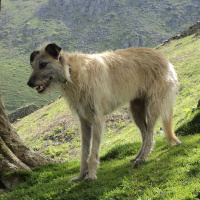
| Given their mixed heritage, Lurchers are a breed of varied appearance. Most are fairly tall and lean, resembling their Greyhound parent. Their long limbs and muscular, deep-chested bodies provide speed and endurance when running. The Lurcher's head and muzzle are long and fairly narrow. Their triangular ears tend to remain semi-erect, with the upper tips turning down, although some have more pendulous ears. Their eyes are not too large, but should be evenly spaced and free from obstructions such as facial fur or skin folds. The Lurcher's tail is often long and thin. Given their mixed origins, there is a wide range of acceptable heights and weights for the Lurcher. As a general rule, they weigh between 27 and 32 kg and measure between 55 and 71 cm. However, weights and heights outside these parameters are not unusual. Coat type and color are also difficult to predict, and while some will have the short, fine coat of their Greyhound parent, others may have a longer, finer coat. Virtually any coat color is permitted, including black, white, fawn, gray, brindle and blue. White markings are a common feature. |
Temperament of the Lurcher |
| As a working dog by nature, the Lurcher has the gentle, loving personality of the Greyhound, making it a charming pet to own. They bond well with their families and are generally very respectful and obedient. Athletes at heart, Lurchers love nothing more than to be free in nature and chase something. They can be quiet house guests, but only once their exercise needs have been met. For most, a rural home with outdoor access is preferable. When it comes to their natural instincts, Lurchers are rarely able to control themselves. Having been bred for centuries to seek out and hunt small prey, this is a task they will perform whenever given the chance. This characteristic means that Lurchers should not be left to fend for themselves in a public place, and many will need muzzles when outdoors. Similarly, they can't really be housed with smaller animals, such as rabbits or gerbils, as their prey drive is too powerful. |
Needs and activities of the Lurcher |
| Lurcher-type dogs seem to be universally active in small movements, just like their Greyhound ancestors. Although they need a place to run a little every day, they tend to be real couch potatoes at home. In addition to running and walking, which should never be done off-leash due to this dog's highly developed prey drive, your Lurcher can enjoy and even excel in activities such as luring and agility training. They also tend to be very quiet compared to many breeds, and even the largest Lurchers can make suitable pets for people with smaller living spaces, provided they have enough activity during the day. |
Maintenance of the Lurcher |
| The Lurcher is generally a fairly easy dog to care for, although this can vary somewhat, depending on the breeds that have been combined to develop your dog. In most cases, bathing will only be necessary a few times a year, and too frequent bathing may even remove the natural oils from this dog's coat, especially if it has inherited a weather-resistant double-layered coat from its parents. Those mixed with dogs such as Bull Terriers retain this short coat in one layer, which can usually be kept clean and healthy with weekly brushing with a rubber curry comb or a soft cloth with a damp towel. Many Lurchers can have a double coat that can sometimes be thicker and require more grooming, and dogs with Wirehaired Terrier influence can have a coat that requires occasional stripping. |



 English (United Kingdom)

Comments