
 |
July Hound |
|
He is not recognized by the F.C.I. |
Origin |
U.S.A. | |
Translation |
Francis Vandersteen |
A brief presentation of the July Hound |
| The July Hound is a specific variety of American Foxhound that was developed using Irish Foxhounds that proved exceptional as hunting dogs for the large, long-lived red fox. Earlier varieties of Foxhounds in the USA were better suited to hunting the gray fox, an animal that escaped its predators by climbing trees. The July Hound strain was developed by Colonel Miles G. Harris, a Georgian hunter, who was looking for a dog better suited to tracking red foxes on land, rather than tree-climbing gray foxes, which his previous dogs specialized in. |
History of the July Hound |
| Until the 1800s, the predominant type of fox in the Georgia region was the gray fox, a small, dark-colored fox with hooked claws that enabled them to climb the sides of trees. The Foxhounds and Coonhounds of the time would chase them into the trees to corner them, then call the hunter to come and ransack their prey. Then the red fox migrated to the area from the northeastern USA, a faster fox that ran farther and bolted into its den or a hole in the ground rather than a tree, and local hunters discovered that the hounds they used weren't suited to the task of tracking these new foxes. One of the state's most prominent hunters, a Colonel Miles G. Harris, searched the countryside for hounds that would meet his needs. He finally found his treasure when he located a breeder in Maryland named Nimrod Gosnell, in a pair of Irish Foxhounds named Red Tickler and Leda. Mr. Gosnell presented Colonel Harris with a pair of puppies from the union of Red Tickler and Leda and nicknamed the Irish Foxhound puppies July and Mary. They had shorter ears than most local dogs and were ridiculed by other local breeders. The two dogs quickly became superior hunters, surprising other hunters and breeders, and their offspring became much desired. Mary, sadly, perished before she could have puppies, and July became even more sought-after, breeding with several types of females across Georgia and passing on his exceptional drive and stamina to his offspring. |
Appearance of the July Hound |
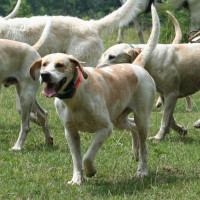
| American Foxhounds such as the July Hound are generally a little longer than they are tall, with strong, straight legs and powerful hindquarters, developed to help them keep up with and eventually overtake the long-legged red fox. They have broad, slightly domed skulls with broad, straight muzzles that are roughly equal in length to the skull and broad, square black or brown noses. They have large, round eyes that can be brown or hazel and have a gentle, almost pleading expression, and long, hanging ears with rounded tips that hang slightly beyond their jaws. The July Hound's ears are a little shorter than the ears of other American Foxhound strains, and they can be a little higher than average. American Foxhounds are available in many colors, and although the tricolor black, beige and white is a very common combination, many July Hounds are available in lighter colors, such as blond and white or orange and white, and their coat may be a little fuzzier than some other dogs. |
Temperament of the July Hound |
| The July Hound has a temperament similar to that of other American Foxhounds. If they get enough exercise, they are generally playful, friendly family members who are very eager to please. They tend to get on well with all ages, although they need to be carefully supervised with younger children because of their generally noisy behavior and they can be a little wary of strangers. Although they are generally bright and eager to please, they have short attention spans and can sometimes be quite difficult to train, especially when it comes to potty training. Short, positive training sessions work best for this breed, especially if they include a variety of exercises. When hunting foxes or other ground game, they are tenacious and motivated, often following the quarry long after other dogs have given up, but they are unwilling to tree their prey and can lose track of animals climbing to escape. |
Needs and activities of the July Hound |
| These dogs are specially designed for endurance and stamina, which means they need plenty of exercise every day to stay happy and healthy, both mentally and physically. These dogs are specially designed for hunting, and even untrained dogs are likely to chase if a fox or other canine passes by, but there are several other options if hunting isn't your favorite activity, activities such as scent tracking, swimming and even rally sports. The July Hound is not well suited to apartment living and is likely to be too vocal and active for small living spaces. |
Maintenance of the July Hound |
| The July Hound has a short, weather-resistant coat that is generally fairly easy to manage. Bathing should only take place occasionally, as too frequent a bath can strip the coat of the natural oils that keep it healthy and make the dog more sensitive to the cold. Moderate shedding throughout the year can usually be managed with a weekly grooming session using a smooth brush, damp washcloth or grooming glove. It's particularly important to check for moisture and debris in the ears, as dog breeds with long, hanging ears are more likely to develop ear infections than other dog breeds. |



 English (United Kingdom)

Comments