 |
Odis |
|
He is not recognized by the F.C.I. |
Origin |
Ukraine | |
Translation |
UKU | |
Date of publication of the official valid standard |
Friday 09 November 2012 | |
Date of the last update |
Monday 02 October 2017 |
Usage |
| Companion Dog |
Brief historical summary |
| The group of the dogs with the same ancestors and similar conformationwas formed in the result of the planned matings of the dogs of the breeds Fox Terrier, Miniature Poodle, Maltese and Chin in the end of the 70th in Odesa, Ukraine. Tamara Shargorodskaya, the UKU-FCI judge, initiated the creation of a breed group and in 2004 the formed breed was called ODIS and the breed standard was developed. |
General appearance |
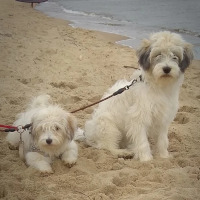
| Odis is a gay and lively dog with a bright temperament. It resembles to the South Russian Shepherd dog in appearance. The bone structure and body must be strongly built which is very important for this small dog, but it does not mean that Odis is clumsy, heavy or coarse. It is neither long-legged nor stumpy. Hindquarters move with plenty of drive and the forequarters have good reach. General measures, constitution and proportions are important. Its body is covered by the dense long hair of 7-15 cm with well-developed undercoat. Top hair on the head forms a forelock, whiskers and a beard. Tail is hanging down at rest, can be carried over the topline when the dog is excited. |
Important proportions |
| The depth of the chest: is half of the height at the withers. Length of the head: is 40% of the height at the withers. Length of the muzzle: is half of the length of the head. Length index (Format): 110 |
Behaviour / temperament |
| A sanguine dog. |
Head |
||
Cranial region |
||
Head |
Head seen from above or from the side resembles to a blunt wedge. The distance measured from the occiput to the stop approximately equals to or a little less than the distance measured from the occiput to the nose. |
|
Skull |
lightly domed, moderately wide, gradually tapering to the eyes. The superciliary arches and occiput are slightly developed. Well-filled under eyes. Jaw muscles are slightly developed. |
|
Stop |
Stop is noticeable. | |
Facial region |
||
Foreface |
Well filled, deep enough. Foreface is gradually tapering to the nose. | |
Nose |
The nose is wide; nostrils are well-developed. The nose is black for the dogs of solid white coat color, white with grey spots and grey coat colors. The dogs of the fawn coat color may have dark brown nose. | |
Lips |
Tight-fitting, moderately thick, well pigmented. | |
Nasal bridge |
Nasal bone is straight. | |
Jaws and teeth |
Scissor or level bite. Jaws are strong. | |
Eyes |
Of medium size, oval, dark, slightly oblique; eye rims are well pigmented. | |
Ears |
Flat, lying closely to the skull, set on high, of medium size and reaching the eye line, slightly rounded at the tip. | |
Neck |
| Longer than the head, middle set, lean, gradually widening to the shoulders, well-muscled with tight skin, without dewlap; nape of the neck is well-pronounced. |
Body |
||
Topline |
Firm, strong, slightly sloping from the well-pronounced nape to the pronounced withers and further along the level back turning into level loin and then into the slightly sloping croup. | |
Withers |
Pronounced, well-muscled. | |
Back |
Strong and straight, its length is half of the body length. | |
Loin |
Short, muscled and level. | |
Croup |
Short, slightly sloping, muscled. | |
Chest |
The chest is sufficiently wide and oval in the cross-section, deep. Forechest is pronounced enough. | |
Ribs |
The ribs are moderately sprung. | |
Underline and belly |
Moderately tucked up. | |
Tail |
| Tail is hanging down at rest, can be carried over the topline when the dog is excited. Reaches the hocks by its length. |
Limbs |
Forequarters |
||
Generality |
Seen from the front, parallel and widely set. | |
Shoulders |
The shoulder blades are sloping. | |
Upper arm |
Forming an angle of 100 degrees with the shoulder blade. Well-muscled. | |
Elbows |
Parallel. | |
Forearm |
Straight, upright, and well-muscled. | |
Carpal |
Lean, reasonably wide, in one plane with the forequarters. | |
Pastern |
Slightly sloping. | |
Forefeet |
Oval, with slightly elongated middle toes, well-knit. | |
Hindquarters |
||
Generality |
Parallel, not widely set. Seen from the side, are standing behind the vertical line drawn from the point of buttocks. Well angulated. | |
Upper thigh |
Seen from the side, slanting. | |
Lower thigh |
Slanting, well-musculed. | |
Stifle |
Pronounced. | |
Metatarsus |
Vertical. | |
Hock |
Well defined. | |
Hind feet |
Round, arched and well-knit. | |
Gait and movement |
| Trot is typical. Movements are free, easy and straight. |
Skin |
| Sufficiently thick, elastic, without wrinkles and folds. |
Coat |
||
Hair |
Thick, long (7-15 cm) coat with well-developed undercoat all over the body. Top hair is moderately rough, long and slightly kicked; young and shedding dogs may have shorter hair. Top hair on the head forms a forelock, covering eyes and reaching the nose; whiskers and a beard. Trimming, which changes the dog’s shape, is not allowed. |
|
Colour |
White, white with spots of various colours (except for liver), white with grey (blue), dark grey, fawn of various tints (except for orange). | |
Size and weight |
||
Height at withers |
Ideal height for males – 37 cm. (with tolerance +/- 2 cm.). Ideal height for females – 35 cm. (with tolerance +/- 2 cm.). |
|
Faults |
| • Any departure from the foregoing points should be considered a fault and the seriousness with which the fault should be regarded should be in exact proportion to its degree and its effect upon the health and welfare of the dog and its ability to perform its traditional work. • Faults listed should be in degree of seriousness. |
General faults |
 Height at withers Higher than 39 cm for males, and lower than 33 cm for females. Short forelock, not covering eyes. Poorly developed whiskers and beard. Spotted nose. At least ½ of the nose is pigmented. Too prominent light eyes. Ears short or turned back. Skull too domed. Too defined, steep stop. Not filled under eyes. Short, thin, loose neck. Low-set tail. Tail not reaching a hock joint. Tail carried over the back, curled in a circle, too short tail. Slightly defined withers. Week back. Excessively prominent loin. Steep croup. Somewhat straight angulation of hindquarters. Sickle hocks. Feet not arched enough. Bindy movements. Soft, too wavy hair. Height at withers Higher than 39 cm for males, and lower than 33 cm for females. Short forelock, not covering eyes. Poorly developed whiskers and beard. Spotted nose. At least ½ of the nose is pigmented. Too prominent light eyes. Ears short or turned back. Skull too domed. Too defined, steep stop. Not filled under eyes. Short, thin, loose neck. Low-set tail. Tail not reaching a hock joint. Tail carried over the back, curled in a circle, too short tail. Slightly defined withers. Week back. Excessively prominent loin. Steep croup. Somewhat straight angulation of hindquarters. Sickle hocks. Feet not arched enough. Bindy movements. Soft, too wavy hair. |
Serious faults |
| Height at withers Lower than 33 cm or higher than 41 cm for males, and higher than 38 cm for females. Square body. Lack of forelock, whiskers and beard. Pricked ears. Light eyes. Spotted nose. Less than ½ of the nose is pigmented. Any color except for the standard ones. Big bright spots of various colors (liver, orange). Short, low set, loose neck. Undefined withers. Saddle back. Humped loin. Steep croup. Low set tail. Bobtail. Too sloping pasterns, weak pasterns. Buck knees. Too strait angles of hindquarters. Splay feet. Dewclaws. Heavy, bindy movements. Curly hair. Ectropion, entropion. |
Disqualifying faults |
| Aggressive, overly shy. Cryptorchids or monorchids. Underdeveloped testicles. Not pigmented nose. Overshot, undershot. Ambling. |
NB : |
| • Any dog clearly showing physical or behavioural abnormalities shall be disqualified. • The above mentioned faults when occurring to a highly marked degree or frequently are disqualifying. • Male animals should have two apparently normal testicles fully descended into the scrotum. • Only functionally and clinically healthy dogs, with breed typical conformation should be used for breeding. |
Detailed history |
| Over 40 years ago, a small group of dog trainers in Odessa began work on a new breed of dog. It was to be small, intelligent and gentle with people. 20 years later, thanks to the cross-breeding of several breeds, the goal was achieved: dogs of the Odis breed were born in Odessa - the first and so far only breed bred in Ukraine since independence. The public was able to see just how difficult the process was, and what Odessa dogs look like. ODIS is a young ornamental dog breed. Odessa is associated with its history, as well as its name. It was here, in the late 1980s, that experts from the local “Consensus” club decided to introduce to the city a companion dog that should have a noble appearance, a cheerful disposition and a compact size. The miniature South Russian Sheepdog became a visual reference. Mixed-breed and pure-bred dogs were selected for mating. The base was made up of a Wire Fox Terrier, a Silver Toy Poodle and a Maltese. The cross-breeding process took over 20 years, but the result exceeded expectations. In 1999, puppies were born whose characteristics matched the specialists' expectations exactly. One of them, the Francik daughter, was recognized as the breed standard. She became the ancestor of all future Odis. Her owner was one of the participants in the creation of the breed - Irina Bahareva. Today, in Odessa, she runs the national club of the same name (...). According to her (Irina Bahareva), in 2006, the Ukrainian Kennel Club officially recognized the Odis as the first national breed, then decided to approve its standard and issue pedigrees. It's the first and so far only breed,” says Irina, ”to be bred entirely in Ukraine. She has absorbed the best: from the Fox Terrier - cheerfulness, from the Maltese - appearance and devotion, and from the Poodle - intelligence. Visually, Odis is a small dog. The ideal size is 35 to 37 centimeters. Color: fawn, gray or white. He has a long coat, framed on the head by a moustache, beard and expressive eyebrows. As for temperament, the dog trainer assures us that Odis are loyal companions and family dogs. They're unpretentious in life and care, they're not aggressive, so they get on easily with people and enjoy going for walks. “These dogs are very friendly and discreet. If properly trained, they get on just as well with children as with the elderly. They can be kept in small apartments and country houses. They're really attached to the family,” said Irina. The woman also added that during the entire breeding period, the dogs showed no serious pathology. The cynologists achieved this result thanks to geneticists and other specialists who constantly monitored the mating process. “We wanted this dog to give people more pleasure than care. That's why we immediately set ourselves the task of creating a healthy breed, capable of living a long and active life. Our Francisca, the first Odis, lived to 19.5 years. His descendants also live long lives: 16 and 18 years. The owner's only task is to enable the dog to lead a healthy life through walks and proper nutrition,” said Irina Bahareva. According to Irina, in the 20 years that the breed has existed, the Odis has become popular not only in Ukraine, but worldwide. Puppies have already taken root in Poland, Israel, Canada, America, Russia, the Netherlands, Germany and other countries. In fact, some even have kennels where they've started breeding the breed. The Odessa national club, which bears the same name, has 450 dogs of this type, and there are many more around the world in general. “Our dogs include champions from Ukraine and Central and Eastern Europe. There are also champions from Poland, Georgia, Montenegro, Cyprus, Macedonia, the Czech Republic, Bulgaria, Latvia, Lithuania and Estonia. The dogs are constantly on show at breeding events. The experts who check them determine the direction of the breed's development,” explains Irina. When asked why they chose this name (ODIS), the woman explains that the homeland of these dogs is Odessa. “In the dog world, there is, for example, a Yorkshire Terrier or an American Bulldog. Everyone knows the region where these breeds were bred. Why should a dog bred in Odessa proudly bear the name of its hometown? - said Irina Bahareva. In 2010, when the breed was officially presented at a press conference, journalists jokingly explained its abbreviation - Odessa Domestic Ideal Dog. Irina Bahareva laughed in agreement and added that the cynologists had not disappointed the city's inhabitants. |
Many thanks |
| Thanks to Kasia - Draiochta FCI - second Polish kennel of ODIS breed for introducing us to this breed. Source of this standard - odis.in.ua/Standard-English |



 English (United Kingdom)

Comments