
 |
New Guinea Singing Dog |
|
He is not recognized by the F.C.I. |
Origin |
New Guinea | |
Translation |
Francis Vandersteen |
| The possession of this animal is not authorized |
A brief presentation of the New Guinea Singing Dog |
| The New Guinea Song Dog is a medium-sized dog that developed in the high altitudes of the mountains of Papua New Guinea. Depending on the expert you talk to, they may be considered a distinct breed of dog or, in some cases, a completely different species, rather like the Dingo in Australia. They are rarely seen in the wild, but the conservation efforts of the New Guinea Singaporean Dog Conservation Society have succeeded in increasing the population of captive-bred dogs while continuing to preserve as much genetic diversity as possible, and a few have thus become available. Although the Nature Conservancy advises against breeding dogs outside the planned program, it does happen. The result is mixed-breed and New Guinea-bred dogs that sometimes become available for adoption, mainly through the conservation group. |
History of the New Guinea Singing Dog |
| The New Guinea Singing Dog originated in New Guinea, as its name suggests, at some point in antiquity, but experts are divided in their theories about the breed's foundation. Like the Dingo, the New Guinea Singing Dog is considered by many to be a true wild dog and, although it is extremely rare to find one in the wild, it is bred by conservationists to ensure the breed's survival. The New Guinea Singaporean Dog Conservation Society was established in 1997 in New Guinea and closely monitors the breeding of this dog in captivity to ensure that surviving animals are as strong, healthy and disease-free as possible. To achieve this, they have used methods designed to maximize the genetic diversity present in the small population of captive dogs, while ensuring that the purity of the breed remains intact. Most captive New Guinea Song Dogs are bred in zoos, and those housed as pets are usually spayed or neutered before transfer, partly to help control the health of the breeding population and partly to prevent the dogs from developing as many problem behaviors. This is an extremely rare canid and very difficult to locate in the USA, but according to the Conservation Society's web page, New Guinea Singing Dog breeders should be offering these dogs at the same price as other, more common pedigree dogs, rather than the US$2,500 to US$5,000 of some rare breed orders. This practice is designed as a measure to discourage inbreeding or outcrossing in environments such as puppy mills or poor backyard breeders. |
Appearance of the New Guinea Singing Dog |
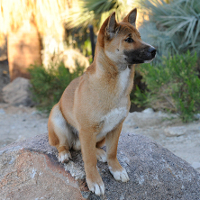
| This medium-sized canine usually stands 46 centimeters high at the shoulder and weighs around 9.5 to 11 kilos. Its body is generally about twenty percent longer than the dog's height. They have a wedge-shaped head with broad cheekbones and a tapering muzzle that, on average, is slightly shorter than the length of the skull. They have small, triangular eyes tending to display different shades of brown, from light amber to very dark brown, and small, widely-spaced triangular ears held upright on a cup-shaped tulip base. The back corners of the mouth tend to turn upwards, giving them a generally happy expression. Their teeth are generally larger than those of other dogs. Their tails are long and bushy, often with a white tip. look very much like a fox's tail. Their thick, double-coated coats can come in many colors, including several shades of red, fawn, sable and rust. The dog is noted for its unique vocalization. |
Temperament of the New Guinea Singing Dog |
| The New Guinea Singing Dog is an introverted, independent animal that has developed without much human interaction. They also tend to adopt this attitude at home when captive-bred animals are kept as pets. They tend to be shy or discriminating towards strangers, but are generous in rubbing cheeks and hugging those they know well. This breed also has a very large prey drive that is often impossible to extinguish, although they can sometimes be socialized to get along with the pets they grow up with. They are protective of children and do not tend towards aggression, but interactions must be carefully supervised to avoid any misunderstanding between the two. This breed of dog has developed independently of other dogs, which has enabled it to develop behavioral traits that differ from those of other, more domesticated dogs. Like other dogs, they can quickly dig under most fences, but unlike other dogs, these dogs can just as easily breach the fence if it's not properly secured. They also have a few other communication differences, such as putting their ears to the side rather than back and crouching to signal play rather than the traditional play bow. This breed is quite intelligent and they tend to solve problems well, but their ability to escape yards and pens, combined with their extremely high prey drive and independent spirit, makes this type of dog extremely difficult to train and live with. |
Needs and activities of the New Guinea Singing Dog |
| This breed is reported to be very active in its first year or so, but tends to settle down a little as it ages. While the few people who have had the pleasure of living with a New Guinea Singing Dog say they tend to have excellent stamina and will generally be able to follow you wherever you want, they become less hyperactive and tend to be quite calm compared to many other breeds. They are also extremely flexible compared to most other dogs and are able to pass through any space where they can get their head through. |
Maintenance of the New Guinea Singing Dog |
| Grooming this breed is not particularly difficult. Bathing should only take place occasionally, as too frequent bathing can strip away the protective oils naturally present in the coat. Their double coat should be brushed several times a week. This will help to remove dirt and debris, control shedding and prevent the formation of tangles and matting, which is particularly important in the thick undercoat, where particularly bad matting and tangles can integrate the animal's skin and cause infection. They tend to shed much more during seasonal changes and may require daily brushing during these periods. |



 English (United Kingdom)

Comments