Falkland Fox

He is a wild animal

Origin
Falkland Islands
Translation
Francis Vandersteen
This breed is also known as
Falkland Wolf
Warrah
Antarctic Wolf
The possession of this animal is not authorized Royal Decree establishing the list of mammals not kept for production purposes that may be kept (M.B. 24.08.2009)
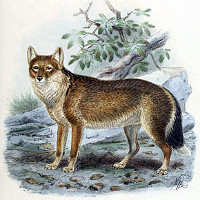
The Falkland Fox or Falkland Wolf (Dusicyon australis, formerly Canis antarcticus), also known locally as the Warrah or occasionally the Antarctic Wolf, was the only land mammal indigenous to the Falkland Islands. The last known specimen died out in 1876 on the archipelago's western island. It is the only canid species to have become extinct in historical times. The closest relative to the Dusicyon genus among southern hemisphere foxes is the Culpeo or Patagonian fox, which was introduced to the Falklands.

The Falkland fox's fur was tawny, and the tip of its tail was white. Its diet is unknown. Given the absence of island rodents, it probably included land-nesting birds such as geese and penguins, larvae and insects, as well as marine carrion. It is sometimes described as living in burrows.

The unusual geographical distribution of this animal (the only other canine species native to oceanic islands are the insular grey fox from California and Darwin's fox from Chile, but these habitats are not as remote as the Falklands) and some details of its skull suggest that this fox originally accompanied indigenous populations visiting the islands as a semi-domestic pet. If so, the ancestral form, located on the South American continent, would have become extinct during the last Ice Age.

DNA analyses of museum specimens have been less than convincing as to the exact parentage of this animal, some even suggesting hybridization (during the domestication process) with a relative or ancestor of the coyote. It is not known whether this would have been biologically possible. Another possibility is that, during the Ice Age, an overland passage between the Falkland Islands and South America enabled fox ancestors to cross the distance between them. In any case, the Falkland wolf is a biogeographical mystery.

In the Falklands, the species is commemorated in various ways: one of the rivers in the east of the Falklands is called the Warrah River, and it is also depicted on the local fifty-pence coin. One of the islands' ecological publications is entitled The Warrah.

Comments

Latest page updates

  • Telomian

    Telomian He is not recognized by the F.C.I. Origin Malaysia Translation Francis Vandersteen A brief presentation of the Telomian The Telomian is a very rare breed of dog, and the only one native to Malaysia to have been bred outside the country. They were originally bred by the indigenous people of Malaysia to combat parasites such as snakes, rats,...
  • King Wheaten -- Cavalier King Charles Spaniel X Irish Soft Coated Wheaten Terrier

    King Wheaten He is not recognized by the F.C.I. Origin Great Britain <> Ireland -> U.S.A. Translation Francis Vandersteen A brief presentation of the King Wheaten The King Wheaten is a small dog with a heart this big and a playful disposition. Borrowing the energy and soft-coated waves of the Irish Soft Coated Wheaten Terrier and the size and...
  • Spanierd -- English Springer Spaniel X German Shepherd

    Spanierd He is not recognized by the F.C.I. Origin Great Britain <> Germany -> U.S.A. Translation Francis Vandersteen A brief presentation of the Spanierd The Spanierd is a hybrid dog. Its parent breeds are the English Springer Spaniel and the German Shepherd. They have an affable personality. He's known for entertaining family and friends with his...
  • Alaskan Goldenmute -- Alaskan Malamute X Golden Retriever

    Alaskan Goldenmute He is not recognized by the F.C.I. Origin U.S.A. <> Great Britain -> U.S.A. Translation Francis Vandersteen This breed is also known as Alaskan GoldenGoldenmuteAlaskan Gold Retriever     A brief presentation of the Alaskan Goldenmute The Alaskan Goldenmute is a descendant of two great dog breeds: the Alaskan Malamute and the Golden...
  • French pointing dog Pyrenean type

    French pointing dog Pyrenean type FCI standard Nº 134 Origin France Translation Mrs. Peggy Davis Group Group 7 Pointing Dogs Section Section 1.1 Continental Pointing Dogs « Braque » Type Working With working trial Acceptance on a definitive basis by the FCI Tuesday 18 January 1955 Publication of the official valid standard Tuesday 01 August 2023 Last...
  • French pointing dog Gascogne type

    French pointing dog Gascogne type FCI standard Nº 133 Origin France Translation Mrs. Peggy Davis Group Group 7 Pointing Dogs Section Section 1.1 Continental Pointing Dogs « Braque » Type Working With working trial Acceptance on a definitive basis by the FCI Monday 17 January 1955 Publication of the official valid standard Tuesday 01 August 2023 Last...
  • Vucciriscu

    Vucciriscu He is not recognized by the F.C.I. Origin Sicily Translation Francis Vandersteen En français, cette race se dit Vucciriscu Diese Norm ist in deutscher Sprache sichtbar Vucciriscu En español, esta raza se dice Vucciriscu In het Nederlands, wordt dit ras gezegd Vucciriscu This breed is also known as Sicilian Vucciriscu Sicilian Butcher...

© 2026 Groupe Milouchouchou ASBL. Tous droits réservés. En savoir plus

Protected by Copyright01
We use cookies

We use cookies on our website. Some of them are essential for the operation of the site, while others help us to improve this site and the user experience (tracking cookies). You can decide for yourself whether you want to allow cookies or not. Please note that if you reject them, you may not be able to use all the functionalities of the site.

Ok

