 |
Red Fox |
|
He is a wild animal |
Origin |
Worldwide | |
Translation |
Francis Vandersteen |
| The possession of this animal is not authorized |
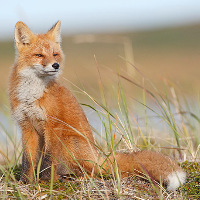
| The Red Fox (Vulpes vulpes), also known as the Common Fox, is a medium-sized Canidae species. It is the most widespread fox in Eurasia, North America, North Africa and Australia. It is a mammal with a red coat marked with white under the belly and throat, a pointed muzzle, erect ears and a bushy tail. The species is classified as a carnivore, but has a predominantly carnivorous omnivorous diet, feeding mainly on rodents and rabbits, but also on insects, fish and fruit. As a result, it is highly opportunistic, adapting to very different environments and modifying its diet according to the month of the year. Depending on the region, the Red Fox breeds from December to February, giving birth in fine weather (gestation period of around 50 days). This takes place in the shelter of a burrow, whereas for the rest of the year, the fox lives almost exclusively in the open air. At first, the cubs are fed on their mother's milk, then, little by little, the pair of parents provide them with meat. They begin to emerge from the burrow after four weeks, are weaned at nine weeks and, after spending the summer with their parents, disperse in autumn. The extent of dispersal and the size of litters vary according to local food resources and mortality, enabling the species to control its numbers. Its opportunism and great adaptability, which have enabled it to colonize a large part of the northern hemisphere, make it one of the most widespread mammals on the planet. The Red Fox has an elongated body with relatively short limbs in relation to its size. Its tail, which is longer than half its body (it generally represents 70% of its body size), is long, fluffy and touches the ground when standing. It ends in a small tuft of white hair. It serves the animal as a pendulum and keeps it warm when it sleeps and wraps itself in it. The front legs have five toes on the ground, while the hind legs have only four, the fifth being higher up. These toes end in semi-retractable claws. They are surrounded by interdigital hairs, which are more abundant in winter. The Red Fox has a narrow, elongated skull with a slender muzzle ending in a black nose, and an underdeveloped skull. The throat, chin and mouth are white, and there is a dark patch behind the nose, on the side of the muzzle, and a more or less pronounced watermark of the same color. It has a small mouth with 42 teeth. Its canines are long and pointed. They are concave, unlike those of the dog, for example. The upper canine teeth are 3 cm apart, the lower 2.6 cm apart. The incisors slope slightly inwards, enabling the animal to grasp its prey and cut small pieces of meat. The premolars are simple and pointed, while the molars have a flatter shape and are well-suited to crushing food, such as the bones of small prey. Teeth are solid, with thick enamel that renews itself regularly. They are razor-sharp. The corners of the mouth are dark and slightly upturned, leaving a sneer on the animal's face. The eyes are amber-yellow to greenish, lined with black lashes on the upper lid. Their pupils are oval and vertical. They have nictitating membranes, but these only move when the eyes are closed. The ears are triangular and mobile. They are bordered on each side by a row of hairs. The Red Fox has an omnivorous diet, even though it belongs to the carnivorous order. On average, it consumes the equivalent of 600 calories a day, i.e. 300 to 600 g of food, but in times of shortage it can make do with 50 calories a day. The Red Fox's stomach capacity is small compared to its size, so it must eat frequently, spending around a third of its time hunting. Its diet is highly varied, depending on its habitat and the season. One study showed that in the territory of the former USSR, no fewer than 300 animals and a few dozen plant species formed part of its diet. Its primary source of food is small vertebrates, no bigger than a wild rabbit, which can make up no less than 60% of its menu, or even more in certain regions such as Scandinavia, where rabbits account for 75% of its diet at certain times of the year, without endangering rabbit numbers due to their prolificacy. It has a preference for small rodents such as voles and mice, but also ground squirrels, hamsters, gerbils, marmots, pocket rats and hunting mice. It avoids shrews, whose sebaceous glands produce a repulsive odor. It may also eat birds (mainly passeriformes, galliformes and waterfowl) and leporids (mainly cottontail rabbits, hares being generally too fast for the fox), as well as porcupines, raccoons, opossums, frogs and reptiles. Occasionally, it eats insects such as beetles and grasshoppers, and other invertebrates such as earthworms, which it collects after rain and which are a significant source of protein. It can also take advantage of stranded marine animals (marine mammals, fish and echinoderms). Much more rarely, it may prey on ungulates. Red foxes don't seem to like the taste of moles, but may occasionally catch them and present them to their young to play with. Foxes are also necrophagous, not disdaining any carcass they come across. They also feed on the placentas of mammals. |



 English (United Kingdom)

Comments