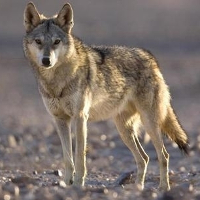
Egyptian wolf

He is a wild animal

Origin
North Africa
Translation
Francis Vandersteen
The possession of this animal is not authorized Royal Decree establishing the list of mammals not kept for production purposes that may be kept (M.B. 24.08.2009)
W.F. Hemprich and C.G. Ehrenberg first recognized the Egyptian wolf's similarity to Canis lupus in 1833. Consequently, it was given the name Canis lupaster. As early as 1880, biologist Thomas Huxley declared that the Egyptian wolf bore an uncanny resemblance to a gray wolf. It was recently classified as a subspecies of the Golden Jackal Canis aureus lupaster in 1926 by Ernst Schwarz.

Fairly recent studies of this Egyptian wolf have shown morphological differences from other subspecies and characteristics that bring it closer to the Canis lupus species. However, because study data were so scarce, the conclusion was to retain the Egyptian wolf as a subspecies of Canis aureus. If it were ever a subspecies of Canis lupus, it would be the only known grey wolf in Africa.

Canis aureus lupaster, also known as Egyptian wolves, are found only in northern Egypt, the Ethiopian highlands and northeastern Libya. They may still be found in Saudi Arabia, but hunting has considerably reduced their numbers.

Appearing large, the Egyptian wolf measures 1.30 to 1.63 m in length from tip of nose to tip of tail, stands 40 to 51 cm at shoulder height and weighs 10 to 16 kg. It is rather slender, with a coat that is generally tinged with gray, beige or dirty yellow. It is often described as gangly and may appear heavier than its actual weight. It is larger and longer than other wolf subspecies, although smaller than the Arabian wolf.

These wolves are generally nocturnal. Like other wolves, they usually bark when excited or growl when irritated. They usually howl or yell at each other just after dark and just before sunrise. They will give an occasional bark. They are very sociable and usually live in packs or, more often, pairs.

The Egyptian wolf is an omnivorous creature, feeding on insects, snails, fish, chickens, young goats, sheep, birds and carrion, as well as melons and corn.

Mating takes place in early spring, with a gestation period of around two months. They will usually have around four or five puppies. However, they have recorded up to eight.

It was classified as critically endangered by the International Union for Conservation of Nature. Then suddenly in January 2011, it was no longer listed anywhere by the IUCN. There are perhaps no more than forty in the world.

Comments

Latest page updates

  • Telomian

    Telomian He is not recognized by the F.C.I. Origin Malaysia Translation Francis Vandersteen A brief presentation of the Telomian The Telomian is a very rare breed of dog, and the only one native to Malaysia to have been bred outside the country. They were originally bred by the indigenous people of Malaysia to combat parasites such as snakes, rats,...
  • King Wheaten -- Cavalier King Charles Spaniel X Irish Soft Coated Wheaten Terrier

    King Wheaten He is not recognized by the F.C.I. Origin Great Britain <> Ireland -> U.S.A. Translation Francis Vandersteen A brief presentation of the King Wheaten The King Wheaten is a small dog with a heart this big and a playful disposition. Borrowing the energy and soft-coated waves of the Irish Soft Coated Wheaten Terrier and the size and...
  • Spanierd -- English Springer Spaniel X German Shepherd

    Spanierd He is not recognized by the F.C.I. Origin Great Britain <> Germany -> U.S.A. Translation Francis Vandersteen A brief presentation of the Spanierd The Spanierd is a hybrid dog. Its parent breeds are the English Springer Spaniel and the German Shepherd. They have an affable personality. He's known for entertaining family and friends with his...
  • Alaskan Goldenmute -- Alaskan Malamute X Golden Retriever

    Alaskan Goldenmute He is not recognized by the F.C.I. Origin U.S.A. <> Great Britain -> U.S.A. Translation Francis Vandersteen This breed is also known as Alaskan GoldenGoldenmuteAlaskan Gold Retriever     A brief presentation of the Alaskan Goldenmute The Alaskan Goldenmute is a descendant of two great dog breeds: the Alaskan Malamute and the Golden...
  • French pointing dog Pyrenean type

    French pointing dog Pyrenean type FCI standard Nº 134 Origin France Translation Mrs. Peggy Davis Group Group 7 Pointing Dogs Section Section 1.1 Continental Pointing Dogs « Braque » Type Working With working trial Acceptance on a definitive basis by the FCI Tuesday 18 January 1955 Publication of the official valid standard Tuesday 01 August 2023 Last...
  • French pointing dog Gascogne type

    French pointing dog Gascogne type FCI standard Nº 133 Origin France Translation Mrs. Peggy Davis Group Group 7 Pointing Dogs Section Section 1.1 Continental Pointing Dogs « Braque » Type Working With working trial Acceptance on a definitive basis by the FCI Monday 17 January 1955 Publication of the official valid standard Tuesday 01 August 2023 Last...
  • Vucciriscu

    Vucciriscu He is not recognized by the F.C.I. Origin Sicily Translation Francis Vandersteen En français, cette race se dit Vucciriscu Diese Norm ist in deutscher Sprache sichtbar Vucciriscu En español, esta raza se dice Vucciriscu In het Nederlands, wordt dit ras gezegd Vucciriscu This breed is also known as Sicilian Vucciriscu Sicilian Butcher...

© 2026 Groupe Milouchouchou ASBL. Tous droits réservés. En savoir plus

Protected by Copyright01
We use cookies

We use cookies on our website. Some of them are essential for the operation of the site, while others help us to improve this site and the user experience (tracking cookies). You can decide for yourself whether you want to allow cookies or not. Please note that if you reject them, you may not be able to use all the functionalities of the site.

Ok

