Maned wolf

He is a wild animal

Origin
South America
Translation
Francis Vandersteen
The possession of this animal is not authorized Royal Decree establishing the list of mammals not kept for production purposes that may be kept (M.B. 24.08.2009)
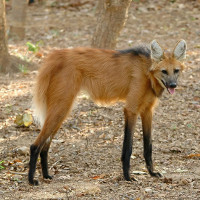
The maned wolf (Chrysocyon brachyurus) is a species of carnivore in the Canidae family, native to South America. It is the only representative of its genus : Chrysocyon. Although resembling a wolf or a large fox, the maned wolf is genetically distinct from all other canids.

The maned wolf owes its name above all to the presence of a long, abundant black fleece on its neck and shoulders. Its wolf-like appearance, although it can also resemble a long-legged fox, lends credence to this appellation. The tail is relatively short, the ears are erect, and the coat is softer in texture than that of other canids, with no undercoat. The maned wolf's long, slender legs are adapted to its habitat, which consists mainly of tall grass: the cerrado. Despite its appearance, it is not a fast runner. But its large ears enable it to detect the small prey it feeds on.

The maned wolf is omnivorous and an opportunistic hunter, attacking prey ranging from small vertebrates to paca. Its most common prey are rabbits, small rodents, birds and armadillos, and more rarely reptiles, insects and even fish. It also eats a lot of fruit (up to half its diet), including the "wolf fruit" (fruit of Solanum lycocarpum, otherwise known as the "tomato-like fruit of Lobeira"). This fruit is said to have anti-parasitic properties against the giant kidney worm, Dioctophyme renate. The maned wolf forages alone, mainly at night. It may also do so during the day, in areas away from humans.

Maned wolves generally reproduce from the age of 2, although they can reach sexual maturity in their first year. Females have one litter a year, between June and September. Maned wolves make their homes in dens with sufficient cover. The role of males in raising young in free-living individuals is unknown, but in captivity, they have been known to regurgitate feed. Pairs appear to be monogamous, living in territories of around 30 km2, according to a study of two pairs.

Comments

Latest page updates

  • Telomian

    Telomian He is not recognized by the F.C.I. Origin Malaysia Translation Francis Vandersteen A brief presentation of the Telomian The Telomian is a very rare breed of dog, and the only one native to Malaysia to have been bred outside the country. They were originally bred by the indigenous people of Malaysia to combat parasites such as snakes, rats,...
  • King Wheaten -- Cavalier King Charles Spaniel X Irish Soft Coated Wheaten Terrier

    King Wheaten He is not recognized by the F.C.I. Origin Great Britain <> Ireland -> U.S.A. Translation Francis Vandersteen A brief presentation of the King Wheaten The King Wheaten is a small dog with a heart this big and a playful disposition. Borrowing the energy and soft-coated waves of the Irish Soft Coated Wheaten Terrier and the size and...
  • Spanierd -- English Springer Spaniel X German Shepherd

    Spanierd He is not recognized by the F.C.I. Origin Great Britain <> Germany -> U.S.A. Translation Francis Vandersteen A brief presentation of the Spanierd The Spanierd is a hybrid dog. Its parent breeds are the English Springer Spaniel and the German Shepherd. They have an affable personality. He's known for entertaining family and friends with his...
  • Alaskan Goldenmute -- Alaskan Malamute X Golden Retriever

    Alaskan Goldenmute He is not recognized by the F.C.I. Origin U.S.A. <> Great Britain -> U.S.A. Translation Francis Vandersteen This breed is also known as Alaskan GoldenGoldenmuteAlaskan Gold Retriever     A brief presentation of the Alaskan Goldenmute The Alaskan Goldenmute is a descendant of two great dog breeds: the Alaskan Malamute and the Golden...
  • French pointing dog Pyrenean type

    French pointing dog Pyrenean type FCI standard Nº 134 Origin France Translation Mrs. Peggy Davis Group Group 7 Pointing Dogs Section Section 1.1 Continental Pointing Dogs « Braque » Type Working With working trial Acceptance on a definitive basis by the FCI Tuesday 18 January 1955 Publication of the official valid standard Tuesday 01 August 2023 Last...
  • French pointing dog Gascogne type

    French pointing dog Gascogne type FCI standard Nº 133 Origin France Translation Mrs. Peggy Davis Group Group 7 Pointing Dogs Section Section 1.1 Continental Pointing Dogs « Braque » Type Working With working trial Acceptance on a definitive basis by the FCI Monday 17 January 1955 Publication of the official valid standard Tuesday 01 August 2023 Last...
  • Vucciriscu

    Vucciriscu He is not recognized by the F.C.I. Origin Sicily Translation Francis Vandersteen En français, cette race se dit Vucciriscu Diese Norm ist in deutscher Sprache sichtbar Vucciriscu En español, esta raza se dice Vucciriscu In het Nederlands, wordt dit ras gezegd Vucciriscu This breed is also known as Sicilian Vucciriscu Sicilian Butcher...

© 2026 Groupe Milouchouchou ASBL. Tous droits réservés. En savoir plus

Protected by Copyright01
We use cookies

We use cookies on our website. Some of them are essential for the operation of the site, while others help us to improve this site and the user experience (tracking cookies). You can decide for yourself whether you want to allow cookies or not. Please note that if you reject them, you may not be able to use all the functionalities of the site.

Ok

