Mongolian wolf

He is a wild animal

Origin
Mongolia
Translation
Francis Vandersteen
The possession of this animal is not authorized Royal Decree establishing the list of mammals not kept for production purposes that may be kept (M.B. 24.08.2009)
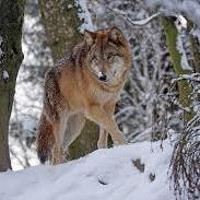
The Mongolian wolf (Canis lupus chanco) is a subspecies of the gray wolf, native to Mongolia, northern and central China, Korea, and the Ussuri region of Russia.

The Mongolian wolf is a carnivorous animal. When in a pack, it can attack very large prey such as goitered gazelles, elaphe deer or sheep, but generally only weak, sick or wounded individuals. It is equally content with small prey such as chipmunks, pikas or marmots.

The Mongolian wolf's range includes Mongolia1 , northern and central China, Korea, and the Ussuri region of Russia, from where they have colonized northern China more recently, due to human settlement and the retreat of their tiger competitors. Their range is limited to the east by the Altai/Tien Shan mountains, beyond which Mongolian wolves are found, and to the south by the Tibetan plateau, and in southern China by another wolf species.

In Mongolia, the wolf is considered an animal spirit, while the dog is considered a family member. Mongolians are not afraid of the wolf and understand that it is afraid of man. He is sometimes called the sheep murderer. According to legend, the first father of Mongolian herders was a wolf, from whom they are all descended, and yet it is necessary for them to kill wolves to protect their flocks of sheep. Some Mongolian herders acknowledge that wolves only kill weak animals, thus preserving the health of their flocks. In the traditions of the nomadic Mongols, they call the wolf the sheep's doctor.

The fur is tawny, longer on the back, stiff, with a mixture of black and grey hairs, the throat, chest, belly and inside of the legs are pure white, the head is pale grey-brown, the forehead greying with short black and grey hairs. The skull is very similar, and has the same dentition as the European wolf (C. lupus). The animal is very similar to the common wolf, but shorter-legged, with short tawny hairs on the ears, flanks and outside of the limbs. Head and body length are 110 cm, tail 38 cm.

Comments

Latest page updates

  • Telomian

    Telomian He is not recognized by the F.C.I. Origin Malaysia Translation Francis Vandersteen A brief presentation of the Telomian The Telomian is a very rare breed of dog, and the only one native to Malaysia to have been bred outside the country. They were originally bred by the indigenous people of Malaysia to combat parasites such as snakes, rats,...
  • King Wheaten -- Cavalier King Charles Spaniel X Irish Soft Coated Wheaten Terrier

    King Wheaten He is not recognized by the F.C.I. Origin Great Britain <> Ireland -> U.S.A. Translation Francis Vandersteen A brief presentation of the King Wheaten The King Wheaten is a small dog with a heart this big and a playful disposition. Borrowing the energy and soft-coated waves of the Irish Soft Coated Wheaten Terrier and the size and...
  • Spanierd -- English Springer Spaniel X German Shepherd

    Spanierd He is not recognized by the F.C.I. Origin Great Britain <> Germany -> U.S.A. Translation Francis Vandersteen A brief presentation of the Spanierd The Spanierd is a hybrid dog. Its parent breeds are the English Springer Spaniel and the German Shepherd. They have an affable personality. He's known for entertaining family and friends with his...
  • Alaskan Goldenmute -- Alaskan Malamute X Golden Retriever

    Alaskan Goldenmute He is not recognized by the F.C.I. Origin U.S.A. <> Great Britain -> U.S.A. Translation Francis Vandersteen This breed is also known as Alaskan GoldenGoldenmuteAlaskan Gold Retriever     A brief presentation of the Alaskan Goldenmute The Alaskan Goldenmute is a descendant of two great dog breeds: the Alaskan Malamute and the Golden...
  • French pointing dog Pyrenean type

    French pointing dog Pyrenean type FCI standard Nº 134 Origin France Translation Mrs. Peggy Davis Group Group 7 Pointing Dogs Section Section 1.1 Continental Pointing Dogs « Braque » Type Working With working trial Acceptance on a definitive basis by the FCI Tuesday 18 January 1955 Publication of the official valid standard Tuesday 01 August 2023 Last...
  • French pointing dog Gascogne type

    French pointing dog Gascogne type FCI standard Nº 133 Origin France Translation Mrs. Peggy Davis Group Group 7 Pointing Dogs Section Section 1.1 Continental Pointing Dogs « Braque » Type Working With working trial Acceptance on a definitive basis by the FCI Monday 17 January 1955 Publication of the official valid standard Tuesday 01 August 2023 Last...
  • Vucciriscu

    Vucciriscu He is not recognized by the F.C.I. Origin Sicily Translation Francis Vandersteen En français, cette race se dit Vucciriscu Diese Norm ist in deutscher Sprache sichtbar Vucciriscu En español, esta raza se dice Vucciriscu In het Nederlands, wordt dit ras gezegd Vucciriscu This breed is also known as Sicilian Vucciriscu Sicilian Butcher...

© 2026 Groupe Milouchouchou ASBL. Tous droits réservés. En savoir plus

Protected by Copyright01
We use cookies

We use cookies on our website. Some of them are essential for the operation of the site, while others help us to improve this site and the user experience (tracking cookies). You can decide for yourself whether you want to allow cookies or not. Please note that if you reject them, you may not be able to use all the functionalities of the site.

Ok

