 |
Red wolf |
|
He is a wild animal |
Origin |
U.S.A. | |
Translation |
Francis Vandersteen |
| The possession of this animal is not authorized |
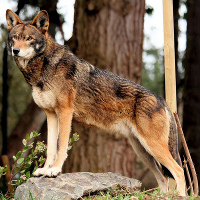
| The red wolf Canis lupus rufus is the only surviving wolf to have evolved in North America. It was identified in 1851 by naturalists John Audubon and John Bachman as the species Canis rufus, distinct from the gray wolf Canis lupus. However, there is a current dispute among biologists as to whether the red wolf is a true species or a hybrid caused by the cross-breeding of coyotes and gray wolves. In defense of the red wolf's right to claim its own species, although early specimens suggest that it began interbreeding with the coyote Canis latrans around 1900, there is no evidence that the red wolf is a hybrid of the gray wolf and the coyote. A common belief is that the coyote, gray wolf and wolves of eastern North America are all descended from a prehistoric ancestor, the Pleistocene Canis edwardii. Eastern North American wolves are then thought to have evolved into today's wolf and the red wolf. However, with all this, the red wolf was recently classified in 2005 as a subspecies of the grey wolf Canis lupus rufus. In addition, Canis edwardii is most recently considered to have evolved into Canis armbrusteri. Red wolves were once found throughout the southeastern USA, from the Atlantic coast to central Texas and from the Gulf coast to central Missouri and southern Illinois. It may have occurred as far north as Maine. The natural habitat of the red wolf could vary from 65 to 130 square kilometers. Any land that provides food, water and abundant vegetation would be a viable habitat for red wolves. Red wolves are smaller than gray wolves, with thinner, elongated heads and shorter, coarser fur. Compared to the coyote, they are taller and more robust, with longer legs and larger ears. Red wolf measurements range from 38 to 41 cm in shoulder height, 1.40 to 1.65 m in length (nose to end of tail), weighing between 18 and 41 kg. Its color is generally predominantly brown, with mixed colors ranging from cinnamon red to almost black. Light markings above the eyes are also common. Red wolves are known to hunt mainly at dusk and/or dawn. They feed mainly on small and medium-sized animals such as grouse, raccoons, rabbits, hares, rodents, carrion and domestic livestock. They also feed on young white-tailed deer when available. Apart from prairie chickens, red wolves rarely feed on birds. Mating season is in February and March, and gestation lasts around 60 days. By April or May, an average of 3 to 6 pups are born. They generally stay with the pack for 15 to 20 months, reaching sexual maturity at around 22 months. Mother and father usually mate for life, and both are involved in raising their offspring. The direct family is usually what makes up the pack. Their dens are formed around dense vegetation, a river bank, an empty tree stump or another creature's abandoned den. Between 1900 and 1920, red wolves were wiped out from most of their range by means of predator control programs using poison, as well as heavy hunting and trapping. In 1980, the Canis rufus that inhabited most of the southeastern USA was declared extinct in the wild. 40 red wolves were captured in the late 1970s, of which 14 were found to be genetically pure and used for captive breeding. Since 1987, hundreds of red wolves have been reintroduced into the wild. However, they are still perceived as undesirable intruders by some people and are hunted down. What's more, the threat of hybridization with the Coyote still exists. |



 English (United Kingdom)

Comments