
 |
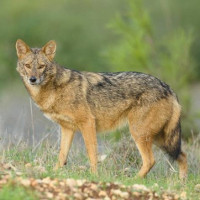
African golden wolf |
|
He is a wild animal |
Origin |
North Africa | |
Translation |
Francis Vandersteen |
| The possession of this animal is not authorized |
| The African golden wolf (Canis anthus), also known as the golden wolf or African wolf, is a native canid of northern and northeastern Africa. The species is common in north-west and north-east Africa, from Senegal to Egypt in the east, in a range including Morocco, Algeria, Tunisia and Libya in the north to Nigeria, Chad and Tanzania in the south. It is a desert-adapted canid, and is common in plains and steppe areas, including those lacking abundant water. In the Atlas Mountains, the species has been spotted at altitudes of up to 1,800 meters. It is primarily a predator, targeting invertebrates and mammals as large as gazelle fawns, although larger animals are occasionally captured. Other foodstuffs include animal carcasses, human waste and fruit. The African wolf is a monogamous, territorial animal, whose social structure includes yearling offspring who stay with the family to help raise their parents' youngest pups. It has previously been classified as an African variant of the Eurasian golden jackal, with at least one subspecies (Canis anthus lupaster) having been classified as a gray wolf. In 2015, a series of analyses of the species' mitochondrial DNA and nuclear genome demonstrated that it was in fact distinct from both the golden jackal and the gray wolf, and more closely related to gray wolves and coyotes. Nevertheless, it is still close enough to the golden jackal to produce hybrid offspring, as indicated by genetic tests on jackals in Israel and a 19th-century captive cross-breeding experiment. As the IUCN golden jackal page has not been updated since 2008, it has not yet recognized the distinctiveness of the African wolf, so its conservation status has not been assessed and no reliable population estimates are available. It plays an important role in some African cultures; in Maghrebian and Egyptian folklore, it is considered an unworthy animal whose body parts can be used for medicinal or ritual purposes, while it is held in high esteem in the Serer religion of Senegal as the first creature to be created by the god Roog. The African wolf is intermediate in size between the African jackals (C. mesomelas and C. adustus) and the smaller subspecies of gray wolf, with both sexes weighing between 7 and 15 kg and measuring 40 cm in height. There is, however, a high degree of variation in size geographically, with specimens from West and North Africa being larger than their East African cousins. It has a relatively long snout and ears, while the tail is relatively short, measuring 20 cm in length. Fur color varies individually, seasonally and geographically, although the typical coloration is yellowish to silvery-gray, with slightly reddish limbs and black spots on the tail and shoulders. Markings on the throat, abdomen and face are usually white, and the eyes are amber. Females have two to four pairs of teats. Although superficially similar to the Eurasian golden jackal (especially in East Africa), the African golden wolf has a more pointed muzzle and sharper, stronger teeth. The ears are longer in the African wolf, and the skull has a higher forehead. In West Africa, the African wolf is mainly restricted to small prey, such as hares, rats, gophers and cane rats. Other prey includes lizards, snakes and ground-nesting birds such as francolins and bustards. It also consumes large quantities of insects, including dung beetles, larvae, termites and grasshoppers. It will also kill young gazelles, duikers and warthogs. In East Africa, it consumes invertebrates and fruit, although 60% of its diet consists of rodents, lizards, snakes, birds, hares and Thomson's gazelle. During the wildebeest calving season, African wolves feed almost exclusively on their placentaaa. In the Serengeti and Ngorongoro Craters, less than 20% of their diet comes from trapping. In Senegal, where both C. a. anthus and C. a. lupaster coexist, a degree of niche segregation is apparent in their choice of prey; the former is reputed to feed mainly on lambs, while the latter preys on larger prey, such as sheep, goats and cattle. |



 English (United Kingdom)

Comments