
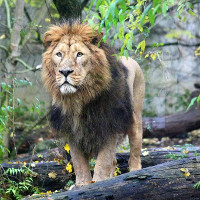
 |
Asiatic lion |
|
He is a wild animal |
Origin |
India | |
Translation |
Francis Vandersteen |
| The possession of this animal is not authorized |
| The Asiatic lion is a subspecies of lion. Its natural habitat once extended across the Indian subcontinent, and it could be found from Syria to eastern India. Due to hunting and habitat destruction, it had virtually disappeared from the continent by the 20th century. The last wild specimens, around 500, are found in India, in the Gir forest and in the southern parts of the Saurashtra peninsula. A number of zoos are home to a few individuals. Asiatic lions are found exclusively in Gir National Park and Wildlife Sanctuary, in the Indian state of Gujarat. Their original range extended from Greece to northern North Africa, covering the Middle East to India. The Greek historian Herodotus (VII, 125-126) states that lions in Europe live exclusively in the mountains of northern continental Greece. To illustrate this point, he recounts that in 480 BC, during the Median Wars, camels belonging to Xerxes' caravan were attacked by lions in Macedonia, although these lions did not attack humans or horses. Over time, the limits of the Asiatic lion's territory were gradually pushed back: it became extinct in Greece as early as the 1st century BC, in Palestine in the 13th century, in Pakistan in 1842 and survived until the 20th century (around 1914) in Iraq and Iran, where it was spotted in 1942. In Persia, it disappeared in 1941. At the end of the 19th century, only around a hundred lions were counted in the Gir forest, whereas in 1857 a British officer boasted of killing up to three hundred lions in the Delhi region. In 1974, 200 individuals were counted in the Gir reserve. For several decades now, there has been a sizeable population residing outside Gir, throughout the southern Kathiawar peninsula, and these lions now make up over 40% of the wild population. There is little difference between the Asiatic lion and the African lion. The mane of the Asiatic lion is less bushy than that of its African counterpart, and the ears are often uncovered rather than buried in the hair. Another point of differentiation is a pocket of skin (a gusset) extending under the belly to the hind legs, which the African lion rarely develops. The Asiatic lion generally has a thicker coat and a longer tuft of hair at the tip of the tail. Asiatic lion skulls also feature double foramens. The average male Asiatic lion measures 1.9 meters long, weighs 150-180 kg (120 to 160 kg for a female) (head and body) and has a tail of around 80 centimeters. The Asiatic lion is a territorial predator, living in small herds. Unlike the African lion, the herd is small: two to six males defend a territory occupied by several groups of females. Territory size is 100 to 200 km2 for males and 50 to 100 km2 for females. Males and females associate only during mating season or when hunting big game. The Asiatic lion's prey consists of deer, such as Sambar and Chital, and sometimes cattle. A study carried out in 1993 showed that the diet of Gir lions is made up of 43% Chitals, 14.8% Sambar and over 35% cattle. Asiatic lions are not considered to be man-eaters. |



 English (United Kingdom)

Comments