
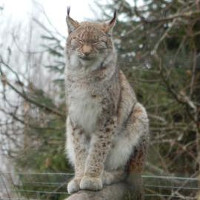
Siberian lynx

He is a wild animal

Origin
Siberia
Translation
Francis Vandersteen
The possession of this animal is not authorized Royal Decree establishing the list of mammals not kept for production purposes that may be kept (M.B. 24.08.2009)
The Siberian lynx is a medium-sized predator, measuring 75 cm at the withers and weighing between 15 and 30 kg. Its large footprints can be mistaken for those of the forest cat. This animal is easily recognized by the 3 cm brushes of hair on its ears. It also has a short tail, which allows it to lose less heat during harsh winters. Fur color is highly variable, ranging from creamy white to dark brown, with more or less black spots on the body.

The species lives in eastern Siberia, a very cold region of Russia. The Lynx prefers forested areas with dense, overgrown undergrowth. It is most frequently found in boreal and temperate forests, but can also adapt to steppe and rocky areas.

The lynx is territorial. The male's territory overlaps that of one or more females. He is intolerant of other males crossing his territory, but it is the females who are the most vindictive among themselves. There are, however, "neutral zones" where it is possible to move around without confrontation, often at the limits of the territory. The size of the territory varies from 11 to 300 km², depending on the abundance of prey.

The Siberian lynx is a true specialist in hunting medium-sized game. It is a carnivore, feeding on birds and rodents, as well as deer and chamois.

In Western Europe, roe deer is the lynx's favorite prey, complemented in the mountains (Jura, Alps, Vosges) by chamois. Other possible prey includes young deer, deer fawns, ewes, brown hares, mountain hares, foxes, cats (forest or domestic), marmots and birds. It takes its prey to cover. It generally starts with the hind parts (the "legs"). If left undisturbed, it will consume the entire prey (excluding skin, large bones, head and abdominal viscera) for several days in a row, from early at night until morning. In the meantime, it often covers the animal with moss, grass, leaves, snow, etc. Sheep or goats are generally left at the hunting site.

Finally, unlike other large predators such as wolves and bears, lynxes are not scavengers.

An adult lynx generally requires between 1.5 and 3 kg of meat per day, with variations.

Comments

Latest page updates

  • Telomian

    Telomian He is not recognized by the F.C.I. Origin Malaysia Translation Francis Vandersteen A brief presentation of the Telomian The Telomian is a very rare breed of dog, and the only one native to Malaysia to have been bred outside the country. They were originally bred by the indigenous people of Malaysia to combat parasites such as snakes, rats,...
  • King Wheaten -- Cavalier King Charles Spaniel X Irish Soft Coated Wheaten Terrier

    King Wheaten He is not recognized by the F.C.I. Origin Great Britain <> Ireland -> U.S.A. Translation Francis Vandersteen A brief presentation of the King Wheaten The King Wheaten is a small dog with a heart this big and a playful disposition. Borrowing the energy and soft-coated waves of the Irish Soft Coated Wheaten Terrier and the size and...
  • Spanierd -- English Springer Spaniel X German Shepherd

    Spanierd He is not recognized by the F.C.I. Origin Great Britain <> Germany -> U.S.A. Translation Francis Vandersteen A brief presentation of the Spanierd The Spanierd is a hybrid dog. Its parent breeds are the English Springer Spaniel and the German Shepherd. They have an affable personality. He's known for entertaining family and friends with his...
  • Alaskan Goldenmute -- Alaskan Malamute X Golden Retriever

    Alaskan Goldenmute He is not recognized by the F.C.I. Origin U.S.A. <> Great Britain -> U.S.A. Translation Francis Vandersteen This breed is also known as Alaskan GoldenGoldenmuteAlaskan Gold Retriever     A brief presentation of the Alaskan Goldenmute The Alaskan Goldenmute is a descendant of two great dog breeds: the Alaskan Malamute and the Golden...
  • French pointing dog Pyrenean type

    French pointing dog Pyrenean type FCI standard Nº 134 Origin France Translation Mrs. Peggy Davis Group Group 7 Pointing Dogs Section Section 1.1 Continental Pointing Dogs « Braque » Type Working With working trial Acceptance on a definitive basis by the FCI Tuesday 18 January 1955 Publication of the official valid standard Tuesday 01 August 2023 Last...
  • French pointing dog Gascogne type

    French pointing dog Gascogne type FCI standard Nº 133 Origin France Translation Mrs. Peggy Davis Group Group 7 Pointing Dogs Section Section 1.1 Continental Pointing Dogs « Braque » Type Working With working trial Acceptance on a definitive basis by the FCI Monday 17 January 1955 Publication of the official valid standard Tuesday 01 August 2023 Last...
  • Vucciriscu

    Vucciriscu He is not recognized by the F.C.I. Origin Sicily Translation Francis Vandersteen En français, cette race se dit Vucciriscu Diese Norm ist in deutscher Sprache sichtbar Vucciriscu En español, esta raza se dice Vucciriscu In het Nederlands, wordt dit ras gezegd Vucciriscu This breed is also known as Sicilian Vucciriscu Sicilian Butcher...

© 2026 Groupe Milouchouchou ASBL. Tous droits réservés. En savoir plus

Protected by Copyright01
We use cookies

We use cookies on our website. Some of them are essential for the operation of the site, while others help us to improve this site and the user experience (tracking cookies). You can decide for yourself whether you want to allow cookies or not. Please note that if you reject them, you may not be able to use all the functionalities of the site.

Ok

