
 |
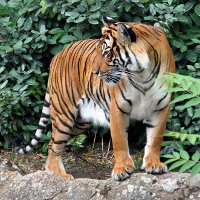
Indochinese tiger |
|
He is a wild animal |
Origin |
Southeast Asia | |
Translation |
Francis Vandersteen |
| The possession of this animal is not authorized |
| The Indochinese tiger is a subspecies of tiger that lives in Burma, Thailand, Laos, Cambodia, Vietnam and southwest China, and has been classified as endangered by the International Union for Conservation of Nature. Little is known about its status, but its recent decline is a cause for great concern. The tigers of Peninsular Malaysia, once considered Indochinese tigers, have recently been recognized as a distinct subspecies, the Malayan tiger. No Indochinese tigers have been officially sighted in China since 2007; it seems that the last specimen there was killed and eaten by a man who was sentenced in 2009 to twelve years in prison for committing the crime. Males measure between 2.55 and 2.85 meters in length (averaging around 2.74) and weigh between 150 and 195 kilograms (averaging around 181). Their skulls measure 31.9 to 36.5 centimetres in length. The largest individuals can weigh up to 227 kilograms. Females measure 2.30 to 2.55 meters long and weigh 100 to 130 kilograms. Their skulls are 27.5 to 31.1 centimetres long. Their average length is 2.44 meters, and their average weight is 115 kilograms. Indochinese tigers live in remote forests in hilly or mountainous terrain, most of which lies along national borders. Access to these areas is frequently restricted, and biologists have recently been granted limited permits to carry out field studies. For this reason, relatively little is known about the situation of these big cats in their natural environment. Females give birth to litters of two or three tigrons. Indochinese tigers mainly hunt large and medium-sized wild ungulates. Sambar, wild pig, saro and large cattle such as banteng and young gaur make up the bulk of their diet. However, in much of Southeast Asia, illegal hunting has seriously depopulated large animal populations, leading to the so-called "empty forest syndrome": an apparently untouched forest where most of the fauna has been eliminated. Some species, such as the kouprey and Schomburgk deer, are extinct, and the Eld deer, hog deer and water buffalo are mere relics. In such habitats, tigers are forced to live on small prey, such as muntjac, porcupine, macaque and balisaur. But small prey is not enough to sustain a large carnivore like the tiger, and this complicates its reproduction. Along with the poaching of tigers for traditional Chinese medicine, this is the main factor behind the decline of the Indochinese tiger throughout its range. According to government estimates of national tiger populations, there are around 350 individuals of this subspecies left in total. More than half the population is found in Thailand's western forest complex, more specifically in the Huai Kha Khaeng Wildlife Sanctuary. All existing populations are seriously threatened by poaching, prey depletion due to deer and feral pig poaching, landscape fragmentation and inbreeding. In 2009, China's last known Indochinese tiger was killed and eaten by residents of the Xian village of Mengla. In Vietnam, almost three-quarters of the tigers killed were used to supply Chinese pharmacies. Poverty-stricken villagers see the tiger as a financial resource. It will be difficult to increase the number of tigers as long as local people do not consider that a tiger is more valuable alive than dead. Some are beginning to realize this and hope to use the tiger to develop ecotourism. |



 English (United Kingdom)

Comments