
 |
Iriomote Cat |
|
He is a wild animal |
Origin |
Japan | |
Translation |
Francis Vandersteen |
| The possession of this animal is not authorized |
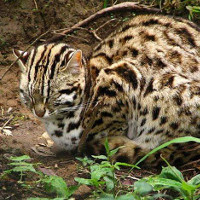
| The Iriomote Cat is a subspecies of Leopard Cat, endemic to the island of Iriomote in Japan's Okinawa prefecture. The male measures between 55 and 60 cm in length and weighs between 3.7 and 4.7 kg. The smaller female measures between 50 and 55 cm long and weighs between 2.9 and 3.5 kg. The tail measures 25 to 30 cm. The height at the withers is 25 to 30 cm. Footprints are 29 to 37 mm apart, compared with 24 to 30 mm for the domestic cat. Slightly heavier and larger than the domestic cat, the Iriomote has a proportionally longer body, with short, thick legs and tail. The neck is broad, and the shoulder muscles are fairly well developed, although jumping ability is relatively limited. The spine is less flexible than that of other felines. In the Iriomote Cat, the anal glands surround the anus, unlike other feline species in which the glands are located inside the anus. The coat of the Iriomote Cat is dark brown with very small, inconspicuous spots organized in horizontal bands of black or dark brown that tend to merge into indistinct stripes. The coat is longer than that of other Leopard Cats. Irregular stripes are present on the chest. The upper part of the tail is dark brown with dark spots and the lower part is plain white, with a dark, ringed tip. The hair on the belly and back of the legs is slightly lighter. The hair around the jaw is white, and two white lines run up the nose to emphasize the eyes. Like the Leopard Cat, five to seven stripes extend from the forehead to the back of the head, but in the case of the Iriomote Cat they stop before reaching the shoulders. The tips of the ears are rounded and edged with black hairs that do not form ear brushes. Adults have a white patch on the back of each ear. Kittens do not have these spots, and even on adults, the spots are not as white as those of the Leopard Cat. The Iriomote's eyes are light amber. The nose is broad and flat, with a reddish-brown tip devoid of hair. The skull, longer and narrower than that of a domestic cat, is the same size as that of a Leopard Cat, albeit thicker. For this reason, its brain is smaller: around 30 g for a male Iriomote Cat, compared with around 42 g for a Leopard Cat. The mandibular symphysis is short. The Iriomote Cat has just twenty-eight teeth: compared with other feline species, it lacks a pair of premolars behind the canines in the upper jaw. However, this absence is also found in the Leopard Cat, with 40% of individuals living north of the Himalayas and 11% south of the Himalayas missing a premolar. These teeth help to determine the age of a specimen and the feeding behavior of Iriomote Cats. The Iriomote Cat lives on the ground, but climbs trees and can also swim across rivers. This crepuscular, nocturnal animal is especially active around sunset. During the day, it sleeps in hollow trees, in caves or on branches. It can be especially active during the day, notably hunting the skink Plestiodon kishinouyei. Females rearing young are most active late at night and in the morning. The Iriomote Cat is a strict carnivore for which 95 different prey items have been recorded. With no competition from other predators, the cat's diet is varied. It typically consumes between 400 and 600 g of food per day. Unlike other felines, the Iriomote Cat does not kill its prey immediately by breaking the spinal cord, but holds the animal between its jaws until it stops moving. The Iriomote Cat hunts small mammals such as the Black Rat and Formosa Dogfish, as well as numerous birds such as the Mottled Duck, Forest Rail, Pale Blackbird and White-breasted Flufftail. Reptiles include many types of snake and skinks such as Plestiodon kishinouyei. Frogs such as Fejervarya sakishimensis are occasionally taken as prey, as are insects, gerris and crabs. As their habitat is often marshland or the coast, they sometimes swim and dive to catch waterfowl, fish and freshwater shrimp. |



 English (United Kingdom)

Comments