
 |
American Bobtail |
|
TranslationFrancis Vandersteen |
||
OriginThe American Bobtail is a new breed of cat from the United States. |
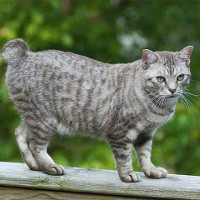
| This medium to large cat is characterized by its almost complete lack of tail. |
A brief historical overview |
| The breed was discovered in 1965 by an American couple, the Sanders, in the state of Arizona. The kitten had a wild look and a short, curled tail. They immediately decided to adopt him and named him Yodie. We crossed him with a Siamese. One of the kittens born of this litter was crossed with a cream cat, and it is the kittens born of this union that are the first subjects of the breed. At first, only shorthairs were available, but the breed was crossed with Persians to obtain a semi-longhair variety. The breed has been recognized by TICA since 1989. It is also recognized by the LOOF, but remains rare in Europe. |
General appearance |
| The American Bobtail must give the impression of an active, alert, athletic and well-proportioned cat, with a tail that is neither too long nor too short, which would affect its natural balance. The absence of a tail is due to a natural genetic mutation. Generally speaking, the Bobtail is a medium to large-sized cat that grows slowly, up to two or three years. |
Behavior / characteristics |
| Bobtails are reputed to be patient, active but gentle cats. They are said to be attached to their owners and dislike solitude. They generally get on well with dogs. They are also said to be good hunters. |
Head |
||
Cranial region |
||
Head |
The head is broad, with powerful jaws and no flat surface. | |
Facial region |
||
Nose |
Viewed from the side, the nose has a gentle curve between the eyes, but there may be a slight stop. | |
Muzzle |
The muzzle is as broad as it is long, with well-defined blocks. | |
Cheeks |
Full cheeks. | |
Eyes |
Large and wide, oval-shaped, set at an angle to the base of the ear. Color should be as uniform as possible. | |
Ears |
Medium-sized, broad at the base, wide open and set fairly low on the head. They are slightly rounded, with lynx tips at the tips. The inside is well furnished with abundant hair. | |
Neck |
| In proportion to the body, the neck appears short due to the strength of the musculature and density of the coat. |
Body |
||
Generality |
Semi-cobby in shape, the athletic, powerful body is slightly longer than it is tall. Males should be more strongly built, with broad shoulders and a muscular appearance. Females should also be muscular, while maintaining a feminine elegance. |
|
Back |
Straight back. | |
Chest |
Full chest and strong hips. | |
Side |
Broad flanks. | |
Tail |
| Naturally short and supple, between 2.5 and 10 cm long (without hair), never reaching beyond the hock. |
Limbs |
| Well proportioned to the body, the legs are heavily boned and muscular. | ||
Forequarters |
Hindquarters |
||
Generality |
Hindquarters are slightly longer than front legs. | |
Feet |
| Broad, round feet. |
Coat |
||
Coat and texture |
Shorthair: Medium-short, slightly shaggy coat with slightly longer hair on ruff, breeches, belly and tail. Seasonal variations are noticeable. Semi-longhair: Semi-long, dense, shaggy coat with lots of undercoat. It is most abundant on the ruff, breeches, belly and tail. Tufts of hair between the toes are desirable. Seasonal variations are permissible. Texture is dense and resilient in all seasons. |
|
Size and weight |
||
Height at withers |
Male height at withers: between 22 and 24 cm. Female height at withers: between 22 and 24 cm. |
|
Weight |
Average adult male weight: between 6 and 9 kg. Average adult female weight: between 5 and 8 kg. |
|
Tolerances |
 A straight tail is ideal, but it can be slightly knotted, kinked, curved or hooked at the tip, as long as it remains flexible. White medallions are tolerated. A straight tail is ideal, but it can be slightly knotted, kinked, curved or hooked at the tip, as long as it remains flexible. White medallions are tolerated. |
Penalties |
| Tail too long (extending beyond the point of the hock) or too short (less than 2,5 cm). Extremely short muzzle. Nose with too pronounced a stop. Thin bone structure. Coat flat or too silky. |
Refusal of any title |
| Absence of tail, tail of normal size, docked tail. General faults and defects eliminatory in show. |
Authorized marriages |
| American Bobtail Shorthair x American Bobtail Shorthair American Bobtail Longhair x American Bobtail Longhair American Bobtail shorthair x American Bobtail longhair |



 English (United Kingdom)

Comments