
 |
American Curl |
|
TranslationFrancis Vandersteen |
||
OriginThe American Curl is a cat breed originating in the United States. |
| "American curl" means "curly American", referring to the breed's origin (the U.S.A.) and the typical shape of the ears. |
A brief historical overview |
| The first specimen is a long-haired, black-coated, yellow-eyed cat called "Shulamith1". This young female naturally has ears that curve backwards. She was taken in by a Californian couple, Grace and Joe Ruga, in Lakewood in the summer of 1981. Another female, probably from the same litter, black and white, was also adopted by the Rugas: named Panda, she disappeared two weeks after adoption. When, on December 12, 1981, Shulamith gave birth to a litter of four kittens, two of which had curled ears, she attracted the attention of the Ruga couple. The hereditary nature of ear curvature gave them the opportunity to use their cats as founders of a new breed. Following the publication of an article on the Scottish fold in a local newspaper, the Ruga couple contacted Jean Grimm, a judge at Cat Fanciers' Association (CFA) cat shows. Although hesitant about creating a new breed, she recognized that Shulamith and her kittens were a novelty in the cat world. The help and knowledge provided by Jean Grimm was the first step towards recognition of the breed. On October 23, 19837, Shulamith and her kittens were presented by Nancy Kestrel, a friend of the couple, at a cat show in Palm Springs, where they met with great success. The standard was written with Shulamith's physical characteristics in mind, using the structure of the Abyssin, Egyptian Mau and Ocicat standards. To respect Shulamith's alley cat origins, only house cats resembling the american curl standard are used for crossbreeding. This decision has given the breed great genetic diversity. The first cross between two american curls took place in January 1984 and, in March 1984, the black and white female Playit By Ear became the first homozygous subject. In 1985, The International Cat Association (TICA) became the first federation to recognize the breed. It was provisionally accepted by the CFA in 19867 and in 1991, this federation in turn recognized the American Curl. Although the breed's founder was longhaired, shorthaired kittens appeared from the very first litter. The american curl was thus the first breed recognized by the CFA for two hair lengths. The breed was subsequently recognized by the Fédération Internationale Féline (FIFé) in 2002. The particular shape of the ear, which appears to be neither a disadvantage nor a source of pain for the cat, is sometimes seen as a malformation artificially maintained by breeders. As a result, the breed is widely appreciated in the breeding world. It is considered rare, not least because not all kittens are born with curved ears. In 1993, Desmond Morris estimated that there were fewer than 1,000 kittens in the world. In 1995, 223 births were registered by CFA, an increase of 23% on the previous year. This catapulted the American Curl to 25th place (out of 37) in the CFA's ranking of the most popular breeds. In 2014, it was ranked 27th (out of 43). In the 1990s, Christiane Sacase listed three main breeders in France. Between 2009 and 2013 in France, the longhaired american curl totaled 114 entries in the Livre officiel des origines félines (LOOF). 63 shorthairs were registered between 2003 and 2008, after which there were no further entries. The two varieties account for just 0.08% of LOOF pedigrees. In 2014, the American Curl is not recognized by the main British federation, the Governing Council of the Cat Fancy (GCCF). |
General appearance |
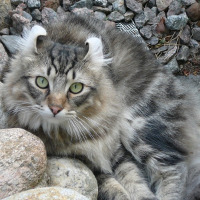
| The american curl is a medium-sized cat with a rectangular body. The head is described in the standards as triangular with rounded contours. The eyes are walnut-shaped. The ears are characteristic of the breed: they form an arc of 90° to 180° towards the back of the head. They are preferably crescent-shaped. All coats are accepted, medium-length and short. |
Behavior / characteristics |
| Character traits are not described in the breed standards, but remain entirely individual and depend on the history of each cat. Breed promoters consider that the American Curl "acts like a kitten all its life". Dr. Bruce Fogle describes the american curl as playful, curious and sociable, which he attributes to the breed's oriental origins. Christiane Sacase describes the American Curl as discreet, quiet, sociable with other animals, playful and well-balanced. Desmond Morris uses the following terms to describe the breed's character: smart, curious, placid, playful, lively, temperamental, friendly, affectionate, intelligent and thieving. |
Health |
| The American Curl is considered a breed of robust health and easy reproduction. The breed's great genetic diversity means it is free from genetic disease. Maturity is reached between two and three years of age. Coat maintenance is considered easy due to the low undercoat, with weekly brushing sufficient. For the semi-long-haired variety, it is advisable to detangle the coat every day with an iron comb and brush, especially during the moulting period. According to Christiane Sacase, it is quite demanding and requires a litter tray that is renewed frequently. Ears should be monitored and cleaned with a lotion-impregnated wipe; cotton buds are not recommended. |
Head |
||
Cranial region |
||
Head |
The medium-sized head is triangular, longer than it is wide, with no flat face. Viewed from the side, it curves gently from the skull to a rather straight nose. | |
Facial region |
||
Muzzle |
Seen from the front, the muzzle is a continuation of the head triangle, without pinch and with rounded contours. | |
Eyes |
Moderately large in proportion to the head, walnut-shaped (oval on top, round underneath). They are spaced about the width of an eye. All uniform eye colors are accepted, with the brightest and most brilliant preferred. | |
Ears |
Ears are an essential component of the breed. Curved over the head like two crescent moons, they form an arc of 90° minimum and 180° maximum towards the rear. The tip of the ear must not touch the skull. The ear should not curl so tightly that the tip touches the back of the ear. Moderately large, spaced about the width of an ear. Wide at the base, they are formed of rigid cartilage over at least a third of their length. The tips are flexible and rounded. Both ears should be symmetrically curved. Hair on the inside of the ears is desirable. The particular shape of the American Curl's ears should not prevent their natural movement when the cat is attentive or alert. |
|
Neck |
| Fairly long, the neck is slender and graceful. |
Body |
||
Generality |
Semi-foreign in shape, the body is elegant and rectangular. The length of the body is equal to one and a half times the height at the withers. The American Curl is a medium-sized cat, with males often taller than females. Muscles are long and toned. Bones are medium, neither heavy nor fine. |
|
Tail |
| Thick at the base, the tail is as long as the body. It should be flexible. |
Limbs |
| Of medium length in proportion to the body, the legs are well parallel to each other. Medium bone structure. | ||
Forequarters |
Hindquarters |
Feet |
| Medium-sized, round feet. |
Coat |
||
Coat and texture |
Shorthair: short, silky coat, lying close to the body, with little undercoat. The tail coat is as long as the body coat. Longhair: mid-length coat, fine texture, silky, close to the body. Minimal undercoat. The feathery tail should be relatively full. |
|
Size and weight |
||
Height at withers |
Male height at withers: 22-24 cm. Female height at withers: 22-24 cm. |
|
Weight |
Average adult male weight: between 3 and 5 kg. Average adult female weight: between 3 and 5 kg. |
|
Penalties |
 Ears set too low. Pinched ears. Wrinkled skin inside ear. Nose with a stop. Coat texture rough or woolly, abundant undercoat. Thick collar. Oriental or cobby body. Ears set too low. Pinched ears. Wrinkled skin inside ear. Nose with a stop. Coat texture rough or woolly, abundant undercoat. Thick collar. Oriental or cobby body. |
Refusal of any title |
| Extreme ear curvature in an adult cat where the tip of the ear touches the back of the ear or head. Ears soft at base or with calcified tips. Straight or asymmetrically curved ears in adults. Inner ear completely closed. General faults and defects eliminatory in show. |
Authorized marriages |
| American Curl shorthair x American Curl shorthair American Curl longhair x American Curl longhair American Curl shorthair x American Curl longhair Straight-eared American Curls are considered breeding aids and are not eligible for the championship. |



 English (United Kingdom)

Comments