
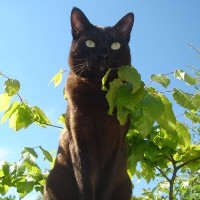
 |
Asian |
|
TranslationFrancis Vandersteen |
||
OriginThe Asian, also known as the Asiatic, is a breed of cat that originated in England. |
| This medium-sized cat is a variety of the English Burmese, with coats and patterns different from those of the Mink, but with the same physique. It is the offspring of the Burmilla breeding program run by Baroness Miranda von Kirchberg. |
Standard |
| Asian is recognized by the following federations: GCCF, LOOF and WCF. The LOOF judges Asian, Burmilla and Tiffany on the same standard, these breeds differing only in hair color or length. The WCF standard adds the remark that the Asian is a Burmese type. |
A brief historical overview |
| Breeding of the breed began by accident in England, in 1981, when, unbeknownst to their mistress Baroness Miranda von Kirchberg, a European Burmese and a chinchilla Persian had a litter of kittens that looked like Burmeses but were chinchilla-colored. The beauty of the kittens prompted the Baroness to launch a breeding program for silver Burmeses and create the Burmilla breed. This breeding program produced many kittens whose color was not that of a chinchilla or whose coat was long-haired, giving rise to the Asian and Tiffanie breeds respectively. |
General appearance |
| The Asian is a medium-sized semi-foreign cat, muscular but elegant. |
Behavior / characteristics |
| Character traits remain entirely individual and are a function of each cat's history; however, Asians are considered by Dr. Brice Fogle to be "more relaxed than the Burmese and more sociable than the Persian", they also like company. The LOOF, on the other hand, considers Asians to be identical in character to the Burmese. |
Head |
||
Cranial region |
||
Head |
The head is medium-sized but fairly high, between the chin and the top of the skull. From the front, it forms a short triangle that tapers towards the rounded muzzle. | |
Skull |
The top of the skull is broad, domed and the forehead rounded. | |
Facial region |
||
Nose |
The nose is marked by a stop and ends straight. | |
Eyes |
The eyes are large, expressive and set wide apart. The underside of the eye is rounded, while the top is straight and slopes slightly towards the nose. Colors between yellow and green are accepted. LOOF specifies that gold eyes are preferred for solid cats and green eyes for silver-haired cats. | |
Ears |
The medium-sized ears are set wide apart on the skull. They are broad at the base, rounding off at the tip. In profile, they point forward. | |
Body |
||
Generality |
Semi-foreign in shape, the body is of medium length and size, firm and muscular to the touch, and heavier than it appears. | |
Back |
Straight back. | |
Chest |
Strong, rounded chest in profile. | |
Tail |
| Medium length, with rounded tip. |
Limbs |
| The legs are slender and proportionate to the body, with the hind legs slightly higher than the front. | ||
Forequarters |
Hindquarters |
Feet |
| Oval feet. |
Coat |
||
Coat and texture |
The coat is short, with almost no undercoat. It should also be fine, glossy and close lying to the body. All traditional patterns are accepted, as well as tabby markings. All colors are accepted for the WCF, but the LOOF does not recognize the solid white color. The Asian uni noir is called "Bombay" by the GCCF and must not be confused with the Bombay breed. Chinchilla and Smoke Asians are considered Burmillas. | |
Size and weight |
||
Height at withers |
Male height at withers: between 21 and 23 cm. Female height at withers: between 21 and 23 cm. |
|
Weight |
Average adult male weight: between 4 and 5 kg. Average adult female weight: between 4 and 5 kg. |
|
Tolerances |
 Phantom tabby markings on kittens and non-agouti young adults. Tabby markings on head, legs and tail in non-agouti orange series cats. Phantom tabby markings on kittens and non-agouti young adults. Tabby markings on head, legs and tail in non-agouti orange series cats. |
Penalties |
| Flat top of skull. Pinch in an adult. Busted nose. Nose receding forward. Round or oriental eyes, very small or very close. Protruding eyes or chin. Phantom tabby markings in non-agouti adults (except orange series). |
Refusal of any title |
| Medallion or white spots. Oriental or cobby morphology. Green eyes in English Burmese. Small, puny or thin-boned adult. General faults and defects eliminatory in show. |
Authorized marriages |
| Asian x Asian Asian x English Burmese Asian x Burmilla English Burmese x English Burmese English Burmese x Burmilla Burmilla x Burmilla |



 English (United Kingdom)

Comments