
 |
Chausie |
|
TranslationFrancis Vandersteen |
||
OriginThe Chausie is a breed of cat native to the United States. |
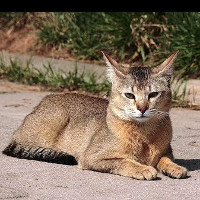
| This cat is characterized by its Chaus-like physique. |
A brief historical overview |
| The Chausie is the result of hybridization between a Chaus and a domestic cat. The first crosses were made in the late 1960s to produce a cat with a wild type similar to the Chaus, but with the character of a domestic animal. Abyssinians, Orientals and Bengals were chosen, as well as wild-looking alley cats. These first hybrids (classified as F1 for “first generation”) offered an alternative to capturing the Chaus, which is a wild animal. In 1995, TICA registered the founding of the breed, and in February 2001 it changed its status to “breed under evaluation”. In March 2003, the Chausie was promoted to the status of “New Breed”, allowing it access to cat shows, but without the possibility of obtaining a title. This is the last step before full access to the championship. In France, the LOOF gives it the same status as in its country of origin. Other associations do not yet recognize the breed. As the breed is still young, breeders are still working on its characteristics to bring it closer to the Chaus and enable it to compete in shows. At present, most Abyssinians are crossed with Chausies to eliminate any trace of tabby, while retaining the ticking of the coat. |
Behavior / characteristics |
| The Chausie is an active cat that doesn't tolerate solitude and needs company. It's said to be close to its owner, outgoing and very intelligent. However, as these character traits are above all a function of each cat's history, they are entirely individual. |
Health |
| Chausie generations are categorized after hybridization as F1, F2, F3, F4, etc., F1 being the generation born directly from a hybridization between a domestic cat and a Chaus. Males of generations F1 to F3, or even F4, are generally sterile, which makes it very difficult for breeders to develop this rare breed. What's more, this breed is more susceptible to certain intestinal problems. Some are gluten intolerant and cannot tolerate industrial food such as kibble. |
Head |
||
Cranial region |
||
Head |
Viewed from the front, the head is broad and of medium size. The cheekbones are pronounced and angular. | |
Facial region |
||
Forehead |
The forehead is slightly rounded. Viewed from the side, this gentle curve changes direction slightly at the birth of the nose, forming a slight concave slope. | |
Nose |
The broad nose is slightly arched, with a bulging nose. | |
Muzzle |
The muzzle is in harmony with the rest of the head, with rounded corners. | |
Eyes |
Medium-sized, the eyes form a slightly flattened oval and are set at a slight angle. Gold to yellow is preferred, with hazel or green acceptable. | |
Ears |
High and large, the ears are set close together. Broad at the base, they have a rounded tip. Plumets are desirable, but cats without plumets should not be penalized. A light-colored thumb mark at the back of the ear is desirable. | |
Neck |
| Well muscled, the neck is of medium size and width. |
Body |
||
Generality |
The Chausie is a large cat (especially males) with a long, rectangular body. The body is muscular, but not overly showy. | |
Chest |
The ribcage should not be too bulging, but the chest should be broad. | |
Limbs |
| The legs are of medium length, with powerful muscles but average bone structure. The hind legs are more powerful than most other breeds (about 3/4), but have, if possible, the same number of vertebrae. This particularity should in no way prevent good tail articulation. | ||
Forequarters |
Hindquarters |
Feet |
| Round, the feet are small in relation to the cat's size. |
Coat |
||
Coat and texture |
Short to medium length, close to the body, the coat should be of sufficient length for each hair to show at least four alternating light and dark stripes, called ticking. Tabby markings are desirable on the tail, the inside of the forelegs and the outside of the hocks. Collars may or may not be present. The undercoat contributes to the coat's silky, elastic character. | |
Size and weight |
||
Height at withers |
Male height at withers: between 23 and 25 cm. Female height at withers: between 22 and 24 cm. |
|
Weight |
Average adult male weight: between 7 and 13 kg. Average adult female weight: between 7 and 13 kg. |
|
Tolerances |
 Tail of normal length. Phantom tabby markings in black kittens. Light green eyes. Tail of normal length. Phantom tabby markings in black kittens. Light green eyes. |
Penalties |
| Dark green eyes. Delicate or very strong bones. Lack of tabby markings on legs or tail in ticked kittens. White medallion. |
Refusal of any title |
| Tail too short due to the action of the Manx or Pixie Bob gene. Tail knotted or lacking flexibility. Mackerel or classic tabby pattern. Other colors than those described in the standard. General faults and defects eliminatory in the show ring. |
Authorized marriages |
| Chausie x Chausie Chausie x Abyssinian Chausie x domestic cat not belonging to any breed Chausie x Chaus cat (subject to meeting legal requirements for keeping and breeding wild felines) New Breed (NR) until January 1, 2020: New breeds may be shown but may not obtain a title certificate or participate in Best In Show. They are judged and may be awarded an excellent if the subject presented is of sufficient merit. Feral cats and F1 to F4 hybrids are forbidden in LOOF shows and presentations. |



 English (United Kingdom)

Comments