
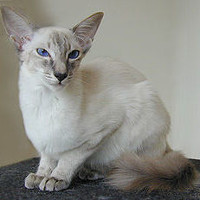
 |
Balinais |
|
TranslationFrancis Vandersteen |
||
OriginThe Balinais is a cat breed that originated in the United States. |
| This medium-sized cat is the semi-long-haired variety of the Siamese. |
Standard |
| The French standard specifies that the Balinais, although fine, must not be too thin. |
A brief historical overview |
| The Balinais is the semi-long-haired variety of the Siamese. Their history is therefore identical until the 1950s. Various legends tell us that these colorful cats were sacred temple cats, that they were bred in Thailand under the supervision of the King of Siam, or that they were presented to the English as sacred cats so that they wouldn't be robbed of their real lucky cats, the Khao Manee. It was the English who imported these cats to Europe at the end of the 19th century. They had already been exhibited in London as early as 1881. This very exotic cat quickly captivated the English, who were very fond of it. From 1930 to 1954, the number of accepted Siamese colors increased considerably, from the single seal point to blue, lilac and chocolate point. A trace of a semi-long-haired Siamese has been found dating from 1928. It's likely that this was a spontaneous genetic mutation, as semi-long-haired kittens appeared naturally in Siamese litters. These kittens were kept out of the breeding circuit because they didn't correspond to the breed standard. After the Second World War, many Siamese were imported to the United States. It was one of the most popular breeds, along with the Persian. In fact, it was two American Siamese breeders who launched the breeding of this semi-long-haired Siamese. They selected the semi-long-haired kittens born in their litters and named them Balinais. Their appearance reminded them of the dancers of Bali. A number of Balinais breeders worked to gain recognition for the breed at numerous shows. TICA and CFA accepted the Balinais as a separate breed in 1970, FIFé in 1972 and LOOF in 1983. The 1980s were devoted to refining the Balinais' silhouette. In fact, the Siamese had already evolved and refined considerably, moving from the traditional type (now known as Thai) to the modern type. To bring about the same change in the Balinais, breeders resorted to crossing Siamese and Balinais. The short-haired kittens resulting from these crosses are known as “variants”. With the emergence of many other breeds over the last twenty years, the Balinais declined in popularity. In 2008, it was still rare in France, representing just 0.08% of all pedigree cats. Between 2003 and 2008, the LOOF registered fewer than 20 new births each year. In England, the GCCF has recorded an average of 172 Balinais births for a total of 30,000 purebred births per year since 1997. |
Behavior / characteristics |
| The Balinais shares with the Siamese a playful, outgoing and active character. Like its cousin, it's also a great talker. They are sociable and extremely affectionate. These traits are, however, entirely individual and depend on the history of each cat. |
Health |
| Oriental cats such as the Balinais also seem to be more affected than other breeds by amyloidosis. This disease ultimately leads to chronic renal failure and death. Affected cats generally die before the age of 5, at an average of 3½ years. This pathology has only recently been discovered in cats, and no genetic studies have yet been carried out to determine how the disease is transmitted. However, an analysis of pedigrees shows that it is hereditary. Symptoms include diarrhoea, which may be accompanied by lethargy and refusal to eat. There is no treatment for the disease, only its symptoms. The aim is to prevent inflammation and slow the progression of renal failure. In the event of anemia, veterinarians may also resort to transfusions. Veterinarians currently recommend autopsies on all Siamese and related cats with unexplained deaths, in order to better understand the disease. Colorpoint cats show convergent strabismus in greater numbers than cats of other breeds. This defect was extremely common in the Siamese, and even permitted until the introduction of a stricter standard. This strabismus is due to various abnormalities in nerve fibers, which do not always arrive in the right hemisphere of the brain. Their three-dimensional vision is altered and their visual acuity diminished. In order to compensate, cats have to change the position of their eyes. It would appear that the allele coding for the colorpoint coat is the cause, since it modifies the presence of melanin in the retina. |
Genetics |
| Colorpoint is a genetic peculiarity that prevents color from developing in areas of the body at normal temperature. It is the “cs” allele that causes the production of tyrosinase, which cannot function at normal body temperature. As the limbs, tail, ears and face are colder, they are the only parts to become colored. Kittens are born white because they have been kept warm throughout gestation, and their color only appears slowly after birth, when their extremities have reached a lower temperature than the rest of the body. This coat also darkens with age, lightening in the event of high fever. |
Head |
||
Cranial region |
||
Head |
The head is medium-sized and triangular in shape. The head should not be too broad or too round. | |
Skull |
The skull and forehead should be flat or slightly domed, but excess would be considered a penalty. The profile is either entirely straight or slightly curved. In all cases, there should be no break along the line of the nose. |
|
Facial region |
||
Nose |
The nose is long and straight, but must not be too narrow. | |
Cheeks |
The cheeks are flat, with the exception of adult males, which may have jowls. | |
Eyes |
Almond-shaped and slanted. They should be set wide apart, and their color is always blue. The intensity of the color plays an important role. Eyes that are round, too small or not well-set penalize the cat in a championship. Any color other than blue is considered a serious fault and directly eliminates the cat from the championship circuit. The CFA standard specifies that Balinais with strabismus are penalized. | |
Ears |
The ears are large, set wide apart on the head. | |
Neck |
| The neck is long and fine. |
Body |
||
Generality |
Like the Siamese, the Balinais has a long, lithe body. It is of medium size, and its athletic silhouette and fine bone structure make it elegant. A body that is too short or massive is considered a show fault. | |
Tail |
| The tail is long and fine, whip-like. The length should not be excessive, however, and should remain in harmony with the rest of the body. In the Balinais, it is furnished only with fine hairs whose lightness is comparable to that of an ostrich feather. |
Limbs |
| Legs should be long but in harmony with the rest of the body. They are fine but not exaggerated. As with the rest of the body, the bone structure should be fine and the muscles firm. Legs that are too short or too massive are penalizing faults at shows. | ||
Forequarters |
||
Shoulders |
Hips and shoulders of equal width. | |
Hindquarters |
Feet |
| Small, oval feet. |
Coat |
||
Coat and texture |
The coat of the Balinais is medium-length, with no undercoat. The coat is fine and silky, lying close to the body. The Balinais should not have a ruff, but the breeches and tail should be well furnished with hair. The coat may be shorter on the shoulders. The standard tolerates an incompletely developed coat in kittens under 12 months of age. A coat that is too short or lacking in silkiness is considered a fault. The presence of undercoat is an eliminatory fault. | |
Color and ticking |
The only authorized pattern is colorpoint, in all LOOF colors. CFA only allows seal, blue, chocolate and lilac. Balinais in other colors are registered as Javanese. The contrast between the colored tips and the rest of the body must be sharp. The color of the tips should be as uniform as possible. Any white spot, including on the paw pads, is an eliminatory fault in France, whereas for the CFA standard it only entails a penalty. | |
Size and weight |
Authorized marriages |
 Cross-breeding is authorized with Siamese, Oriental and Mandarin. The CFA standard also authorizes outcrossing with Colorpoint Shorthairs. Crossing Siamese cats with fully Colored cats has given rise to a new coat, the Sepia, whose extremities are colored, but unlike the Colourpoint, the body color remains fairly dark. Crossing Sepia and Colourpoint cats gave rise to the mink coat. Cross-breeding is authorized with Siamese, Oriental and Mandarin. The CFA standard also authorizes outcrossing with Colorpoint Shorthairs. Crossing Siamese cats with fully Colored cats has given rise to a new coat, the Sepia, whose extremities are colored, but unlike the Colourpoint, the body color remains fairly dark. Crossing Sepia and Colourpoint cats gave rise to the mink coat. |



 English (United Kingdom)

Comments