
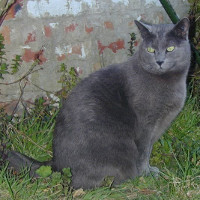
 |
Russian blue |
|
TranslationFrancis Vandersteen |
||
OriginThe Russian Blue or Russian is a cat breed with controversial origins, usually considered a natural breed that originated in cold countries such as Russia and Scandinavia. |
| Often described as a calm breed that is very attached to its master, the Russian Blue is well suited to life in an apartment. Care is limited to weekly brushing. |
A brief historical overview |
| The origins of the Russian Blue are controversial, usually attributed to Russia or Scandinavia, but they could also be in the Mediterranean region. Illustrating the vagueness of these origins, various names have been given to this breed, including “Blue Archangel”, “Abyssinian Blue”, “Arkhangelsk Blue”, “Spanish Blue”, “Icelandic Blue”, “Norwegian Blue”, “Caucasian Blue”, “Maltese Blue” or “Russian Blue”. Desmond Morris also notes the terms “American Blue Cat”, “Chartreuse Blue”, “Foreing Blue”, “Russo-American Blue”, “Russian Shorthair” and “The Connoisseur's Cat”. One theory is that the breed originated in the Russian port of Arkhangelsk, where it developed its dense coat over the centuries, making it a natural breed. Various accounts corroborate the fact that it was hunted for its warm fur used in clothing. It is said to have served on ships as a rodent hunter and to have been introduced to Britain by sailors. A common origin with the Chartreux is also put forward. The Arkhangelsk theory is frequently repeated, with the date of arrival of the Russian Blue in Britain ranging from the late 16th century during the reign of Elizabeth I to the more commonly cited mid-19th century. Arrival in Britain may have been via Sweden, or directly by sailors. Another hypothesis is that the Russian Blue is a very old breed, originating in Russia and spread to Europe by the Vikings. A final theory is that the Russian Blue originated in northern Norway, from where it was imported into Britain under various names, including “Shorthaired Blue Tabbies” and “Canon Girdlestone's breed”. |
Behavior / characteristics |
| Character traits are not generally described in standards. However, TICA and LOOF standards describe the Russian Blue as a shy cat. The Russian Blue is often described as an intelligent, calm cat. It is said to be discreet, with a soft, melodious meow for females, and would not particularly like noise or children, preferring its tranquility and a quiet family life. The Russian Blue is described as a cat well suited to life in an apartment. It is said to be sociable with other animals. Tamsin Pickeral describes the Russian Blue as shy and reserved, attached to its habits and intelligent. Affectionate with his master, he would follow him on his travels and loudly demand his food. Dr. Bruce Fogle also emphasizes the Russian Blue's reserved character, adapted to life in an apartment. |
Reproduction |
| In France, with 142 pedigrees issued in 2016, the Russian Blue is the 22nd most popular breed out of a total of 55 breeds in 2016. In the UK, the Russian represents the 14th most popular breed out of 34 in 2015. In the United States, the Russian Blue was the 16th most popular breed in 2015 out of 42 breeds, according to CFA statistics. |
Head |
||
Cranial region |
||
Head |
The wedge-shaped head is particularly broad at eye level. The angular face is formed by seven facets: in profile, the top of the skull to the forehead, the forehead to the nose, the tip of the nose to the point of the chin, then, from the front, the two faces on either side of the muzzle and the two faces formed by the cheekbones. | |
Facial region |
||
Forehead |
In profile, the broad, flat forehead and straight nose form a convex angle at the eyebrows. The forehead should be slightly longer than the nose, according to the CFA. | |
Muzzle |
The muzzle, with rounded contours, is short and massive, without pinch. | |
Mouth |
The corners of the mouth are slightly upturned, giving a soft, smiling impression. | |
Eyes |
Large, well-spaced eyes are walnut-shaped for most standards and almond-shaped for FIFé. The only color accepted is the most intense green possible in adults, yellow-green in kittens. In shows, penalties are given for adults with imperfectly green eyes. Yellow eyes are forbidden. | |
Ears |
As high as they are wide at the base, the ears are set wide apart and carried vertically. Hair is very short and fine on the outside, and longer on half the inner surface of the ear. | |
Neck |
| The neck is long and fine. |
Body |
||
Generality |
Foreign-type, the body is long and graceful, well muscled and without any heaviness. A massive, compact body or, on the contrary, one that is too oriental is a show fault. Fine bones and powerful muscles. | |
Tail |
| Rather thick at the base, tapering to a tapered tip. Medium length, reaching to the base of the shoulder blades, in good proportion to the body. |
Limbs |
| Legs are long and slender, well proportioned with the body. | ||
Forequarters |
Hindquarters |
Feet |
| Small, rounded feet. |
Coat |
||
Coat and texture |
The coat is short, fine and soft, dense with heavy undercoat. A close-lying coat is a serious fault at shows, as is the presence of a medallion or white patches. Breeding federations accept one to three different colors. ACF, GCCF, LOOF, NZCF and SACC accept blue, white and black. American federations (CFA and TICA) and federations with a European or worldwide scope (FIFé and WCF) only recognize the color blue. Phantom tabby markings are tolerated in kittens. Blue should be uniform and luminous, with a preference for light tones. The tips of the guard hairs have a silvery coloration that gives the coat a shiny appearance. The nose and pads are gray. The white should have a silvery sheen. Nose and pads are pink. Black should be glossy, jet-black. Nose and pads are black or dark brown. |
|
Size and weight |
||
Height at withers |
Male: 25 to 30 cm; female: 25 to 30 cm. | |
Weight |
Male weight: 3 to 5 kg; female weight: 2 to 3 kg. | |



 English (United Kingdom)

Comments