 |
Himalayen |
|
TranslationFrancis Vandersteen |
||
OriginThe Himalayen, also known as the colorpoint or colorpoint (US), is a cat breed originating in the United States. |
| In some European countries, this breed does not exist and is considered a coat of the Persian. |
A brief historical overview |
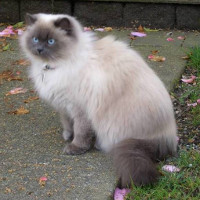
| The Himalayen is a colorpoint Persian. These Persians are alternately known as Himalayans, colorpoints or Malaysian Persians. Apart from their coat, they are very similar to Persians. The name refers to a breed of domestic rabbit with an identical coat. Colorpoint Persians are the result of research into the Siamese gene. This research was carried out in the U.S.A. and Sweden between 1924 and 1930. The result was “Débutante”, the first longhaired Siamese cat. Other programs were subsequently carried out in France, and it was in 1935 that “Khmer” type cats appeared. But this new breed was abandoned in 1955 because it was too oriental. The true colorpoint Persian was created by breeding programs launched in 1947 in Great Britain and the United States: it was a cross between a semi-long-haired Siamese and black and blue Persians. The breed was finally recognized in England in 1955 and in the United States in 1957. It wasn't until 1958 that the colorpoint won the first prize for best long-haired cat. The first colors obtained were seal point (very dark black or brown markings), chocolate point, blue point and lilac point, then other colors quickly followed, such as cream, tortoiseshell, russet or tabby. Shaded and smoke varieties also exist. Colorpoint Persians always have blue eyes: this physical characteristic is associated with the gene that gives the cat its colorpoint coat. First registered as a breed by the Cat Fancier Association (CFA), the Himalayen was included in the Persian breed as an additional division in the 1980s. It is still considered a breed by federations such as ACFA, TICA and WCF. The Himalayen is a great success on the North American continent, but remains more discreet in Europe. |
Behavior / characteristics |
| Himalayens are generally considered to be calm, gentle cats, ideally suited to apartment living. The heritage of Siamese blood, however, makes them a slightly more active breed than their Persian cousin. However, these traits are entirely individual and depend on the individual's history. |
Health |
| This breed is also particularly prone to polycystic kidney disease (PKD), a genetic disorder affecting the kidneys. A DNA screening test is available to prevent the breeding of cats affected by this disease. Because of its snub nose, the cat's eyes and nose are particularly sensitive, and should be cleaned regularly. The long coat also poses problems of hair ingestion and tangles, which can be painful. This breed therefore requires special attention. |
Head |
||
Cranial region |
||
Head |
The Himalayen's head is typical: round and massive. Viewed in profile, the forehead, nose and chin should line up vertically. | |
Stop |
Ideally, the stop should be higher than the middle of the eye, so that the top of the nose leather is at the same height. | |
Facial region |
||
Nose |
The nose is as broad as it is long, with a pronounced stop. | |
Jaws and teeth |
Powerful jaws. | |
Cheeks |
Full, prominent cheeks. | |
Eyes |
The eyes are large and round, giving an impression of softness. They should always be the deepest blue possible. | |
Ears |
The ears are small, rounded and not very open at the base. They should not be too close together on the head. | |
Body |
||
Generality |
Like all Persians of its origin, the Himalayen is round, massive and short-legged. | |
Back |
Straight back, massive bones, even thickness of shoulders and hips. | |
Tail |
| Short, but proportionate to the body. Carried straight. |
Limbs |
| The legs are short but strong, thanks in particular to the powerful bone structure. | ||
Forequarters |
Hindquarters |
Feet |
| The feet are round and large, with the toes close together. The ACFA specifies that there should be five toes in front and four in back. |
Coat |
||
Coat and texture |
The Himalayen's coat is long and glossy, with a thick undercoat giving volume. It is of equal length all over the body, but with an imposing ruff. The coat is always colorpoint and all colors are accepted, as are tabby markings (known as “lynx point”) and tortoiseshell tips (tortie point). | |



 English (United Kingdom)

Comments