 |
Korat |
|
TranslationFrancis Vandersteen |
||
OriginThe Korat is a breed of cat native to Thailand. |
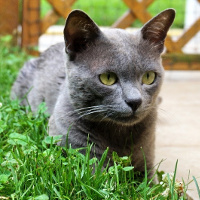
| This small cat is characterized by its blue coat and green eyes. |
A brief historical overview |
| The Tamra Meow, or Book of Cat Poems, is a richly illustrated Thai collection of verses written between 1350 and 1767, describing seventeen different cats, some lucky and some not, the korat being one of the lucky cats. The manuscript lists and poetically describes the cat breeds existing at the time, and distinguishes between the “Si-Sawat” and the rest of the blue cats. The Korat is described as follows: “His coat is soft, with cloud roots and silver tips. Its eyes shine like dew on a lotus leaf”. Representations of these ancient breeds can be found in Asian art, and some Thai works can now be interpreted as Siamese or Korats. King Rama V commissioned the monk Somdej Phra Buddhacharn Buddhasarmahathera to copy the Tamra Meow, which became known as Smud Khoi of Cats; several versions of the book are held in Thailand's national library. The Korat is considered a natural cat breed. The origin of the breed's name “Korat” lies in a province of Thailand where it is said to have remained confined: the Khorat plateau, in today's Nakhon Ratchasima province, in the northeast of the country. The name is said to have been given by King Rama V when he asked where this breed of cat came from. In Thailand, the name of this cat is “si-sawat”: it refers to blue cats with green eyes, but not necessarily from the Khorat plateau. The terms “Maled” and “Dorklao” are also used. |
General appearance |
| The Korat's type must remain as close as possible to that of its ancestors, and resembles the original Siamese, called Thai, although it is smaller on average. All Korats are descended from Thai cats, and no cross-breeding with other breeds is allowed. The Korat's gait is supple and balanced: neither too compact nor too slender, in the foreign semi-coby style. They should appear powerful and muscular without being heavy. Many standards describe them as “alert”. |
Behavior / characteristics |
| The Korat's character is often described as resembling that of the Siamese; however, it remains perfectly individual and is above all a function of the cat's history, whatever its breed. Like other Oriental cats, they are extremely loyal and show a strong attachment to their owner and their home. They show a keen interest in play throughout their lives, and their intelligence enables them to learn little tricks quickly, earning them the nickname “dog-cat”. Philippe Coppé considers it a cheerful, affectionate cat; Christiane Sacase adds in Le guide vert des chats that it is attentive to its surroundings, discreet and hates noise. It can be difficult to handle at shows, and it may be necessary to train kittens destined for the show ring to become accustomed to noise by leaving a radio on in the nursery and teaching them the poses the judges will make them assume. The Korat is considered by Dr. Fogle to be an outgoing, playful breed, capable of withstanding the presence of several cats in the home, unlike Christiane Sacase, who considers it to be unsociable. Both authors agree, however, on its authoritarian behavior towards other cats, seeking to be the dominant one. |
Health |
| A recessive gene causing a neuromuscular disease, gangliosidosis, is present in the breed and is gradually being eliminated by breeders. Gangliosidosis is a serious autosomal recessive genetic disease whose symptoms can be detected as early as two to three months of age, depending on the type (GM1 or GM2): the first sign of the disease in kittens is head tremors, rapidly followed by ataxia and then loss of mobility after eight to ten weeks. Death occurs before the age of eight months, following progressive neurological dysfunction. Diagnosis can be confirmed by urine or blood tests, or by skin biopsy; screening tests for healthy carriers have been available since 1998. These genetic tests, performed on a gingival swab, cost between $40 and $65 per cat in 2011. It is advisable to vaccinate the korat against respiratory ailments, and to avoid variations in temperature and humidity, as the breed is very sensitive to these. The korat is considered low-maintenance. It should be brushed twice a week and massaged daily. Its diet should be meaty and varied; it will accept vegetables. |
Head |
||
Cranial region |
||
Head |
The Korat's head is described as “heart-shaped”, with the prominent superciliary arches forming the top of the heart and the chin forming the tip. | |
Facial region |
||
Forehead |
The forehead is broad and flat. | |
Nose |
The tip of the nose is domed like a lion's. | |
Muzzle |
The short muzzle, neither too square nor too pointed, shows a slight stop in profile. | |
Jaws and teeth |
FIFé considers a pinched jaw undesirable. | |
Eyes |
The eyes, which must absolutely be green, are very large, set the width of an eye apart and round; eyes that are too small or too close together are considered faults. Amber green is tolerated up to the age of two. | |
Ears |
Rounded at the tip, broad at the base, with little hair on the inside. | |
Body |
||
Generality |
The hips are round. | |
Croup |
The croup is rounded. | |
Chest |
Broad chest. | |
Tail |
| Medium length, with rounded tip. |
Limbs |
| The legs are of medium size and should be close to the distance between the base of the tail and the base of the neck. | ||
Forequarters |
Hindquarters |
Coat |
||
Coat and texture |
The Korat's coat is short, close lying and glossy. It is normal for the hair on the back to stand up when the Korat walks. The only authorized color is blue. Silver highlights appear due to tipping at the tip of the coat. In areas where the coat is shorter (head, legs, tail), highlights are more visible; however, they must cover the whole body. The coat should be light at the root, blue in the center and silvery at the tip. Nose and pads are blue. In adults, ghost markings, white patches or lack of silver highlights are considered faults. The Korat has no undercoat, the small, downy hairs that are usually hidden beneath the longer hairs. | |
Size and weight |
||
Height at withers |
The Korat is a small cat, so much so that adult specimens are often mistaken for young cats by the uninitiated. The fact is, they remain very playful throughout their lives, and this contributes to the confusion. | |
Weight |
Males rarely exceed four or five kilos, depending on whether they are neutered or not. Females are smaller and thinner, weighing between two and four kilos on average. | |
Authorized marriages |
| The only marriages permitted are between Korats. It is forbidden to cross a Korat with another breed. |



 English (United Kingdom)

Comments