
 |
Manx |
|
TranslationFrancis Vandersteen |
||
OriginThe Manx is a breed of cat originating from the Isle of Man (British Isles). |
| This cat is characterized by its lack of tail. |
A brief historical overview |
| The Manx cat (kayt Manninagh or stubbin in Manx), also known as the Isle of Man cat, originated, as its name suggests, on the British Isle of Man. The gene mutation responsible for the absence of a tail developed on the island due to the isolation of the cats and excessive inbreeding. English folklore attributes this trait to the stinginess of the island's inhabitants, who, during a harsh winter long ago, cut off the tails of all the cats to save firewood. In effect, the door of the house would close faster on the cats, preventing the heat from escaping outside. |
General appearance |
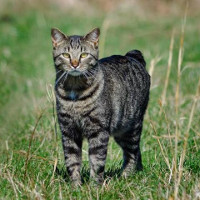
| The Manx is a medium to large-sized cat with a muscular, compact, powerful yet rounded body. Strong bones and muscles, straight back. |
Behavior / characteristics |
| The Manx is described as an easy-going cat that adapts well to change and is affectionate with its owner. It is a robust cat and a good hunter. However, these traits are completely individual and depend on the history of each cat. |
Genetics |
| Breeding the Manx is a tricky business, firstly because a female cat gives birth to very few kittens, and secondly because of the genetic aspect. A homozygous Manx (carrying the two genes responsible for the absence of tail) is not viable, as the spinal cord does not fully develop. All such kittens die in the womb, so those born are inevitably heterozygous. You can't breed two Manx rumpy either, as it's possible for a lethal gene to appear. It is therefore advisable to breed them with British Shorthair or Longhair to avoid the problem, but in this case, not all the kittens in the litter will be Manx. Genetic research carried out by the University of California at Davis has reported the presence, at very low frequency, of the recessive allele responsible for the white gantage of the Sacred Birman in the Manx. This particularity is obviously not sought after by breeders. A specific genetic test exists to detect the Burmese gantage gene. |
Head |
||
Cranial region |
||
Head |
The head is broad and rounded, with prominent cheekbones and a short, broad, well-curved nose. | |
Facial region |
||
Eyes |
Large, open, round eyes of a color that matches the coat. | |
Ears |
Medium-sized to small, broad at the base with rounded tips, set wide apart on the skull. | |
Body |
Tail |
| The main characteristic of the Manx is its tail, or rather its lack of tail (caused by a mutation in the M gene). There are several types of tail length: - Rumpy: no tail at all. - Rumpy riser: the tail is reduced to an outgrowth of cartilage under the fur at the end of the spine. The name comes from the fact that the stump is only visible when the cat tries to raise it. - Stumpy: the tail measures just a few centimetres and is made up of 1 to 3 caudal vertebrae. - Longy: some Manx cats can have a tail of almost normal length, but it can be twisted and is not accepted in championships. Kittens with different tail lengths can be found in the same Manx litter. In general, only rumpy Manxes are shown. |
Limbs |
| The legs are medium to short, with good bone and muscle structure. The hind legs are slightly higher than the front ones, and the feet are round and firm. The Manx's hind legs are longer than its front legs. So, to get around, it hops like a rabbit, and its rabbit-like coat accentuates the resemblance. |
||
Forequarters |
Hindquarters |
Coat |
||
Coat and texture |
The coat is short, dense and with a thick undercoat. All colors and coats are acceptable for this breed. | |
Authorized marriages |
| Crosses are permitted with Cymric, British Longhair and British Shorthair, although Manx rumpy, rumpy riser and stumpy can only be crossed with Manx or Cymric longy. |



 English (United Kingdom)

Comments