 |
Munchkin |
|
TranslationFrancis Vandzersteen |
||
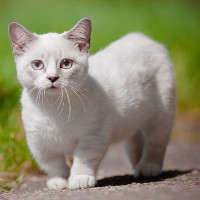
OriginThis cat is characterized by its very short legs, hence its nickname of “basset cat”. |
| This cat is characterized by its very short legs, hence its nickname of “basset cat”. |
Standard |
| For a cat to be recognized as a Munchkin, it must conform to the breed standard. If certain criteria are not met, the cat is not accepted as a member of the breed. |
A brief historical overview |
| The Munchkin is a recent breed. In 1983, Louisiana breeder Sandra Hochenedel took in a short-legged black cat named Blackberry. She gave birth to several kittens, half of which had the short-legged mutation. This wasn't the first time the mutation had appeared: throughout the 20th century, cats with the same characteristics had already been exhibited in England and Russia. The first exhibition of a Munchkin took place in 1991, at Madison Square Garden in New York. The name Munchkin comes from the film The Wizard of Oz, in which the heroine encounters a people of small humanoids called Munchkins. All of today's subjects are said to be descended from Blackberry. Since the birth of the breed, crosses have been made with other cats, but it's important that the Munchkin retains its moderate, European-like type. The breed is not recognized by many cat associations, including the Fédération Internationale Féline and the Governing Council of the Cat Fancy (GCCF). These associations consider the breed to be a genetic disease that should not be bred selectively. On the other hand, the International Cat Association recognizes the Munchkin as a breed in its own right. |
Behavior / characteristics |
| The Munchkin is reputed to retain its kitten-like character into adulthood. It is a very sociable cat, with a rather gregarious temperament. They're generally active, and the size of their legs doesn't prevent them from running, jumping or hunting. However, these traits are entirely individual and depend above all on the history of each cat. |
Genetics |
| The allele responsible for the “short legs” mutation is dominant, and if present in duplicate, renders the fertilized egg non-viable. All Munchkins therefore have one copy of the allele coding for the munchkin phenotype (noted M for the example) and one copy of the allele coding for the normal legs phenotype (noted m). |
Head |
||
Cranial region |
||
Head |
Proportionate to the body, the head forms a rounded triangle. Males have slightly larger heads than females. | |
Facial region |
||
Forehead |
The forehead and skull are slightly rounded. | |
Nose |
The nose has no stop, but a slight change of direction: it is usually straight. | |
Muzzle |
The muzzle is strong, without a break with the cheeks (absence of pinch), with a firm chin. | |
Eyes |
The eyes are medium to large, walnut-shaped and set at an angle. The eye color, which does not necessarily match that of the coat, is as bright as possible. | |
Ears |
The medium-sized ears are broad at the base and rounded at the tip. They are set fairly far apart and well furnished with hair on long-haired dogs. A long nose and round head or eyes are penalized at show. | |
Neck |
| The neck is medium-sized, fairly thick and well muscled. |
Body |
||
Generality |
The Munchkin has a balanced morphology and should not evoke any other breed except the European Shorthair. Semi-foreign in shape, the medium to large body is rectangular. | |
Back |
The back must not be hollow, which is an eliminatory fault in the show ring. | |
Chest |
The broad, well-developed chest is cylindrical in shape. Bones and muscles are well developed. The shoulder blades are prominent. | |
Tail |
| The tail is of medium length, thick at the base and rounded at the tip. It is carried straight when the cat is in motion. In cat shows, penalties are inflicted on cats lacking muscle tone or having a type that is too thin or too heavy. |
Limbs |
| The legs, which distinguish the Munchkin from other breeds, are short, muscular and strong. Legs must be straight: limbs that are bow-legged or sway-backed are eliminatory in the show ring. Similarly, it is forbidden to show a cat that has difficulty walking or standing upright. Arm and forearm should be of equal length, while thigh and hock should be of similar, but not equal, length. Bone structure is average. | ||
Forequarters |
Hindquarters |
||
Generality |
The hindquarters are slightly higher than the front legs. | |
Feet |
| The feet are round and firm. There is a difference in size between males and females. Females have smaller feet. |
Coat |
||
Coat and texture |
Munchkins come in short and medium-length coats. All patterns and coats are accepted, except amber. Shorthairs have moderately dense, glossy coats that lie close to the body, with little undercoat. Medium-length coats are silky, with little undercoat. A slight ruff is acceptable. Full breeches and a plume tail are preferred. | |
Authorized marriages |
| Cross-breeding with any Alley Cat is authorized by TICA, WCF and SAAC. The LOOF accepts crosses with the European shorthair. |



 English (United Kingdom)

Comments