
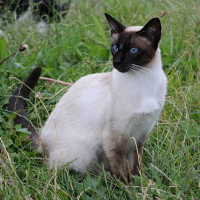
 |
Siamois |
|
TranslationFrancis Vandersteen |
||
OriginThe Siamois is a cat breed originally from Thailand. |
| The first Siamois arrived in Great Britain in the mid-19th century. |
A brief historical overview |
| Originally, the true Siamois cat had a round head, a robust body and athletic muscles. Since the 1960s, some breeders have significantly evolved the breed, crossing it with Oriental subjects. They have lengthened the head, enlarged the ears and refined the body. The exact origin of the Siamois is considered remote, although the exact appearance is unknown. The first records of cats with a colorpoint pattern come from the kingdom of Siam. Manuscripts discovered in Ayutthaya in the mid-14th century describe colorpoint cats. Representations of these ancient breeds can be found in Asian art, and some Thai works can now be interpreted as Siamois or Korats. The exclusive property of the Thai royal family, the Siamois is considered sacred: it guarded the temples, never leaving the palace grounds. Cats with characteristic Siamese markings were described by Peter Simon Pallas in Russia in 1793, but it's difficult to know whether they came from Siam or whether colorpoint cats have always existed in East Asia. The first Siamois were imported to Great Britain in the 19th century, first in 1871 where they greatly intrigued the public, then in 1884 a pair were imported by Major Owen Gould, ambassador to Bangkok. Exhibited at the Crystal Palace, the Siamois attracted a great deal of attention among the British shorthairs and Persians. The King of Siam adopted the habit of giving Siamois to diplomats, which helped establish the breed in Great Britain, where the first standard was written in 1889. In France, a first pair, brought back from Thailand by Auguste Pavie, was kept by the Jardin des Plantes, but it wasn't until 1896 that the breed was able to establish itself and, in the 1920s, to prosper. At first, only seal points were recognized, but chocolate point, blue point and lilac point kittens were regularly born. In the 1930s, the knotted tail, i.e. the tail forming a ring, was banned. After the Second World War, which greatly slowed down cat breeding, the Siamois became a fashionable breed, and breeders began to "produce" without worrying about quality. In the 1970s, breeders accentuated the Siamois' physical characteristics. In the United States, breeders developed a cat with a very slender body, increasingly long legs and a head with a pointed muzzle. This overtyped Siamois did not meet with success, particularly in Europe, and presented health problems (prognatism, pancreatitis). American breeders returned to a more balanced morphology. In England, the ears become lower and larger, forming an equilateral triangle with the chin, and the shape of the eyes evolves towards an oriental, oblique almond shape. In France, breeders seek a compromise between American and English types. |
General appearance |
| While many Siamois squinted some time ago (to compensate for an abnormal connection of the optic chiasm, resulting from the albino allele responsible for coloring the cooler parts of the body), selections made by breeders over the years have virtually eliminated squinting problems in the Siamois. White patches on colored parts of the body (excluding particolored cats), depigmented nose or pads, tail anomalies and eye color other than blue are eliminatory at shows. Round eyes, a short muzzle, a pinch, a break in the profile, a round, broad head, short legs, a heavy bone structure or a short, massive body are just some of the penalizing faults. |
Behavior / characteristics |
| Siamois are generally very close to their owners. Some people say they converse with their Siamois, which can be very talkative and communicative. Siamese cats are intelligent and affectionate. He comes as soon as he's called, quickly understands prohibitions and tends to follow his human companion spontaneously and in many cases systematically. You can easily teach him to walk on a leash and take him everywhere, even on vacation, because, unlike most other cats, he develops an attachment to people rather than to a territory. Very attached to his master, he has difficulty tolerating solitude. He usually chooses one person in the household and never leaves. For all these reasons, we call them "dog cats". |
Health |
| Studies based on data from Swedish insurance companies have shown that Siamois and related breeds have a high mortality rate compared with other breeds. The majority of deaths are due to neoplasms and mammary tumors. Siamois also have a high morbidity rate. The species is more prone to gastrointestinal problems, but can also be weakened by diseases of the lower urinary tract. Worldwide research is currently being carried out by several European and American laboratories. They are aware of a disease that affects the Siamois and Oriental breeds: feline amyloidosis, known as "familial" amyloidosis. This disease mainly affects cats between one and five years of age. But older cats can also trigger the disease. The main symptoms are kidney failure (highly suspicious if the subject is young) or internal bleeding in the liver or pancreas. Studies have shown that this disease can also be found in various animal organs, such as the uterus. Amyloidosis is a genetic disease. It's a protein that deposits heavily in either the kidneys or the liver/pancreas, causing internal disorders. The mode of onset is not yet known. Its mode of transmission is not yet fully understood. Some theories suggest polygenic transmission. The various laboratories involved in this research are attempting to develop a genetic test to detect the disease. They are currently encouraging Siamois and Oriental breeders to take part in the research. They can send tissue samples from their cats or blood samples. |
Head |
||
Cranial region |
||
Head |
The medium-sized head is long and triangular in shape. | |
Skull |
The skull and forehead are flat or slightly rounded. | |
Facial region |
||
Nose |
The nose is long and straight, not narrow at the tip, and fits into the triangle of the head, without a pinch. | |
Jaws and teeth |
Medium-sized jaws. | |
Cheeks |
Flat cheeks, jowls permitted for adult males only. The profile can be either straight, slightly convex or "two-plane", i.e. the forehead plane extends the nose plane, without a break. | |
Eyes |
Medium-sized, deep blue, almond-shaped, set wide apart and slanted toward the nose. | |
Ears |
The ears form the end of the head's triangle. They are large, broad at the base and set wide apart. | |
Neck |
| The neck is long, fine and elegant. |
Body |
||
Generality |
The Siamois is a long, medium-sized cat with a slender, well-muscled body. The cat must be in good physical condition and must not be thin. The bones are fine and the muscles supple and firm. Body shape is described as tubular. | |
Tail |
| The size of the tail should be well proportioned to the length of the body and the height of the legs. Whip-like, long and fine, it ends in a point. |
Limbs |
| Long, in harmony with the length of the body. The legs are slender, with hindquarters slightly higher than the fronts and small oval paws. | ||
Forequarters |
||
Shoulders |
Shoulders and hips of equal width. | |
Hindquarters |
Coat |
||
Coat and texture |
The coat is short, close to the body and glossy. Fine and silky to the touch. A "variant" Siamois, born of a Balinais or Mandarin, may have a longer coat and less fine texture. The only authorized pattern is colorpoint. There must be a clear contrast between colored and light areas. The color must be uniform over the whole body, although the age of the cat is taken into account: a kitten often has incompletely developed markings, while an older cat may show shading on the lighter parts of the body. There should be no white hairs in colored areas. The face mask should not extend over the entire head. Ghost markings are tolerated in tabby cats and cats under 12 months of age. | |
Color and ticking |
All colors are recognized by LOOF: classic colors (seal, chocolate, blue, lilac), with or without tabby markings, white, red, cream, tortoiseshell, silver and smoke are also accepted. In the U.S.A., on the other hand, only four colors are authorized: black, blue, chocolate and lilac. CFA makes an exception, and Siamois of other colors are called colorpoint shorthairs. More recently, there have been two-tone Siamois, called Seychellois or two-tone Siamois. All Siamois kittens, although completely white at birth, develop visible coloring from the very first days on the least warm parts of the body. It may take a few days or weeks to determine the cat's color. |
|
Authorized marriages |
| LOOF authorizes matings with Oriental, Mandarin and Balinais. |



 English (United Kingdom)

Comments