
 |
Lykoi |
|
TranslationFrancis Vandersteen |
||
OriginU.S.A. and Europe |
| The Lykoi (sometimes Lykoï) is a breed of cat, a natural mutation of the domestic shorthair. |
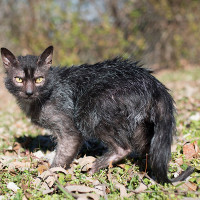
| The Lykoi (sometimes Lykoï) is a breed of cat, a natural mutation of the domestic shorthair. The first spontaneous mutations of the Lykoi were discovered in Virginia and then Tennessee, followed by a natural mutation found in Italy in 2014 in Brescia, the latter contributing to the expansion of the breed's gene pool in Europe begun in France in 2013. In July 2016, another natural mutation appeared this time in France at Strasbourg, and the kittens resulting from this natural mutation will be integrated into the breed creation program started in France by Christine Boulanger, the breed's importer in Europe since 2013. The Lykoi's main characteristic is its resemblance to a werewolf, but also its ROAN (salt and pepper) coat, which is unique among cat breeds. The Lykoi is partially or completely hairless. Its coat has a unique appearance, resembling that of an Opossum. Generally, it has a deep roan-black coat, an elongated head and an agile body, massive but not fat. This cat is hairless around the eyes, nose, ears and mouth. Lykoi cats are known for being friendly and easy to get along with. They need a lot of affection from their owners. The unique characteristic of this breed is that the Lykoi's coat moults once it reaches adulthood. The hair grows back, but this depends on the season, and also on periods for unspayed cats, such as when females are in heat or pregnant. When its coat is gone, the Lykoi may resemble a werewolf. Two different litters of Lykoi-like shorthaired kittens were discovered in Tennessee and Virginia in the 2010s. Between 2010 and 2011 a series of genetic and health tests were carried out to make sure that their partial nakedness was not due to a skin disease or condition causing this coat appearance. In 2011, the first marriages between Lykois began. The Lykoi has been part of the International Cat Association (TICA) registry since 2012 and was adopted to “registration only” status by unanimous consent. The breed has now been recognized as a new advanced breed by TICA since October 2015. Since May 1, 2017, the breed has been officially recognized at championship status by TICA and can compete against other cat breeds. A crossbreeding program with Black Domestic Cats from which the Lykoi originated spontaneously is underway to broaden the breed's gene pool. The Lykoi is in the process of being accepted by the LOOF. Christine Boulanger, who imported the first Lykois to Europe in 2013, submitted the application for acceptance of the breed in January 2016 to the LOOF. Following the LOOF Board of Directors meeting at the end of 2016, the Lykoï breed was granted “New Breed” status and was therefore recognized by the LOOF on January 1, 2017. Many cat breed creators have been the subject of controversy, but the Lykoi is the result of a completely natural mutation. In November 2015, the Cat Fanciers' Association (CFA) clarified that the Lykoi was not recognized by it as a provisional breed. It is, however, recognized as an advanced cat breed by TICA. At the University of Tennessee, dermatologists examined them for possible skin abnormalities. Using skin biopsy samples, the researchers could find nothing in their coats except that a few hair follicles, necessary for hair creation, were missing: this is why the Lykoi has little hair. This lack threatens the proper balance of components designed to maintain the coat, which explains why Lykoi molt and can sometimes become completely bald. The Lykoi was considered to be a true natural mutation when it was first bred. Today, there are 25 Lykoi breeders, including just one in France and two in Europe. Recognition of the breed by TICA and LOOF would enable Lykois to compete in cat shows. |



 English (United Kingdom)

Comments