The ticks


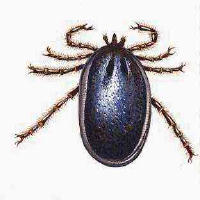
Ticks are not insects, but mites.


It has 8 legs, and in France, there are 2 kinds of ticks:
Wild ticks living in hedges, meadows and forests, and domestic ticks living in kennels, stables and cowsheds.

Ticks develop in 4 stages: egg, nymph, larva and adult.
The last three stages are parasitic and require a blood meal taken from mammals (from the smallest: mice, shrews, to the largest: horses, cattle, humans, dogs, etc.).

The tick's reproductive cycle extends over 2 months or more (up to a year), depending on climatic conditions. To take its meal, the nymph, larva and adult attach themselves to the parasitized animal by its rostrum (a kind of small, hard proboscis that enables it to pierce the skin and pump blood).

The bite is painless, as the tick secretes a local anesthetic. On dogs, the attached tick is discovered by stroking or combing the animal; it looks like a wart. In humans, a small, unusual tumour is discovered during grooming.

There's no ideal way to get rid of a tick, but if it's removed before the 24th hour, the risk of disease transmission is greatly reduced.
In the past, oil, petroleum or ether were used to loosen the tick. These are bad methods, as the tick regurgitates before detaching itself, increasing the risk of disease inoculation.

Using tweezers, pinch the tick at the base of the rostrum and pull gently in the direction of the tick, then disinfect the skin. Most of the time, a part of the rostrum remains attached to the skin, which will later be removed or encysted (which is benign).

Tick bites can be prevented by frequently disinfecting and cleaning the kennel if the dog spends the night there.

You can also use repellent or acaricide products (note that products used for fleas or lice have no effect).
These can be applied directly: aerosol cans, liquids applied to the skin around the neck, or by wearing an acaricide collar (check with your vet).

Diseases transmitted by tick bites are essentially piroplasmosis (very frequent) and other rarer diseases: Lyme disease, ehrlichiosis, hepatozoonosis, etc. These diseases are usually fatal if not treated early on. Initially, all these diseases have common symptoms: fever, loss of appetite, sometimes vomiting. So keep a close eye on the fever, and visit the vet immediately if the temperature rises above 39°. Don't wait for dark urine, diarrhoea or haemorrhaging, as it's often too late at these stages of the disease's evolution.

Comments

Latest page updates

  • Telomian

    Telomian He is not recognized by the F.C.I. Origin Malaysia Translation Francis Vandersteen A brief presentation of the Telomian The Telomian is a very rare breed of dog, and the only one native to Malaysia to have been bred outside the country. They were originally bred by the indigenous people of Malaysia to combat parasites such as snakes, rats,...
  • King Wheaten -- Cavalier King Charles Spaniel X Irish Soft Coated Wheaten Terrier

    King Wheaten He is not recognized by the F.C.I. Origin Great Britain <> Ireland -> U.S.A. Translation Francis Vandersteen A brief presentation of the King Wheaten The King Wheaten is a small dog with a heart this big and a playful disposition. Borrowing the energy and soft-coated waves of the Irish Soft Coated Wheaten Terrier and the size and...
  • Spanierd -- English Springer Spaniel X German Shepherd

    Spanierd He is not recognized by the F.C.I. Origin Great Britain <> Germany -> U.S.A. Translation Francis Vandersteen A brief presentation of the Spanierd The Spanierd is a hybrid dog. Its parent breeds are the English Springer Spaniel and the German Shepherd. They have an affable personality. He's known for entertaining family and friends with his...
  • Alaskan Goldenmute -- Alaskan Malamute X Golden Retriever

    Alaskan Goldenmute He is not recognized by the F.C.I. Origin U.S.A. <> Great Britain -> U.S.A. Translation Francis Vandersteen This breed is also known as Alaskan GoldenGoldenmuteAlaskan Gold Retriever     A brief presentation of the Alaskan Goldenmute The Alaskan Goldenmute is a descendant of two great dog breeds: the Alaskan Malamute and the Golden...
  • French pointing dog Pyrenean type

    French pointing dog Pyrenean type FCI standard Nº 134 Origin France Translation Mrs. Peggy Davis Group Group 7 Pointing Dogs Section Section 1.1 Continental Pointing Dogs « Braque » Type Working With working trial Acceptance on a definitive basis by the FCI Tuesday 18 January 1955 Publication of the official valid standard Tuesday 01 August 2023 Last...
  • French pointing dog Gascogne type

    French pointing dog Gascogne type FCI standard Nº 133 Origin France Translation Mrs. Peggy Davis Group Group 7 Pointing Dogs Section Section 1.1 Continental Pointing Dogs « Braque » Type Working With working trial Acceptance on a definitive basis by the FCI Monday 17 January 1955 Publication of the official valid standard Tuesday 01 August 2023 Last...
  • Vucciriscu

    Vucciriscu He is not recognized by the F.C.I. Origin Sicily Translation Francis Vandersteen En français, cette race se dit Vucciriscu Diese Norm ist in deutscher Sprache sichtbar Vucciriscu En español, esta raza se dice Vucciriscu In het Nederlands, wordt dit ras gezegd Vucciriscu This breed is also known as Sicilian Vucciriscu Sicilian Butcher...

© 2026 Groupe Milouchouchou ASBL. Tous droits réservés. En savoir plus

Protected by Copyright01
We use cookies

We use cookies on our website. Some of them are essential for the operation of the site, while others help us to improve this site and the user experience (tracking cookies). You can decide for yourself whether you want to allow cookies or not. Please note that if you reject them, you may not be able to use all the functionalities of the site.

Ok

