 |
Romanian Raven Shepherd Dog |
|
FCI standard Nº 373 |
||
Origin |
Romania | |
Group |
Group 2 Pinscher and Schnauzer – Molossoid and Swiss Mountain and Cattledogs | |
Section |
Mountain type Molossoids | |
Working |
Without working trial | |
Acceptance on a provisional basis by the FCI |
Tuesday 17 September 2024 | |
Publication of the official valid standard |
Tuesday 17 September 2024 | |
Last update |
Tuesday 24 September 2024 | |
En français, cette race se dit |
 |
Chien de berger roumain Corb |
Diese Norm ist in deutscher Sprache sichtbar |
 |
Rumänischer Hirtenhund Corb |
En español, esta raza se dice |
 |
Perro Pastor Rumano Corb |
In het Nederlands, wordt dit ras gezegd |
 |
Roemeense Herdershond Corb |
In his country of origin, his name is |
Ciobănescul Românesc Corb |
Usage |
| Shepherd dog for sheep and cattle. Excellent guardian. |
Brief historical summary |
| The Ciobănescul Românesc Corb (Romanian Raven Shepherd Dog) is a natural breed which was formed in the area of Meridional Carpathian Mountains and in the sub Carpathian regions (Dâmbovița, Argeș, Prahova, Brașov). In these regions, the breed is highly appreciated and successfully used for defending flocks and as a watchdog for households. This dog has been known for generations and called “Raven” because of his predominantly black coat. Although his habitat is relatively limited, due to his qualities the existing population is numerous. |
General appearance |
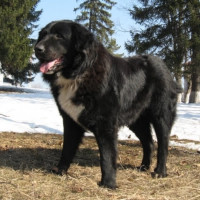
| Large sized dog, towering, courageous and proud. Sexual dimorphism is well marked, the males being stronger, larger in size than the females. The coat is black or predominantly black, more than 80%, with white marks on the chest and limbs. |
Important proportions |
| - The muzzle is slightly shorter or almost the same length as the skull. - The body is slightly longer than the height at the withers, rectangular in shape. - The distance between the point of the withers to the elbow and the elbow to the ground are equal. |
Behaviour / temperament |
| Balanced, calm with a well developed guardian instinct, obedient and attached to his masters. It is diffident towards strangers. Very good guardian for livestock, courageous and capable to fight against predators (bear, wolf). His bark is loud, profound and can be heard from a great distance. |
Head |
||
Cranial region |
||
Head |
Powerful, massive, with well chiselled forms, never ragged. The head is carried proudly above the top line. | |
Skull |
Wide, square, the length and the width being approximately equal. The longitudinal axis of the skull and the muzzle are almost parallel. The skull, viewed from the front, is slightly domed; seen from the side, it is almost flat; skull width: males 16-18 cm, females 15-17 cm. Zygomatic arches are moderately developed. Occipital protuberance is slightly evident. | |
Stop |
Fairly marked. | |
Facial region |
||
Nose |
Black, well developed and broad. | |
Muzzle |
Truncated cone shape, with length slightly less than or equal to that of the skull; well developed, narrowing progressively to its tip, never pointed; its width and depth are equal. | |
Lips |
Thick, slightly dropped, covering the inferior line of the mandible, strong pigmentation. | |
Jaws and teeth |
Strong jaws; complete dentition with healthy teeth, well set, white; scissor or pincer bite. Reverse scissor bite is allowed. | |
Cheeks |
Not prominent. | |
Eyes |
Small in relation to the head; almond shape and set obliquely, brown colour from light to dark shade. Eyelids well pigmented. | |
Ears |
Inserted slightly above the level of the eyes, « V » shaped with slightly rounded tip, pendent and carried close to cheeks. When pulled forward, the ears must reach the corner of the lips. | |
Neck |
| Medium length, large and strong, with a little dewlap. |
Body |
||
Body |
Massive, vigorous. | |
Topline |
Level. | |
Withers |
Highly evident. | |
Back |
Well supported and muscular. | |
Loin |
Strong and muscular. | |
Croup |
Muscular and moderately inclined toward base of tail. | |
Chest |
Broad and deep, descending to elbows; well sprung ribs. | |
Underline and belly |
Slightly ascendant. | |
Tail |
| High set-on. At rest, it is pendent, with the extremity slightly curved in its last third. Long, reaching to or lower than the hock; when the dog is alert or in action the tail is raised, surpassing the top line level but it never curved on the flanks. |
Limbs |
| Strong bones. | ||
Forequarters |
||
Generality |
Strong and well angulated. | |
Shoulders |
Long, strong and oblique, firmly attached to the body, well muscled. Scapulo-humeral angle about 100°-110°. | |
Upper arm |
Moderately long, muscular. | |
Elbows |
Close to the body, free movement. | |
Forearm |
Strong. | |
Carpal |
Strong. | |
Pastern |
Short, seen from the side slightly slopping. | |
Forefeet |
Rounded, compact and strong, black or ashen nails. | |
Hindquarters |
||
Generality |
Muscular and strong, normal in stance. | |
Upper thigh |
Medium length, wide, very muscular. | |
Lower thigh |
Moderately long, muscular. | |
Stifle |
Femoro-tibial angle is approx. 110°. | |
Metatarsus |
Strong and upright. The presence of dewclaws should not be penalized. Seen from behind, parallel to median plan of body. | |
Hock |
Strong, moderately angulated. | |
Hind feet |
Slightly longer than forefeet, compact and strong, black or ashen nails. | |
Gait and movement |
| Harmonious, elastic, well-coordinated, giving the impression of effortless power. Preferred gait is the trot. |
Skin |
| Thick, dark-ashen pigmentation. |
Coat |
||
Hair |
Head and the front part of the legs are covered with short hair. On the body, hair is abundant, long (7-10 cm), flat, straight and rough. Undercoat is shorter and dense. At the neck region, hair is much longer forming a mane; on the back side of the forequarters, the hair forms fringes; on the backside of hindquarters, the hair is longer and forms culottes. The tail is bushy, completely natural. | |
Colour |
Coat is always black (like a raven) or black on more than 80% of the body, with white marks on the chest and the forequarters. The white marks on the forequarters must not exceed the metacarpal joint level on the front but could be extended almost to the elbow on the posterior part. Other colours except black are not allowed on the white. The presence of white on the tip of the toes of the hind feet is not to be penalised. When two dogs are of almost the same value, that with more black will be preferred. A coat with a reddish tinge, due to prolonged exposition to the sun during summer, should not be penalised. | |
Size and weight |
||
Height at withers |
Males: 70-80 cm. Females: 65-75 cm. |
|
Weight |
In proportion to height. | |
Faults |
| • Any departure from the foregoing points should be considered a fault and the seriousness with which the fault should be regarded should be in exact proportion to its degree and its effect upon the health and welfare of the dog and its ability to perform its traditional work. • Faults listed should be in degree of seriousness. |
General faults |
 Lack of substance or exaggerated molossoid aspect. Multiple teeth absence. Overweight or weak subject. Tail curled, carried in a ring or on the flanks. Flat toes, looking in or out. Elbows turning out. Heavy gait. Lack of substance or exaggerated molossoid aspect. Multiple teeth absence. Overweight or weak subject. Tail curled, carried in a ring or on the flanks. Flat toes, looking in or out. Elbows turning out. Heavy gait. |
Serious faults |
| Untypical expression. Lack of sexual dimorphism. Round protruding eyes. Erect ears. Top line sagging or dipping. Hair too short (under 6 cm). Curly coat or bad coat texture. Yellow eyes with untypical expression. Different colour of eyes (heterochromatic). Cow hocked. |
Disqualifying faults |
| Aggressive or overly shy dogs. Untypical subject. Overshot or undershot without contact of the incisors bite. Absence of incisors or canines. White marks covering more than 30% of the body surface. Other colours than those described by standard. Absent or atrophic tail. Height under 65 cm for males. Height under 62 cm for females |
NB : |
| • Any dog clearly showing physical or behavioural abnormalities shall be disqualified. • The above mentioned faults when occurring to a highly marked degree or frequently are disqualifying. • Male animals should have two apparently normal testicles fully descended into the scrotum. • Only functionally and clinically healthy dogs, with breed typical conformation should be used for breeding. |
Bibliography |
| https://www.fci.be/ |



 English (United Kingdom)

Comments