 |
Romanian Mioritic Shepherd Dog |
|
FCI standard Nº 349 |
||
Origin |
Romania | |
Translation |
Jennifer Mulholland and Raymond Triquet Revised by Renée Sporre-Willes Official language (EN) |
|
Group |
Group 1 Sheepdogs and Cattle Dogs (except Swiss Cattle Dogs) | |
Section |
Section 1 Sheepdogs | |
Working |
Without working trial | |
Acceptance on a definitive basis by the FCI |
Tuesday 09 June 2015 | |
Acceptance on a provisional basis by the FCI |
Wednesday 06 July 2005 | |
Publication of the official valid standard |
Thursday 22 September 2022 | |
Last update |
Thursday 29 September 2022 | |
En français, cette race se dit |
 |
Chien de berger roumain de Mioritza |
Diese Norm ist in deutscher Sprache sichtbar |
 |
Ciobanesc Românesc Mioritic |
En español, esta raza se dice |
 |
Perro pastor rumano de Mioritza |
In het Nederlands, wordt dit ras gezegd |
 |
Romanian Mioritic Shepherd Dog |
In his country of origin, his name is |
Ciobanesc Românesc Mioritic |
Usage |
| Excellent herding dog, incorruptible guardian and marvellous companion. |
Brief historical summary |
| The Romanian Mioritic Shepherd Dog was selected from a natural breed of the Carpathian mountains, the principle reason being utility. This breed has many fanciers in Romania because of its vigorous appearance. The standard was drafted by the Romanian Cynological Association in 1981. The Technical Commission of the R.C.A. adapted and revised the Standard on 29.03.2002 to conform to the F.C.I model established in Jerusalem. |
General appearance |
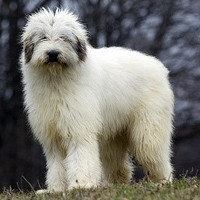
| A large dog but never heavy; vigorous and spectacular. The coat is long and well furnished on the head, all of the body and the limbs. Males are taller and stronger than females. |
Important proportions |
| The length of the body / height at withers 11 : 10. The depth of chest should be approximately half of the height at the withers. The muzzle is slightly shorter than the skull. |
Behaviour / temperament |
| A calm and stable dog. A good herd dog, very courageous and efficient fighter against possible animals prey (bear, wolf, lynx). Wary of strangers. He likes children. |
Head |
||
Cranial region |
||
Skull |
Moderate width, slightly domed. The upper profiles of the skull and muzzle are almost parallel. Seen from the front the upper line is slightly domed. The zygomatic arches are only slightly defined. Occipital protuberance well defined. | |
Stop |
Not too pronounced. | |
Facial region |
||
Nose |
Wide, well developed, black. | |
Muzzle |
A little shorter than the skull; well developed, tapering progressively towards the nose but never pointed; strong underjaw. | |
Lips |
Thick, tight, strongly pigmented. | |
Jaws and teeth |
Powerful jaws; complete dentition (lack of PM1 and M3 allowed), strong and healthy with well set white teeth; scissor bite. | |
Cheeks |
Not protruding. | |
Eyes |
Moderate size, oblique; the colour is hazel, dark brown or slightly lighter, never yellow. Eyelids well pigmented. Calm and intelligent expression. | |
Ears |
Relatively high set, “V” shaped with the tip slightly rounded, 10-15 cm long, hanging closely to the cheeks; cropping forbidden. | |
Neck |
| Moderate length, broad and powerful, without dewlap. |
Body |
||
Body |
Well developed. | |
Topline |
Straight and solid. | |
Withers |
Moderately defined. | |
Back |
Horizontal, strong and muscled. | |
Loin |
Moderately long, wide and very muscular. | |
Croup |
Muscled and moderately sloping towards the base of the tail. | |
Chest |
Not too long, broad, depth being approximately half of the height at the withers, ribs well sprung. | |
Underline and belly |
Slight tuck up without being whippety. | |
Tail |
| High set-on. At rest, it is carried hanging, reaching or lower than the hock; when the dog is alert or in action, the tail is carried higher, slightly curved, sometimes above the topline but never curled over the back. Docking is forbidden. |
Limbs |
Forequarters |
||
Generality |
Upright, seen from the front or the side. | |
Shoulders |
Moderate length, oblique, very muscular and well attached. The scapula-humerus angle is approximately 100°-105°. | |
Upper arm |
Moderate length, well muscled. | |
Elbows |
Close to the body, turning neither in nor out. | |
Forearm |
Sufficiently long, powerful and muscled. | |
Carpal |
Firm. | |
Pastern |
Slightly sloping seen from the side. | |
Forefeet |
Oval, compact and massive, toes are tight and arched, nails ash-grey colour. | |
Hindquarters |
||
Generality |
Very muscular and powerful, straight and parallel seen from behind. Angulations only slightly open. | |
Upper thigh |
Long, broad and very muscular. | |
Lower thigh |
Sufficiently long, muscled with good bone. | |
Stifle |
The femur-tibial angle is approximately 100°-105°. | |
Metatarsus |
Not too long, robust and almost vertical, seen from the side. The presence of dewclaws should not be penalized. | |
Hock |
Moderate height, strong, well bent, turning neither in nor out. | |
Hind feet |
Slightly longer than the front feet. | |
Gait and movement |
| Harmonious, free, well coordinated, powerful and effortless. The trot is preferred. The gallop is sustained and balanced. |
Skin |
| Thick, tight fitting and well pigmented. |
Coat |
||
Hair |
The coat is abundant on the head and body, harsh texture, straight and minimum length of 10 cm. The undercoat is more dense and supple and of a lighter colour. On the limbs the coat is shorter. The tail is well furnished. | |
Colour |
Piebald : The ground colour must be white with well defined black or grey markings. Solid colours : Solid white or solid grey. |
|
Size and weight |
||
Height at withers |
Male minimum 70 cm, ideal height 75 cm. Female minimum 65 cm, ideal height 70 cm. | |
Weight |
In proportion to the size. | |
Faults |
| • Any departure from the foregoing points should be considered a fault and the seriousness with which the fault should be regarded should be in exact proportion to its degree and its effect upon the health and welfare of the dog and its ability to perform its traditional work. • Faults listed should be in degree of seriousness. |
General faults |
 Overweight or weak subject. Tail curled or carried in a ring. Absence of teeth, other than PM1. Elbows turned in or out. Heavy gait. Overweight or weak subject. Tail curled or carried in a ring. Absence of teeth, other than PM1. Elbows turned in or out. Heavy gait. |
Serious faults |
| Sexual characters not sufficiently marked. Untypical expression. Round, protruding eyes. Wall eye. Erect ears. Coat too short (less than 8 cm). Curly coat or of a texture other than described in the standard. Topline sagging, arched or dipping. Spreading feet, turned out or in. Rear limbs : angulation too open. Cowhocks. Presence of brindle markings. |
Disqualifying faults |
| Aggressive or overly shy. Untypical subject. Absence of incisives or canines. Overshot or undershot. Albinism. Naturally absent or naturally short tail. Docked tail. Height at the withers less than 68 cm for males. Height at the withers less than 63 cm for females. |
NB : |
| • Any dog clearly showing physical or behavioural abnormalities shall be disqualified. • The above mentioned faults when occurring to a highly marked degree or frequently are disqualifying. • Male animals should have two apparently normal testicles fully descended into the scrotum. • Only functionally and clinically healthy dogs, with breed typical conformation should be used for breeding. |
Bibliography |
| https://www.fci.be/ |
Additional information from visitors |
| One of the three recognized livestock guarding and herding breeds of Rumania, the Mioritic Sheepdog is a reliable and valued worker. Named after the Mioritic region of the Carpathian mountains, this old herder was reportedly developed from Bukovina Sheepdogs, Hutsul Dogs, Bosnian Baraks, South-Russian Ovcharkas and a number of other bearded breeds of Eastern Europe centuries ago, with the most prized modern bloodlines coming from Moldavia. However, some fanciers believe that it is a naturally developed indigenous breed, without any influence of non-Romanian dogs, being a result of selective breeding of bearded (undesired) examples of other LGD breeds from the region. Dogs of this variety have been around in Romania since ancient times, but no efforts were made to establish a recognizable type until recently. Much older than the Carpatin, but not as old as the Bukovinac, the Mioritic Sheepdog is still very common and it remains a valued working breed in its homeland, as well as an increasingly popular Show contestant. Courageous, protective and alert, it is an excellent flock guardian, wolf-killer and property watchdog. The Mioritic Sheepdog can be unfriendly towards other dogs and needs proper socialization from an early age. This is a smart and trainable bearded mastiff, completely devoted to its owner, making an amenable family companion. Tall and massive, it is better suited for rural environments, but can be happy living in a city if provided with appropriate amounts of excercise. The Mioritic is a powerful working dogs, with a large head, broad shoulders and a reasonably wide, deep chest. In the past, some shepherds used to crop and dock their dogs, but the majorty of examples today are unaltered. The nose must be black, as do the eyerims and lips. The long coat is harsh, thick and wavy, commonly found in lighter pastel colourings ranging from white to gray, often with darker patches. Average height is around 28 inches, but larger dogs exist. |



 English (United Kingdom)

Comments