 |
Austrian Black and Tan Hound |
|
FCI standard Nº 63 |
||
Origin |
Austria | |
Translation |
C. Seidler | |
Group |
Group 6 Scenthounds and related breeds | |
Section |
Section 1.2 Medium size Scenthounds | |
Working |
With working trial | |
Acceptance on a definitive basis by the FCI |
Friday 03 September 1954 | |
Publication of the official valid standard |
Tuesday 10 October 1995 | |
Last update |
Tuesday 18 June 1996 | |
En français, cette race se dit |
 |
Brachet autrichien noir et feu |
Diese Norm ist in deutscher Sprache sichtbar |
 |
Brandlbracke |
En español, esta raza se dice |
 |
Sabueso Austriaco Negro y Fuego |
In het Nederlands, wordt dit ras gezegd |
 |
Brandlbracke |
Usage |
| The Black and Tan Austrian Hound is an universally popular hunting dog on account of its special suitability for heavy work on high mountains as well as on flat country for hunting by giving tongue and for the tracking of wounded game. |
Brief historical summary |
| The Black and Tan Austrian Hound (Brandlbracke) counts as a true descendant of the "Keltenb racke" (Celtic Hound). As with all breeds of older origin, there is no definite authentic history for the "Brandlbracke" until the middle of the 19th century. The reason for this is that until that date nocontrolled breeding took place. |
General appearance |
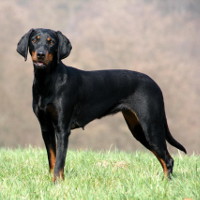
| Medium size. Strong, long cast, supple body. |
Behaviour / temperament |
| Sensitive nose; giving tongue, above all, for hare; tracking firmly and willingly with agreeable temperament. |
Head |
||
Cranial region |
||
Skull |
Skull broad. Occiput barely defined. | |
Facial region |
||
Nose |
Leather black. | |
Muzzle |
Strong. | |
Lips |
Well developed, close fitting, pigmented throughout. | |
Nasal bridge |
Straight nasal bridge. | |
Jaws and teeth |
Strong scissor bite. A complete set with 42 teeth is sought after; the absence of totally two PM1 or PM2 (premolar 1 or 2) is tolerated; the M3 (molar 3) are not taken into account. | |
Eyes |
Clear, dark brown, not showing any red in corner of eye. | |
Ears |
Of medium length, not too broad, set on high, rounded at tips, hanging flatly. | |
Neck |
| Medium length. Very strong. Dewlap not desired. |
Body |
||
Withers |
Well defined. | |
Back |
Long. | |
Loin |
Slightly arched. | |
Croup |
Falling away in slight slope. | |
Chest |
Broad and deep. | |
Tail |
| Long, tapering gradually, slightly bent. Pendant in repose. Coarse hair on underside, but without an obvious brush. |
Limbs |
Forequarters |
||
Generality |
Well developed. Legs straight and strong. | |
Shoulders |
Well laid back, well muscled. | |
Hindquarters |
||
Generality |
Well angulated. | |
Upper thigh |
Slim, moderately developed, long. | |
Feet |
| Strong, round, arched; toes fitting close together. Nails strong and black. Pads large and strong. |
Gait and movement |
| Ground covering, elegant. |
Coat |
||
Hair |
Smooth hair, close fitting, dense, full, resilient with silky sheen. Length approximately 2 cm. | |
Colour |
Black with small, clearly defined light to dark fawn markings. The two fawn markings above the eyes (Vieräugl) must be present. | |
Size and weight |
||
Height at withers |
48-56 cm. Dogs 50-56 cm, bitches 48-54 cm. | |
Faults |
| • Any departure from the foregoing points should be considered a fault and the seriousness with which the fault should be regarded should be in exact proportion to its degree and its effect upon the health and welfare of the dog and its ability to perform its traditional work. • Faults listed should be in degree of seriousness. |
General faults |
 Skull too narrow. Broad muzzle. Leathers folded, too pointed, narrow, short. Tail too short, too thick. Tail carriage bent too far upwards, lack of coarse hair on underside. Weak limbs. Shy temperament. Skull too narrow. Broad muzzle. Leathers folded, too pointed, narrow, short. Tail too short, too thick. Tail carriage bent too far upwards, lack of coarse hair on underside. Weak limbs. Shy temperament. |
Disqualifying faults |
| Aggresive or overly shy. Under or overshot mouth. More than two missing premolars 1 or 2. Any other colour than that stated. Lack of well defined fawn markings above eyes (Vieräugl). |
NB : |
| • Any dog clearly showing physical or behavioural abnormalities shall be disqualified. • The above mentioned faults when occurring to a highly marked degree or frequently are disqualifying. • Male animals should have two apparently normal testicles fully descended into the scrotum. • Only functionally and clinically healthy dogs, with breed typical conformation should be used for breeding. |
Bibliography |
| https://www.fci.be/ |



 English (United Kingdom)

Comments