 |
Austrian Pinscher |
|
FCI standard Nº 64 |
||
Origin |
Austria | |
Translation |
Elke Peper | |
Group |
Group 2 Pinscher and Schnauzer-Molossoid breeds- Swiss Mountain- and Cattle Dogs | |
Section |
Section 1.1 Pinscher | |
Working |
Without working trial | |
Acceptance on a definitive basis by the FCI |
Saturday 04 September 1954 | |
Publication of the official valid standard |
Tuesday 25 March 2003 | |
Last update |
Monday 05 May 2003 | |
En français, cette race se dit |
 |
Pinscher autrichien |
Diese Norm ist in deutscher Sprache sichtbar |
 |
Österreichischer Pinscher |
En español, esta raza se dice |
 |
Pinscher austriaco |
In het Nederlands, wordt dit ras gezegd |
 |
Oostenrijkse Pinscher |
Usage |
| Watch- and companion dog. |
Brief historical summary |
| The Austrian Pinscher descends from the ancient Austrian country pinschers that were widespread still in the second half of the 19th century, being modest, versatile farm dogs. In 1921 the systematic pure breeding of this breed began. On Oct. 16th, 1928, the breed was recognized by the Austrian Kennel Club (Österreichischer Kynologenverband) as Österreichischer kurzhaariger Pinscher (Austrian Shorthaired Pinscher). In the year 2000 the breed was renamed Österreichischer Pinscher (Austrian Pinscher). |
General appearance |
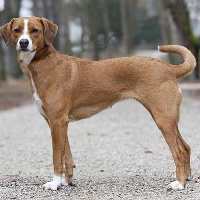
| Stocky dog of medium size with lively and bright expression. |
Important proportions |
| The ratio of height at withers to length of body is 9 to 10. The ratio of length of muzzle to length of skull is 4 to 6. |
Behaviour / temperament |
| Assertive, lively, alert, playful and especially devoted and friendly dealing with people familiar to him. Towards strangers he is suspicious and an incorruptible guard. His hunting instinct is only slightly developed. |
Head |
||
Cranial region |
||
Head |
Pear-shaped; in harmonious proportion to the body. | |
Skull |
Broad and rounded with pronounced frontal furrow and groove. Distinctly developed zygomatic arches, strong masticatory muscles. | |
Stop |
Well marked. | |
Facial region |
||
Nose |
Black. | |
Muzzle |
Strong, nasal bridge straight. | |
Lips |
Tight, smooth, well fitting, with dark pigmentation. | |
Jaws and teeth |
Strong, complete scissor bite. | |
Eyes |
Large eyeball in round palpebral aperture, eyerims close-fitting with dark pigmentation. | |
Ears |
Button ear (folded ear), small, set on high. | |
Neck |
| Strong, of medium length. |
Body |
||
Withers |
Well defined. | |
Back |
Short, broad, straight, tight. | |
Loin |
Short and broad. | |
Croup |
Long and broad. | |
Chest |
Long, deep, broad, barrel-shaped; well developed forechest. The muscles of the chest are strong and tight. | |
Underline and belly |
Belly slightly tucked up. | |
Tail |
| High set, strong, of medium length and densely covered with hair. |
Limbs |
Forequarters |
||
Generality |
Strong bone. Well muscled, straight legs, broad front. | |
Shoulders |
Shoulder blade long, well laid-back. | |
Upper arm |
Obliquely set. | |
Forearm |
Of medium length, straight. | |
Carpal |
Strong. | |
Pastern |
Short, moderately sloping. | |
Hindquarters |
||
Generality |
Strong bone. Well angulated. | |
Upper thigh |
Broad. | |
Lower thigh |
Of medium length. | |
Metatarsus |
Short. | |
Hock |
Strong. | |
Feet |
| Close-knit with strong nails. |
Gait and movement |
| Flowing and harmonious movement covering a lot of ground. |
Skin |
| Tight fitting. |
Coat |
||
Hair |
Thick double coat. The outer coat is short to medium-long, thick, smooth and close-lying. The undercoat is thick and short, buttocks slightly trousered. | |
Colour |
Russet gold (semmelgelb), brownish yellow, stag-red, black with tan-coloured markings. White markings: chest patch, muzzle, neck, throat, nape, feet and tip of tail. Lack of white markings is not a fault. | |
Size and weight |
||
Height at withers |
42 – 50 cm. (Males 44 – 50 cm, bitches 42 – 48 cm). | |
Faults |
| • Any departure from the foregoing points should be considered a fault and the seriousness with which the fault should be regarded should be in exact proportion to its degree and its effect upon the health and welfare of the dog and its ability to perform its traditional work. • Faults listed should be in degree of seriousness. |
Disqualifying faults |
 Aggressive or overly shy. Undershot, overshot. Aggressive or overly shy. Undershot, overshot. |
NB : |
| • Any dog clearly showing physical or behavioural abnormalities shall be disqualified. • The above mentioned faults when occurring to a highly marked degree or frequently are disqualifying. • Male animals should have two apparently normal testicles fully descended into the scrotum. • Only functionally and clinically healthy dogs, with breed typical conformation should be used for breeding. |
Bibliography |
| https://www.fci.be/ |



 English (United Kingdom)

Comments