 |
Blue Picardy Spaniel |
|
FCI standard Nº 106 |
||
Origin |
France | |
Translation |
Mrs. Peggy Davis. Revision : Iris Borianne and Prof. Claude Guintard. Official language (FR) |
|
Group |
Group 7 Pointing Dogs | |
Section |
Section 1.2 Continental Pointing Dogs; « Spaniel » type | |
Working |
With working trial | |
Acceptance on a definitive basis by the FCI |
Monday 06 December 1954 | |
Publication of the official valid standard |
Thursday 08 June 2023 | |
Last update |
Thursday 10 August 2023 | |
En français, cette race se dit |
 |
Epagneul bleu de Picardie |
Diese Norm ist in deutscher Sprache sichtbar |
 |
Blauer Picardie-Spaniel |
En español, esta raza se dice |
 |
Spaniel azul de Picardia |
In het Nederlands, wordt dit ras gezegd |
 |
Blauwe Spaniel van Picardie |
Usage |
| Pointing dog. |
Brief historical summary |
| In 19th-century Picardy, various authors described, in their writings, some black or black and white spaniels called “épagneuls du Nord” (“Spaniels of the North”). It was only from the early 20th century that the Blue Picardy Spaniel started running in a specific category until it became officially recognised as a breed. When the standard was officially registered in 1938, the general appearance and abilities of the Blue Picardy Spaniel were described in the following terms: “Quite low to the ground dog, well built for the job”. The main difference between the Blue Picardy Spaniel and the Spaniel of Picardy (the two PICARDY breeds) is the colour of their coat. A contact dog for chases within firing range, the Blue Picardy Spaniel adapts to all sorts of small game hunts and is particularly skilled in woodcock hunting. A daily walk is necessary to keep him fit and help him relax. He will always find his way to a happy cuddle. Out on a walk, his elegant, characteristic bluish coat will not go unnoticed. |
General appearance |
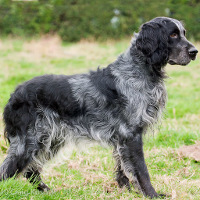
| Dog of medium proportions and a Continental spaniel-type (“Braque” in French) with flat, slightly wavy hair. The singularity and elegance of the Blue Picardy Spaniel stem from the typical colour of his coat. Quite low to the ground dog, well built for the job. General appearance on the whole : a true French Spaniel. |
Important proportions |
| The length between the tip of the shoulder and the ischium exceeds by roughly 1/10th the height at the withers. Chest well developed and let down to the elbows. Length of the muzzle should be equal to that of the skull. |
Behaviour / temperament |
| Flexible and gentle dog with an even temperament, well adapted to family life; should come out as placid and never aggressive. An athletic dog, the Blue Picardy Spaniel enjoys a daily walk to work off his energy. |
Head |
||
Cranial region |
||
Head |
The lateral sides should be almost parallel between them. The upper longitudinal axes of the skull and muzzle are parallel or slightly convergent. | |
Skull |
Oval, relatively wide without prominent parietal bones, occipital protuberance slightly visible. | |
Stop |
Well marked. | |
Facial region |
||
Nose |
Black, broad, well open nostrils. Colour of nostrils in accordance with coat. | |
Muzzle |
Long and quite broad. | |
Lips |
Wide, thick and pendulous forming a distinctly square muzzle. | |
Jaws and teeth |
Complete scissor bite. | |
Cheeks |
Not too pronounced, with tight-fitting skin. | |
Eyes |
Calm expression; eyes dark, large, well open. | |
Ears |
Must be set approximately at eye level, quite thick, framing the head; beautiful wavy silky hair; the leather stretched in its length must reach the tip of the muzzle. | |
Neck |
| Well set. A slight dewlap is permitted. |
Body |
||
Topline |
Straight, well sustained when dog is in motion or standing still. | |
Withers |
Dry, well pronounced and broad. | |
Back |
Well sustained. The length of the body slightly exceeds the height at the withers. | |
Croup |
Slightly sloping. | |
Chest |
Slightly sprung and descending to elbow level. | |
Underline and belly |
Slightly tucked up. | |
Tail |
| Not extending too much beyond the point of the hock and usually without a hook. Beautiful silky feathers. |
Limbs |
Forequarters |
||
Generality |
Forelegs straight; rear side of forelegs is covered in wavy, medium-long feathers above the elbow, and distinctly longer feathers on the forearm down to the metacarpus. | |
Shoulders |
Close to the chest and quite oblique (forming a 50° angle to the horizontal line). | |
Upper arm |
Slightly oblique. Forming an angle of approximately 60° to the horizontal line. | |
Forearm |
Strong and well muscled. | |
Carpal |
Well defined, dry. | |
Pastern |
Very slightly oblique when viewed from the side. | |
Forefeet |
Rather round, a little broad but not flat, well furnished with hair in the tightly closed interdigital spaces. Colour of the pads should be in accordance with coat genetic colours. | |
Hindquarters |
||
Generality |
When viewed from behind, the hindquarters are vertical. Legs are strong and muscled from the upper thigh down to the lower thigh. | |
Upper thigh |
Broad and rather long, with powerful and quite visible muscles and forming a 65° to 70° angle to the horizontal line. | |
Lower thigh |
Long, with visible muscles and furnished with profuse fringes. | |
Hock |
Bent without exaggeration and furnished with fringes from the hock to the foot. | |
Hind feet |
Rather round, a little broad but not flat, well furnished with hair in the tightly closed interdigital spaces. | |
Gait and movement |
| Easy, supple, even and strong, yet elegant. Legs should move within the body line, without inducing excessive vertical movement in the topline. When galloping, the topline should display a slight tilting movement. |
Skin |
| Supple and close fitting. |
Coat |
||
Hair |
Flat or slightly wavy. Legs and tail well furnished with fringes. | |
Colour |
Silver grey to grey black specled forming a bluish shade, with or without black patches. (“mixed black and white and/or black and white speckling” resulting in an overall silver-grey black coat according to the traditional classification system). | |
Size and weight |
||
Height at withers |
57 to 62 cm for the males, 55 to 60 cm for the females. A tolerance of ± 2 cm is permitted yet undesirable. |
|
Faults |
| • Any departure from the foregoing points should be considered a fault and the seriousness with which the fault should be regarded should be in exact proportion to its degree and its effect upon the health and welfare of the dog and its ability to perform its traditional work. • Faults listed should be in degree of seriousness. |
Serious faults |
 Skull too broad or too narrow. Ear too short or triangular. Nose any colour other than black; lack of pigmentation (nose largely flesh-coloured). Eye : Light and too small. Lack of bone. Skull too broad or too narrow. Ear too short or triangular. Nose any colour other than black; lack of pigmentation (nose largely flesh-coloured). Eye : Light and too small. Lack of bone. |
Disqualifying faults |
| Aggressive or overly shy dogs. Overshot or undershot bite. Teeth one missing canine or 2 missing incisors or more than 2 other missing teeth (PM or M) with the exception of PM1 and M3. Size outside the limits of tolerance of the standard. Lack of type. Atypical coat (white or brown patches). |
NB : |
| • Any dog clearly showing physical or behavioural abnormalities shall be disqualified. • The above mentioned faults when occurring to a highly marked degree or frequently are disqualifying. • Male animals should have two apparently normal testicles fully descended into the scrotum. • Only functionally and clinically healthy dogs, with breed typical conformation should be used for breeding. |
Bibliography |
| https://www.fci.be/ |
Detailed history |
| The Blue Spaniel of Picardy, still too little known by the amateurs of dogs of stop, descends in direct line of the old and vast family of the Spaniels of France. As early as the fourteenth century, Gaston Phoebus and Henri de Ferrieres gave us the first descriptions of the "oysel dogs" and "wolfing dogs" in their hunting treatises, but it is probable that the origin of the Blue of Picardy is well before to these testimonies. Over time, the family of Spaniels dissociated itself into many regional types, whose size, colors, hunting style varied according to the territories and habits of their masters. Picardy has thus been the stronghold of one of these varieties, which it has fashioned in a very characteristic way. Indeed, the Bay of Somme as well as the multiple valleys formed by swampy peat bogs and the seaside where the dunes stopped the marshes (or "low fields") were the paradise of the waterfowl who, by employing the Spaniels, shaped their numerous qualities. In addition, the area was often visited by the British, especially towards the end of the 19th century, when game began to become rare in Great Britain, which was one of the reasons for the selection of breeds for the larger and larger quest. fast and which encouraged the most bitten and wealthy hunters to cross the Channel to satisfy their passion. Thus, the Picardy marshes, like the Breton heaths, became the favorite hunting grounds of the English who made known their dogs and especially their Setters. These dogs were brought in large numbers before the institution of quarantine (prohibiting the return of dogs to Britain), which had the effect of limiting their presence, without really compromising, to the extent that some owners had managed to to put their companions on board in the Picardy farms. Thus the Epagneuls of Picardy undoubtedly received a certain supply of English blood which vivifia their qualities. It was at the beginning of the century that the Picardian Spaniel made its appearance in the dog world: in 1904, a certain Mr. Ratel presented at the Dog Show of Paris a perfectly fixed type, which was then classified among the French Epagneuls, since the family was not yet differentiated; it was not until 1907, when the Epagneul club, which had just been formed, created exhibition classes for each of the varieties. From the Blue Spaniel of Picardy, there was really no question that in 1921, when was formed the Club of the Picardian Spaniel and the Blue Spaniel of Picardy, whose name is significant: because of its particular color, gray-black speckled with black plates, the cynologists made indeed the Blue Spaniel a distinct race although it is, obviously, only one variety of the Picardian Spaniel, with for principal particularity its pigmentation black and not brown. This color is certainly due to infusions of Setter English blue belton, and perhaps Setter Gordon, after 1900. Nowadays, the Bleu de Picardie remains confined, with a few exceptions, in its original terroir, which is unfortunate because this dog is one of the most successful national breeds on the hunt. Contrary to widely held opinion, the Picardian Blue Spaniel is neither heavy nor slow, like the ancient Spaniels, just as it would be unfair to call it half-blood, as it is sometimes done. "English, because this dog has many qualities very specific to the Spaniels. It is an indefatigable dog, able to go at a gallop or trot, depending on the nature of the terrain, large areas. His nose is very fine, certainly more "long" than that of the French Spaniel. Its stature near the ground, solid and dry, goes hand in hand with its velocity and its activity, which does not prevent it from being also a good dog for the common hunters, since it does not move away excessively from the gun. The Blue Spaniel is also an outstanding companion for hunting in front of you, because, if he is not the "air drinker" of the vast grounds discovered, he becomes however a famous auxiliary as soon as he must search the hedges and woods where he is insensitive to bushes as brambles with his strong pelisse. He is also a remarkable water dog. However, this dog is not specialized; on the contrary, its versatility would allow it to be used in almost all regions of France, just as it can be used successfully for all game species, from pheasant to rabbit and partridge to woodcock. His report is usually almost natural, but before engaging him, the master must of course check the firmness and safety of his arrest, otherwise it is highly likely that his enthusiasm to bring back the game would make him forget mark the stop. The Bleu de Picardie is a dog of the easiest to train, and, out of hunting, his greatest passion is to please his master. Its extreme docility, its great stability of character make it a flexible dog to handle, even by a person little experienced. At home, he is quickly appreciated by the whole family, thanks to his placidity and his discretion. The hostess is grateful for her calm and is sensitive to her elegance, the beauty of her dress with blue highlights. Likewise, she does not hesitate to take her when she goes shopping because she is sure of her patience and good manners. Children are certainly the first to adopt the dog for its natural tenderness, its taste of the game, which parents can also encourage without concern, given the absence in this dog, any brutality. On occasion, however, while being quiet, the Blue Spaniel will perfectly know how to warn and defend his masters. This dog shows many skills that are unfortunately too little recognized. Some are right to think about it "we will look far what is on the doorstep". Indeed, it would be high time to honor the Picardian Spaniel, and those who seek to show a little originality, while wanting a French dog, should turn to this breed which they can only rent cynegetic skills and easy character. In addition, they can only be proud of its beautiful slate dress with subtle bluish reflections and well fringed, which dresses with elegance its very athletic structure. |



 English (United Kingdom)

Comments