
 |
Smålandsstövare |
|
FCI standard Nº 129 |
||
Origin |
Sweden | |
Translation |
Renée Sporre-Willes | |
Group |
Group 6 Scent Hounds and Related Breeds | |
Section |
Section 1.2.Medium sized Hounds | |
Working |
With working trial | |
Acceptance on a definitive basis by the FCI |
Wednesday 12 January 1955 | |
Publication of the official valid standard |
Tuesday 22 August 2017 | |
Last update |
Monday 02 October 2017 | |
En français, cette race se dit |
 |
Chien courant du Smaland |
Diese Norm ist in deutscher Sprache sichtbar |
 |
Småland Bracke |
En español, esta raza se dice |
 |
Sabueso de Småland |
In het Nederlands, wordt dit ras gezegd |
 |
Smålandsstövare |
Usage |
| Scent hound used for hunting hare and fox. It is not a pack hound and not used for hunting deer. |
Brief historical summary |
| A great variety of scent hounds existed in the county of Småland during the 19Th century. Some, whose ancestry came from German, Polish and Baltic hounds, had accompanied soldiers returning to Småland from the great wars (1611-1718). Those hounds together with local farm dogs of spitz type with an addition of English hounds became the foundation of the Smålandsstövare. Size as well as colour varied, as did the length of tail. Some where black-and-tan, others red or yellow. White markings were common. Some dogs were born with short tails. In the early 20Th century great efforts were made to re-establish the old Smålandsstövare, mainly the bobtailed variety, although the first standard drawn in 1921 allowed both the natural short and long tail. Colour was primarily decided to be black-and-tan but red and yellow was allowed as was white markings. The Smålandsstövare has had continuing additions of new blood, sometimes with strong lines to other breeds. The last time new blood was added was in the 1950’s, when for a short period, dogs of accepted type but with unknown background where registered as Smålandsstövare. |
General appearance |
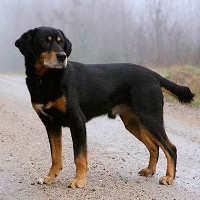
| Robust dog with a somewhat elegant look. It should be strong but not heavy in built. Coat should be harsh. |
Important proportions |
| Almost square in body. Depth of body should be nearly equal to half of the height at withers. |
Behaviour / temperament |
| Calm, kind dog with a faithful and keen temperament. |
Head |
||
Cranial region |
||
Skull |
Lean and of medium length. Broadest between the ears. | |
Stop |
Stop well defined, distance from occiput to stop should be equal to that from stop to tip of nose. | |
Facial region |
||
Nose |
Nose black, with large nostrils. | |
Muzzle |
Muzzle well developed, neither coarse nor snipy. | |
Lips |
Upper lips only slightly overhanging. | |
Nasal bridge |
Bridge of nose straight and parallel to line of skull. | |
Jaws and teeth |
Scissor bite. Teeth strong and well developed. | |
Cheeks |
Cheeks lean. | |
Eyes |
Dark brown with calm expression. | |
Ears |
Set fairly high and slightly raised when the dog is attentive. Slightly shorter than the distance from base of ear to half-way along muzzle. Hanging flat and tips rounded. | |
Neck |
| Moderately long, powerful without being coarse, merging beautifully into shoulders. Skin on neck supple and close fitting. |
Body |
||
Withers |
Withers well defined. | |
Back |
Back short and powerful. | |
Loin |
Loin musclar and slightly arched. | |
Croup |
Croup slightly inclined, long and broad. | |
Chest |
Chest well developed with well sprung ribs. | |
Underline and belly |
Belly only slightly tucked up. | |
Tail |
| Either long and set on in a straight line with the back. Straight or slightly curved in sabre fashion. Barely reaching hocks. Half length tails also permissible. When the dog moves, tail preferably not carried above the level of the back. Naturally born short tail ( stumpy tail ), beartail permissible. |
Limbs |
Forequarters |
||
Generality |
When viewed from front forelegs appear straight and parallel. Strong bone in harmony with the general appearance of the dog. | |
Shoulders |
Shoulder long, muscular and well laid back. Closely lying. | |
Upper arm |
Upper arm long and forming a right angle to shoulders. | |
Elbows |
Elbow set close to body and not visible under ribcage. | |
Pastern |
Springy and forming a slight angle to forearm. | |
Forefeet |
Firm with well knuckled and tight toes. | |
Hindquarters |
||
Generality |
Strong and parallel when viewed from behind. | |
Upper thigh |
Muscles well developed and thighs broad when viewed from side. | |
Stifle |
Well angulated. | |
Metatarsus |
Short, lean and straight. | |
Hock |
Well angulated. | |
Hind feet |
Like front feet. Dewclaws undesirable. | |
Gait and movement |
| Parallel, strong and long-reaching. |
Coat |
||
Hair |
Medium length, harsh, close fitting coat that is coarser on back and neck. Undercoat short, dense and soft. On head, ears and front of legs coat should be short and smooth coach. Under the tail and back of thighs top coat longer than on the back. Coat well developed between toes and pads. | |
Colour |
Black-and-tan. Tan, any shade from amber to a warm auburn. Small white markings permissible on chest and toes. | |
Size and weight |
||
Height at withers |
Males 46-54 cm, ideal size 50 cm. Females 42-52 cm, ideal size 46 cm. | |
Faults |
| • Any departure from the foregoing points should be considered a fault and the seriousness with which the fault should be regarded should be in exact proportion to its degree and its effect upon the health and welfare of the dog and its ability to perform its traditional work. • Faults listed should be in degree of seriousness. |
General faults |
 Wrong proportions, too rectangular in body. Lack of masculinity or femininity. Heavy head, broad skull. Short or snipey muzzle. Pendulous lip corner. Overshot or undershot bite, level bite. Light eyes. Too long in back. Short, steep croup. Tail carried over level of the back. Restricted hind movement. Short or thin coat. Lack of tan-markings ; black pencilling in the tan. Too much white or white in non-permissible areas. Liver-and-tan colour. Wrong proportions, too rectangular in body. Lack of masculinity or femininity. Heavy head, broad skull. Short or snipey muzzle. Pendulous lip corner. Overshot or undershot bite, level bite. Light eyes. Too long in back. Short, steep croup. Tail carried over level of the back. Restricted hind movement. Short or thin coat. Lack of tan-markings ; black pencilling in the tan. Too much white or white in non-permissible areas. Liver-and-tan colour. |
Disqualifying faults |
| Aggressive or overly shy. Aloofness. Pronounced over- or undershot bite. Height at withers which is less than or exceeds allowed variations by more than 1 cm. |
NB : |
| • Any dog clearly showing physical or behavioural abnormalities shall be disqualified. • The above mentioned faults when occurring to a highly marked degree or frequently are disqualifying. • Male animals should have two apparently normal testicles fully descended into the scrotum. • Only functionally and clinically healthy dogs, with breed typical conformation should be used for breeding. |
Bibliography |
| https://www.fci.be/ |
Detailed history |
| The Smålandsstövare owes the life to a single man, Baron Frederick J. von Essen de Stromsberg. Among the various hunting dogs present in central Sweden around 1900, there was one with a truncated tail, which is now thought to have originated in Russia. It was with this dog that von Essen embarked on breeding at the very beginning of the twentieth century. The selection was well underway, and as early as 1921 he managed to have his race recognized by the dog authorities. Since then, the standard has been revised twice, in 1952 and 1968. This dog is not known outside of his country of origin. It should be noted that the Canine Central Society has not included any subject in the French Book of Origins in 1990. Balanced, intelligent and affectionate, this medium-sized animal has a very sharp flair, which is why it is considered a remarkable hunter of foxes and hares. What's more, he works on all terrains and in all weathers. |



 English (United Kingdom)

Comments