
 |
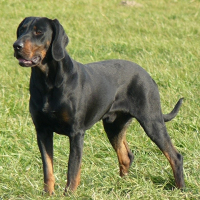
Slovakian Hound |
|
FCI standard Nº 244 |
||
Origin |
Slovakia | |
Translation |
Mrs. C. Seidler | |
Group |
Group 6 Scent Hounds and Related Breeds | |
Section |
Section 1.2.Medium sized Hounds | |
Working |
With working trial | |
Acceptance on a definitive basis by the FCI |
Tuesday 16 April 1963 | |
Publication of the official valid standard |
Tuesday 16 April 1963 | |
Last update |
Monday 19 August 1996 | |
En français, cette race se dit |
 |
Chien courant slovaque |
Diese Norm ist in deutscher Sprache sichtbar |
 |
Slowanischer Laufhund |
En español, esta raza se dice |
 |
Sabueso Eslovaco |
In het Nederlands, wordt dit ras gezegd |
 |
Slovensky Kopov |
In his country of origin, his name is |
Slovenský Kopov |
Usage |
| This breed is distinguished through its enduring hours-long following of a warm trail or scent while giving tongue. Also distinguished by its keenness and therefore used in its native country for hunting wild boar and predatory. |
General appearance |
| Always solid black with tan markings. Lightish body build, yet solid bone structure. Longish rectangle. |
Behaviour / temperament |
| Spirited temperament. Extraordinarily developed sense of direction. |
Head |
||
Cranial region |
||
Skull |
Flat domed top skull ; shape of a longish rectangle. Superciliary ridges and frontal furrow marked; occipital protuberance hardly marked. The direction of the axes of the muzzle and of the skull is parallel. | |
Stop |
Forms an angle of about 45°. | |
Facial region |
||
Nose |
Always black in colour, relatively large, moderately tapering; nostrjls moderately open. | |
Lips |
Not overlapping, close fittfng with noticeable opened corner of Mouth. | |
Nasal bridge |
Bridge of nose straight, in keeping with the skull long and not too broad. | |
Jaws and teeth |
Jaws of regular shape, firm, with well developed complete bite. | |
Eyes |
Dark, set in somewhat deep. Show liveliness and courage. Eyelids always black; almond shaped. | |
Ears |
Set on somewhat above the line of the eyes, carried flat along the head, with rounded tip and of medium length. | |
Neck |
| Well set, carried at an angle of 135°, rather short, muscular and without loose skin. |
Body |
||
Back |
Straight, medium long. | |
Loin |
Not too long, suitably broad, firm and muscular. | |
Croup |
Not too long, medium breadth, rounded. | |
Chest |
Forechest broad and well developed. Medium depth, suitably broad and appropriately long. | |
Ribs |
Ribs arched, set slanting. | |
Underline and belly |
Moderately tucked up. | |
Tail |
| Set on somewhat low, below the upper line ; fittingly strong, tapering to the tip and reaching to the hock. Pendant in repose; curved upwards in sabre shape to a height of 150° when alert. |
Limbs |
Forequarters |
||
Shoulders |
Angle at shoulder joint about 110°. | |
Upper arm |
Rather short, well developed, muscular. | |
Forearm |
In vertical position, dry. | |
Carpal |
Short. | |
Pastern |
Not too long. somewhat sloping. | |
Forefeet |
Oval; well arched toes; nails always black and strong. Pads dark and well developed. | |
Hindquarters |
||
Upper thigh |
Sufficiently broad; fittingly long, muscu1ar. | |
Lower thigh |
Broad, appropriate in length, well muscled. | |
Metatarsus |
About 8 cm long, moderate1y slanting forward ; no dewc1aws. | |
Hock |
Set on in a height of about 15 cm, moderately broad. Angle of hock about 150°. | |
Hind feet |
Oval; toes tight and well arched; pads well developed and black. | |
Gait and movement |
| Lively and balanced. |
Skin |
| Dark brown to black, close fitting without folds or loose skin. |
Coat |
||
Hair |
2-5 cm long, medium coarse, close fitting and dense; longer on back, neck and tail. Undercoat dense, especially during winter months, but must not be lacking in summer. | |
Colour |
Black with brown to mahogany coloured tan markings on limbs. | |
Size and weight |
||
Height at withers |
For dogs 45 to 50 cm, for bitches 40 to 45 cm. | |
Weight |
15 to 20 kg. | |
Faults |
| • Any departure from the foregoing points should be considered a fault and the seriousness with which the fault should be regarded should be in exact proportion to its degree and its effect upon the health and welfare of the dog and its ability to perform its traditional work. • Faults listed should be in degree of seriousness. |
General faults |
 Heavy, clumsy, stocky build. Head too heavy. Lips overlapping. Incomplete bite. Over- or undershot mouth. light eye, eyelids loose or too tight. Leathers too light, pointed. Loose skin on neck (throatiness). Soft back. Flat ribcage (serious fault) . Remarkably too long tail, tail carriage above topline even in repose. Incorrect position of limbs. Soft feet. Coat too short, without undercoat; coat too long, wavy. Colour other than black, white markings, unclear boundary of tan markings. Oversize. Heavy, clumsy, stocky build. Head too heavy. Lips overlapping. Incomplete bite. Over- or undershot mouth. light eye, eyelids loose or too tight. Leathers too light, pointed. Loose skin on neck (throatiness). Soft back. Flat ribcage (serious fault) . Remarkably too long tail, tail carriage above topline even in repose. Incorrect position of limbs. Soft feet. Coat too short, without undercoat; coat too long, wavy. Colour other than black, white markings, unclear boundary of tan markings. Oversize. |
Disqualifying faults |
| Aggressive or overly shy dogs. |
NB : |
| • Any dog clearly showing physical or behavioural abnormalities shall be disqualified. • The above mentioned faults when occurring to a highly marked degree or frequently are disqualifying. • Male animals should have two apparently normal testicles fully descended into the scrotum. • Only functionally and clinically healthy dogs, with breed typical conformation should be used for breeding. |
Bibliography |
| https://www.fci.be/ |



 English (United Kingdom)

Comments