 |
Hamiltonstövare |
|
FCI standard Nº 132 |
||
Origin |
Sweden | |
Translation |
Mrs. Renée Sporre-Willes | |
Group |
Group 6 Scenthounds and related breeds | |
Section |
Section 1.2 Medium-sized hounds | |
Working |
With working trial | |
Acceptance on a definitive basis by the FCI |
Thursday 06 January 1955 | |
Publication of the official valid standard |
Tuesday 22 August 2017 | |
Last update |
Monday 02 October 2017 | |
En français, cette race se dit |
 |
Chien courant de Hamilton |
Diese Norm ist in deutscher Sprache sichtbar |
 |
Hamilton Bracke |
En español, esta raza se dice |
 |
Sabueso Hamilton |
In het Nederlands, wordt dit ras gezegd |
 |
Hamilton Stövare |
Usage |
| Scent hound that gives tongue and is used for hunting hare and fox. It is not a pack hound and it is never used for hunting deer. |
Brief historical summary |
| Scent hounds have been known in Sweden since the 16th century. Hunting with hounds was up to 1789 a privilege for royalty and gentry only. It was not until the end of the 18th century that the ban that had prevented the peasantry from hunting the land was lifted. Hounds earlier kept only by the nobility became known and commonly spread. The origin of the Hamiltonstövare is believed to be a mixture of scent hounds from Southern Germany, Switzerland as well as Foxhounds and Harriers. At the first dog show in Sweden in 1886 some 189 scent hounds were on exhibition. Among them were a dog and a bitch, named Pang and Stella, owned by Count Adolf Patrik Hamilton. This couple is considered to be the origin of the Hamiltonstövare, or as the hounds initially were called, Swedish hound. The breed gained the name Hamiltonstövare in 1921 as a homage to the man that had created the breed, the founder of the Swedish Kennel Club, Count A.P. Hamilton. |
General appearance |
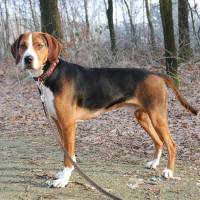
| Rectangular, well proportioned, giving impression of great strength and stamina. Never heavy. The sexual dimorphism should be clearly defined. Tricoloured. |
Important proportions |
| Rectangular body and longish head. |
Behaviour / temperament |
| Friendly and even-tempered. |
Head |
||
Cranial region |
||
Head |
Longish head. | |
Skull |
Slightly arched and moderately broad. | |
Stop |
Well defined but not too pronounced. | |
Facial region |
||
Nose |
Black, well developed with large nostrils. | |
Muzzle |
Long, strong and seen from above or the side almost evenly broad. Bridge of nose straight and parallel to line of skull. Distance from occiput to stop should be equal to that from stop to tip of nose. | |
Lips |
Upper lips thin, tight, softly rounded and slightly overhanging. Males have more pronounced lips than females. | |
Jaws and teeth |
Scissor bite. Teeth strong and well developed. | |
Cheeks |
Lean. | |
Eyes |
Almond shaped, dark brown with calm expression. | |
Ears |
Soft, hanging flat with fore edge close to cheek. Ears slightly shorter than the measure from set on to half way along the muzzle. Ears to be raised at set on, only very slightly to reach top of skull when alert. | |
Neck |
| Long, powerful and well set on into shoulders. Skin on neck supple and close fitting. Males should have a well-defined arch of nape. |
Body |
||
Withers |
Well defined. | |
Back |
Level and powerful. | |
Loin |
Muscular and slightly arched. | |
Croup |
Slightly inclined, long and broad. | |
Chest |
Deep, long, well developed and reaching elbows. | |
Ribs |
Ribs moderately sprung. | |
Underline and belly |
Belly only slightly tucked up. | |
Tail |
| Set in line with back, reaching hock. Carried straight or slightly curved in sabre fashion. Broad at base and tapering towards tip. When the dog moves, tail preferably not carried above the level of the back. |
Limbs |
Forequarters |
||
Generality |
Strong bone in harmony with the general appearance of the dog. When viewed from front, forelegs to be straight and parallel. | |
Shoulders |
Long, muscular and well-laid back. Closely attached to chest. | |
Upper arm |
Long and well angulated to the shoulder blade. | |
Elbows |
Close to body and not visible under ribcage. | |
Pastern |
Springy and forming a slight angle to forearm. | |
Forefeet |
Oval in shape with well knuckled, tight toes. | |
Hindquarters |
||
Generality |
Straight and parallel when viewed from behind. | |
Upper thigh |
Broad and well muscled. | |
Stifle |
Well angulated. | |
Metatarsus |
Short, lean and perpendicular when dog is standing still. | |
Hock |
Well angulated. | |
Hind feet |
Oval in shape with well knuckled, tight toes. | |
Gait and movement |
| Parallel, powerful and long-reaching. |
Coat |
||
Hair |
Harsh, not too short, lying very close to body. On head, ears and front of legs coat should be very short and smooth. Under tail and on back of thighs hairs might be slightly longer. | |
Colour |
Tricolour. On the adult dog black colour to form a mantle to continue on upper side of neck and upper side of tail. Tan on head, ears and legs, as well as on sides of the neck, on shoulders, under body, on thighs and under the tail. Clear marking between the black mantel and the tan on thighs. The tan colour can range from a golden tint to a rich, deep rusty red. White markings as a blaze, on throat, upper side of neck, collar tolerated, on brisket, tip of tail and lower part of legs and on feet. | |
Size and weight |
||
Height at withers |
Males: Ideal height 57 cm, allowed variation 53–61 cm. Females: Ideal height 53 cm, allowed variation 49–57 cm. |
|
Faults |
| • Any departure from the foregoing points should be considered a fault and the seriousness with which the fault should be regarded should be in exact proportion to its degree and its effect upon the health and welfare of the dog and its ability to perform its traditional work. • Faults listed should be in degree of seriousness. |
General faults |
 Lack of sexual dimorphism. Broad skull, pronounced occiput. Short or snipy muzzle, dish-face. Bulging cheeks. Over- or undershot bite, level bite. Light eyes. Soft back. Steep shoulder blades. Short, steep croup. Tail carried above the line of the back. Restricted hind movement. Undefined mantle with strong mixture of black and tan hairs overly marked with black that covers sides of trunk, shoulders and thighs in the adult dog. Heavily marked with black or tan as well as overly marked with white. Lack of sexual dimorphism. Broad skull, pronounced occiput. Short or snipy muzzle, dish-face. Bulging cheeks. Over- or undershot bite, level bite. Light eyes. Soft back. Steep shoulder blades. Short, steep croup. Tail carried above the line of the back. Restricted hind movement. Undefined mantle with strong mixture of black and tan hairs overly marked with black that covers sides of trunk, shoulders and thighs in the adult dog. Heavily marked with black or tan as well as overly marked with white. |
Disqualifying faults |
| Aggressive or overly shy dogs. Shy and severely aloof. Pronounced over- or undershot bite. Two-coloured (yellow-white, black-white, black-tan). All other colours or marking than the ones in the standard. Size the limits in the standard. Blue eyes, one or both. |
NB : |
| • Any dog clearly showing physical or behavioural abnormalities shall be disqualified. • The above mentioned faults when occurring to a highly marked degree or frequently are disqualifying. • Male animals should have two apparently normal testicles fully descended into the scrotum. • Only functionally and clinically healthy dogs, with breed typical conformation should be used for breeding. |
Bibliography |
| https://www.fci.be/ |



 English (United Kingdom)

Comments