 |
Hanoverian Scent Hound |
|
FCI standard Nº 213 |
||
Origin |
Germany | |
Translation |
C. Seidler, revised by E.Peper, latest corrections & revisions by Christina Bailey Official version: (DE) |
|
Group |
Group 6 Scenthounds and related breeds | |
Section |
Section 2 Scenthounds/Leash Hounds | |
Working |
With working trial | |
Acceptance on a definitive basis by the FCI |
Tuesday 06 October 1959 | |
Publication of the official valid standard |
Thursday 19 March 2015 | |
Last update |
Tuesday 26 May 2015 | |
En français, cette race se dit |
 |
Chien de recherche au sang de Hanovre |
Diese Norm ist in deutscher Sprache sichtbar |
 |
Hannoverscher Schweisshund |
En español, esta raza se dice |
 |
Rastreador de Hannover |
In het Nederlands, wordt dit ras gezegd |
 |
Hannoveraanse Zweethond |
Usage |
| Tracking hound for wounded game, Scenthound. In accordance with his hunting requirements as a highly specialised huntingdog for the tracking of wounded game, the Hannoverscher Schweißhund has to display all by the FCI recognized Breed Club’s required hunting abilities, endurance, potential the working trials and be useful for the more difficult tracking of game. |
Brief historical summary |
| The Hannoverscher Schweißhund has developed almost unchanged from the so called «liam hound» (leash hound) of the early Middle Ages. The Liam hound, from the breed section of the «Bracke», already played an extraordinary part at the time of the establishment of clan rights of the Germanic tribes (in about 500AD). With the invention of firearms, the methods of hunting big game altered. Dogs were needed to search for wounded game. The liam hound offered the best conditions for this and so he became a « Liam-Scenthound ». This breed description stayed in place until the hunting estate of the Kingdom of Hannover got more involved with this breed The Hanoverian hunting estate in the kingdom of Hannover developed this breed further and preserved the proven methods of handling these hounds. The Deutsche Schweißhund developed into the Hannoversche Schweißhund.Since 1894 the registered «Verein Hirschmann e.V.» has been taking care of the breed, Since then the breeding of these dogs has continued strictly with regard of their working ability and the dogs are used exclusively in hunting grounds for big game as specialists in tracking cloven-hoof game. The dissertation of Dr. Wolf-Eberhardt Barth of the “Forstlichen Fakultät of the Georg-August University in Gőttingen” about the subject “Der Hannoversche Schweißhund as an example of the development of the German Gundogs” (Magazines of the Landesjagdverbands Freie und Hansestadt Hamburg e.V., Landesjägerschaft, Magazine 2, Hamburg 1970, 96 S) is the scientific base for the insight into the history of this old gundog breed, which is correctly named German culture asset (Deutscher Schweißhund). |
General appearance |
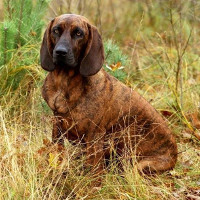
| In general appearance the highly efficient Hannoverscher Schweißhund is of medium size, well proportioned and powerful. Well set strongly muscled fore and hind limbs qualify him for tireless work. Too long legs, specially overbuilt forequarters, affect his work with nose to ground and are foreign to his type. The broad, deep chest provides ample room for the lungs and enables long, strenuous chases. The slightly wrinkled forehead and the clear dark eyes produce the serious expression typical of the Hannoverscher Schweißhund. Also typical for the breed is the red primary colour of the coat, which can vary from a pale fawn colour to a dark brindle, almost black appearing colouring. |
Important proportions |
| Length of body to height at withers : 1.4 to 1 Depth of chest to height at withers : 0.5 to 1 Length of bridge of nose to length of head : 0.5 to 1 |
Behaviour / temperament |
| Calm and assured temperament. Sensitive with his handler, choosy and discerning with strangers. High capability of concentration in any tracking work with strong loyalty to the hunter in charge. |
Head |
||
Cranial region |
||
Head |
Forehead slightly wrinkled. | |
Skull |
Broad, increasing in width towards the rear, flatly rounded. Occiput barely pronounced. Seen from the side, superciliary ridges clearly defined. | |
Stop |
Mostly strongly pronounced, more so in males. | |
Facial region |
||
Nose |
Broad, mostly black, rarely dark brown. Nose large, broad, nostrils well opened. | |
Muzzle |
Strong, deep and broad. Well developed for being used (about 50% of length of head). Mandible strong. | |
Lips |
Broad and pendulous, well rounded. | |
Nasal bridge |
Bridge of nose slightly arched or almost straight, more arched in males. Gradually narrowing towards forehead. | |
Jaws and teeth |
Jaws normally developed, very strong, straight, providing all teeth with sufficient room. 42 teeth. Scissor or pincer bite. | |
Cheeks |
Strongly muscled and very strong. | |
Eyes |
Neither prominent nor deep-set, well fitting lids, darkbrown iris. Free of ectropion or entropion. | |
Ears |
Of medium length. Set on high and broad, smooth, hanging close to the head without twist. Bluntly rounded at the tips. | |
Neck |
| Long and strong, gradually widening towards chest. Skin on throat full and loose, slight dewlap permissible. |
Body |
||
Topline |
Long, often slightly overbuilt. | |
Withers |
With normal rise. Base of neck strong. | |
Back |
Strong. | |
Loin |
Broad and pliable with slight arch. | |
Croup |
Broad and long, sloping slightly towards the tail. | |
Chest |
Deep and spacious, deep rather than broad. | |
Underline and belly |
In a gradually rising line slightly tucked up. | |
Tail |
| High set-on, long and barely curved. Strong at set-on, gradually tapering towards the tip. |
Limbs |
Forequarters |
||
Generality |
Seen from the side, vertically set under the body and straight. Seen from the front, straight, often standing close. Well in proportion to the body. | |
Shoulders |
Shoulder blade flat and close to the body, strongly muscled, well laid back. | |
Upper arm |
Long. | |
Elbows |
Well set backwards, close to the body. | |
Forearm |
Straight, well muscled. | |
Carpal |
Broad, almost straight. | |
Pastern |
Never totally steep. | |
Forefeet |
Strong, round; toes well arched, well-knit; pads large and tough; strong nails. | |
Hindquarters |
||
Generality |
Seen from the side, set under the body or slightly standing back. Well angulated. Seen from behind, straight. For a medium-sized dog which is longer than high, normal in proportion to the body. Pelvis broad and capacious. | |
Upper thigh |
Strongly muscled. | |
Lower thigh |
Straight and lean. | |
Stifle |
With an angle of more than 120°. | |
Metatarsus |
Almost vertical to the ground. | |
Hock |
Broad and strong. | |
Hind feet |
Rounded, well-knit toes. | |
Gait and movement |
| Able to move in all gaits, full of drive, flexible, ground-covering when galloping. Preferred gaits at work are the walk or the gallop. |
Skin |
| Thick, rather loose, mostly wrinkled on the head and occasionally at the throat, too. A wrinkled forehead is typical. |
Coat |
||
Hair |
Short, thick, coarse to harsh. Somewhat longer and coarser on the rear edges of the upper thighs only. Coat on tail is dense and coarse, a little longer and coarser on underside. | |
Colour |
Light to dark deer-red, more or less intensely brindled, with or without mask. Small white patches on forechest tolerated. | |
Size and weight |
||
Height at withers |
Dogs 50 - 55 cm, bitches 48 - 53 cm. | |
Weight |
Dogs 30 - 40 kg, bitches 25 - 35 kg. | |
Faults |
| • Any departure from the foregoing points should be considered a fault and the seriousness with which the fault should be regarded should be in exact proportion to its degree and its effect upon the health and welfare of the dog and its ability to perform its traditional work. • Faults listed should be in degree of seriousness. |
General faults |
 Square build. Fine bones. Faulty mouth , lack of the first premolar (PM1) or of other teeth. Under- or overshot bite. Ectropion, entropion. Twisted or small leathers. Hindquarters strongly overbuilt. Swayback or roach back. Barrel shaped ribcage. Strongly curved or thin tail. Steep or loose shoulders. Strongly cow-hocked or bandy-legged. Splayed feet, harefeet. Square build. Fine bones. Faulty mouth , lack of the first premolar (PM1) or of other teeth. Under- or overshot bite. Ectropion, entropion. Twisted or small leathers. Hindquarters strongly overbuilt. Swayback or roach back. Barrel shaped ribcage. Strongly curved or thin tail. Steep or loose shoulders. Strongly cow-hocked or bandy-legged. Splayed feet, harefeet. |
Disqualifying faults |
| Aggresive or overly shy. |
NB : |
| • Any dog clearly showing physical or behavioural abnormalities shall be disqualified. • The above mentioned faults when occurring to a highly marked degree or frequently are disqualifying. • Male animals should have two apparently normal testicles fully descended into the scrotum. • Only functionally and clinically healthy dogs, with breed typical conformation should be used for breeding. |
Bibliography |
| https://www.fci.be/ |



 English (United Kingdom)

Comments