 |
Norwegian hound - Dunker |
|
FCI standard Nº 203 |
||
Origin |
Norway | |
Translation |
Revised by Renée Sporre-Willes | |
Group |
Group 6 Scenthounds and related breeds | |
Section |
Section 1.2 Medium-sized Hounds | |
Working |
With working trial | |
Acceptance on a definitive basis by the FCI |
Tuesday 07 February 1956 | |
Publication of the official valid standard |
Monday 04 April 2016 | |
Last update |
Friday 03 June 2016 | |
En français, cette race se dit |
 |
Chien courant norvégien - Dunker |
Diese Norm ist in deutscher Sprache sichtbar |
 |
Norwegischer Laufhund - Dunker |
En español, esta raza se dice |
 |
Sabueso noruego - Dunker |
In het Nederlands, wordt dit ras gezegd |
 |
Noorse hound - Dunker |
Usage |
| Scenthound. |
Brief historical summary |
| The Norwegian Hound is named after the Norwegian captain Wilhelm Conrad Dunker, who created the breed by crossing several scent hound breeds in the first half of the 19th century. The county’s hound group was large and included local hare hounds from all over the country. A characteristic trait of the Norwegian Hound has always been the blue-marbled (merle) coat colour and walleyes, although the breed standard also allows other colours. During the Second World War numbers declined but interest increased significally after the war and up to the 1970s, after which the popularity again dwindled. In the 1980s, the breed was very homogenous with excellent hunting abilities. However, due to inbreeding, most dogs were too closely related hence application were made at several stages and eventually granted was given for some crossbreeding which resulted in breed much better genetic variation and health, still maintaining the typical and positive characteristics. Unfortunately the population figure is still low. |
General appearance |
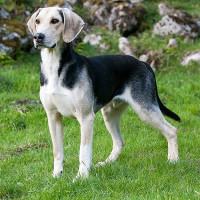
| Medium sized, distinctly rectangular, powerfully built, but should not appear heavy. Should convey the impression of endurance. |
Important proportions |
| Depth of brisket approximately half the height at withers. |
Behaviour / temperament |
| The Norwegian Hound is considered to be the hardy and robust scent hound of old times, a dog with an excellent temperament. The breed is characterized by strong nerves and by being especially sociable and trusting. They are known to have done well in hunting trials. They can thus be characterized as an excellent combination of a hunting and companion dog. Due to its good temperament and open nature, the breed is also easy to train. |
Head |
||
Cranial region |
||
Head |
Head not to be carried highly. Clean and noble with good length and parallel lines, not wedge-shaped. | |
Skull |
Slightly arched, prominent occiput. Provided the muzzle is long and well developed, a somewhat powerful skull is permissible, in males in particular, as long as the head does not lose its parallel planes. | |
Stop |
Defined, but not deep or abrupt. | |
Facial region |
||
Nose |
Black. Wide nostrils. | |
Muzzle |
Rather long than short, squarely cut. Straight and evenly broad nasal bridge. | |
Jaws and teeth |
Scissor bite. Complete dentition. | |
Cheeks |
Clean cheeks without prominent cheek bones. | |
Eyes |
Dark. Round in appearance. Rather large, but not protruding. Bright and expressive with a calm and earnest expression. Eyelids close fitting. Wall eyes are permitted in blue marbled (merle) dogs. | |
Ears |
Medium high set, rather lower than high. Smooth, moderately wide, tapering, rounded at the end. Hanging flat without folds. close to head. Long enough to extend halfway along the muzzle when pulled forward. | |
Neck |
| Fairly long, without noticeable throatiness. |
Body |
||
Topline |
Level. | |
Back |
Straight and firm. Of sufficient length to give length to rib cage. | |
Loin |
Broad and muscular, not roached. | |
Croup |
Slightly sloping, muscular, not too short. | |
Chest |
Capacious chest with well sprung ribs; the back ribs shouldbe particularly well developed, making the ribcage appear long. | |
Underline and belly |
Slightly tucked up belly. | |
Tail |
| Set on level with the topline. Thick at the root, tapering towards the end. The tail should be straight and carried in a slight upward curve, reaching down to the hock or slightly below. |
Limbs |
Forequarters |
||
Generality |
Strong, dry and sinewy forelegs. | |
Shoulders |
Muscular, long and sloping shoulder blades, lying close to the chest, closely set together at the top. Well angulated shoulder and elbow joints. | |
Upper arm |
Well angulated to shoulder. | |
Elbows |
Well angulated at joint. | |
Forearm |
Straight. | |
Pastern |
Slightly sloping. | |
Forefeet |
Arched and well-knit feet, well covered with hair between the toes. Firm pads. The feet should point straight forward. | |
Hindquarters |
||
Generality |
Well angulated. Stand parallel, not crouched nor cow-hocked. Dewclaws should be removed. | |
Upper thigh |
Broad. | |
Lower thigh |
Broad. | |
Stifle |
Well angulated. | |
Hock |
Dry and low set, broad seen from the side. | |
Hind feet |
Arched and well-knit, well covered with hair between the toes. Firm pads. The feet should point straight forward. | |
Gait and movement |
| Free movement, covering ground. Parallel from behind, not crouched nor cow-hocked. |
Coat |
||
Hair |
Straight, hard, dense and not too short. The back of the thighs and the tail may be somewhat more profusely coated, provided the coat is otherwise particularly good. | |
Colour |
Diluted black with tan-markings or blue marbled (merle) with pale tan-markings and white markings. Jet black with warm tan-markings is less desirable. 50% or more white is undesirable. White markings that reach out on the shoulders, on the underside of the belly and on legs (socks) is accepted as a correct marking. | |
Size and weight |
||
Height at withers |
Males: 50–58 cm, ideally 52–54 cm. Females: 47–54 cm, ideally 49–51 cm. | |
Faults |
| • Any departure from the foregoing points should be considered a fault and the seriousness with which the fault should be regarded should be in exact proportion to its degree and its effect upon the health and welfare of the dog and its ability to perform its traditional work. • Faults listed should be in degree of seriousness. |
General faults |
 White colour reaching the saddle on diluted black/pale tanmarked, or white spots in the merle colour. White colour reaching the saddle on diluted black/pale tanmarked, or white spots in the merle colour. |
Disqualifying faults |
| Aggressive or overly shy dogs. |
NB : |
| • Any dog clearly showing physical or behavioural abnormalities shall be disqualified. • The above mentioned faults when occurring to a highly marked degree or frequently are disqualifying. • Male animals should have two apparently normal testicles fully descended into the scrotum. • Only functionally and clinically healthy dogs, with breed typical conformation should be used for breeding. |
Bibliography |
| https://www.fci.be/ |



 English (United Kingdom)

Comments